Category Archives: Social comment

Bank of America: blatant lying about Occupy?

I had to stop by our local B of A branch today. While B of A is pretty odious, so are most of the realistic options. (It’s not about the local employees. The branch manager is a complete sweetheart and her employees reflect her influence.) Outside was a security guard, playing with his doodad phone.

This was new, so while I waited in line, and the bank employee was trying to handle some of the transactions with people in line, I asked him: why the security? His tone was sanctimonious. “It’s because of Occupy. Two of our tellers were assaulted in Texas by four of them; one woman had a broken leg. This is to assure the safety of our female tellers.” It was in that kind of tone that says ‘You cannot dispute me unless you want it to mean you favor beating up women.’ I expressed skepticism, and that if that had happened, it was probably done by provocateurs–perhaps even police infiltrators. He asserted that they were in jail. I’d never seen this guy here before at the branch, so one suspects that he was sent to ‘message’ this to clients.

This being Bank of America, I knew it was entirely credible that they would simply invent a story. When I got home, I did some research. Two tellers beaten up badly by those ultra-violent Occupy maniacs (who seem to be most famous for being roughed up, pepper-sprayed and assaulted by police, not the other way around) would seem a pretty big deal. No one thinks it’s okay to beat up on bank tellers just doing their work, or coming or going from it. I searched the google string “bank of america tellers assaulted by occupy,” no quotes, to have the greatest possible chance to learn about this breaking story.

Nothing about any such assault. I found some about bank robbers assaulting tellers, but Occupy protestors are not bank robbers. Same terms into a news aggregator; nothing. I found nothing to corroborate this story.

Unless I find something to corroborate it (and if I do, I will update this, of course), I have to assume that the employee was telling patrons a bald-faced lie. Sounds to me like a slick anti-Occupy propaganda trick, depending mainly upon people being too lazy to fact-check. In most cases, that’s probably a safe assumption. If there really was no such attack, it would say a lot about B of A’s opinion of the public. It would also say a lot about the corporate values–not that most observant people would bet heavily on those, at this stage of the game.

Editing a book on child-raising…me, of all people

My current project is to edit a book on child-raising. This is funny.

Some of you may not know this, but I’m not real good with children. I never wanted to produce any; the day my ex-fiancée told me very seriously that she was pregnant, shortly thereafter revealing that it was a joke, ha ha, something broke inside me and I never trusted her again. I have recently learned that I can enjoy being around good children for about three or four hours. I can endure them for three or four more, after which I need a couple days in a bar. If they are relatives it’s easier, but only to a point. If they are not exceptionally well-behaved, it’s excruciating. In short, perfect kids about whom I authentically care are difficult enough for me. The other billion are rather harder.

I did not ask to be this way, and it’s not something I’m glad for or proud of. It’s very inconvenient to be missing the gene that says kids are inherently cute and funny no matter whether they are attempting to start fires, defecating in their pants, doing something that they have discovered will frustrate adults, or making a crayon drawing of your pet. My life would be much easier if I liked being around them all, and I have tried to like it. It’s like trying to like a food you must force down. It is like telling yourself that discomfort is joy, edginess is relaxation, cardboard is food. I wish them great educations, lots of adventures, good friends, drug avoidance, full safety and very happy lives, with which I’m increasingly willing to intersect as they age toward maturity. If I had to work at a school, I would rather be the night janitor than a teacher. Night janitors perform a key job to help education happen, and by then the kids would be gone, rather than in my classroom torturing me, knowing that I couldn’t actually discipline them and they could get away with making my job hell. People know when they hit a vulnerable spot, and kids learn it early, long before most of them learn that gratuitous cruelty is not a character strength.

When my wife wants to mess with me, she talks about starting a daycare in our house. She thinks it’s funny. Yuk yuk, what a card. Everyone slap your knees.

As for me, I think it’s pretty funny that I am now editing a book on parenting.

The authors made a good choice in the sense that I’m completely unequipped to debate their parenting concepts. Life has taught me that ‘bad mommy’ is this enormous bugaboo for mothers. They’ll come to blows with the one who even implies Bad Mommy. They’ll yowl that they are Good Mommies, even if their junior Satans are out-of-control unbearable (not just to me, but to normal people). They’ll follow obsessive, fearful childcare regimes in order to avoid even a hint of Bad Mommy. Not that they don’t also do much out of pure maternal love, of course; surely so. I’m not saying that Bad Mommy drives all their decisions. I am saying that in many cases, I smell fear as an additional motivator.

Bad Mommy is even a pack behavior. I used to write for a product review site called Epinions. At Epinions, there was a clique I called the Mommy Platoon. The Mommy Platoon could give you 1000 words on a diaper pail without giggling. Sippy cups were serious business. They kept offsite message boards dedicated to gang-rating reviews they deemed to take parenting insufficiently seriously. They said appalling things to people in comments. Singly, they were cravens, but with the company of a cult of mutual reassurance, they found a form of gangster courage. One of their most devastating bullying weapons was Bad Mommy, used without remorse to bring other women to tears, simply for seeing parenting differently. A number of us, with goodwill and empathy, wrote reviews that made light of parenting and its issues and products, honestly hoping to bring the readership (including the Mommy Platoon) a few good laughs. Laugh about parenting? That was as popular with the Mommy Platoon as bomb jokes are with airport security. I think a majority of the mothers at the site despised the Mommy Platoon.  In the end, a key factor driving many of us away from Epinions was this Mommy Platoon, which evidently never learned the lesson mentioned above about gratuitous cruelty. One lesson I took away from that experience was just how dramatically Bad Mommy will influence a mother’s actions and outlook. I feel for them. I’d hate to have that hanging over me.

Bad Mommy is probably a positive thing in at least one sense. Motherhood is exhausting and endless, and it doesn’t have very many breaks. Perhaps when parenting needs doing in spite of how she feels, at times, Bad Mommy is the lash that drives her onward to do what is needed in spite of her being her own person with her own pains, emotions, desires, and so on. I’m glad I don’t know for sure. I wouldn’t want her job. I could in no way do it, and I marvel that she can.

So I’m editing a parenting book. Here’s the thing: my complete ignorance of the subject is an asset to the authors. I can play my position, which is to fix anything that is flawed about the way they have presented their ideas (as opposed to the ideas themselves). Their parenting advice sounds pretty smart to me, and I think it’ll be a great book; my job is to do my all to help that be so. They must find it a blessed relief that I have zero temptation to debate parenting with them, in much the same way as I have zero temptation to debate Sanskrit translation with lifelong Sanskrit scholars or fly-fishing techniques with a lifelong fisherman. They tell me their previous editor (who sounds very Mommy Platoon to me) fired them and said she would pray for them. I’m impressed that this did not dissuade them. When they sent me the sample chapter to see how I’d handle it, they deliberately picked the most controversial one, just to see how I’d react. When I learned that they had done this, they impressed me more.

I like the project. The authors have a very good sense of humor. I can’t imagine them in the Epinions Mommy Platoon. Along the way, I’ll teach them some stuff. You can divide aspiring writers into two categories: those who want to improve, and those who want to be Frosted Flakes with the reader/reviewer/editor as Tony the Tiger. These ladies are serious about it, which means they have a very real chance to get somewhere with the written word.

Here’s to all moms. They have a hard job.

The Pac-12 Networks, a.k.a. the Not-works

In July 2011, with many college sports programs playing musical conferences and engaging in games of chicken with each other, the recently expanded Pacific-12 Conference (UW, WSU, the Zeroes, OSU, Utah, Colorado, Cal-Berkeley, Stepford, ASU, UA, USC and UCLA) announced plans for a TV network like what the Big 10 (which has more than ten schools) has deployed. Great, we said, we want to see more football and have our conference doing what big-time conferences do. Revenue sharing would help the smaller market schools, etc., etc. Let’s see the show!

The assumption, which we could not know was flawed, was that we would be able to see the show. In the words of the immortal, unbearable Lee Corso:  “Not so fast, my friend.”

Fourteen months later, the 2012 college football season kicks off. The Pac-12 has failed to reach agreement with just about everyone, which is a pretty good sign the conference got very greedy. A number of games are televised on the Pac-12 Not-works, but very few people can watch them on TV. A few clever souls find other ways, naturally, but only the hardest core of fans would do that. Those who do, find out that the Pac-12 Not-works have sold zero advertising, so the not-work fills the space with commercials for itself. Yes. I must have seen the Stanford swimmer’s segment a dozen times. Every few minutes, its ten viewers are treated to advertising telling us how fantastic the not-work is.

That isn’t marketing. It’s masturbation, and comical masturbation at that. Seriously: while having failed in your most basic mission, which is to get on TV so you can sell advertising, rather than spare me a bunch of commercial breaks, you are going to go on and on about your virtues? Do you not understand that when the only advertising content you have to offer is to rhapsodize yourself, you have failed? You are a conference comprised of twelve research universities, all with educational claims to fame and pride, which attract some of the best and brightest people in the world, and you leave the house without your pants? Mr. Larry Scott, you are a Harvard graduate. For the gods’ sake, put some trousers on. No one needs to see you this way.

Not that the satellite and cable providers are any prizes in the area of doing what’s best for viewers. DefectiveTV, which is what I have, engages in a ‘playground recess hair-pulling skirmish of the month’ with some content provider just about every month, taking its message to the blacked-out channels to explain how those nasty stupids at (insert network name) have been unreasonable, pulled their content, and tried to force us all to pay through the nose, but only DefectiveTV stands Promethean in defense of our fair prices and sweet reason. Yeah. When every recess, the same kid is always in a fight with someone, always comes whining, and never takes any responsibility for even being half the problem, guess what. It’s obvious where most of the problem lies.

The much-vaunted Pac-12 Networks are Not-works. They are a failure. At this point, we would be better off without them, since the games they show would otherwise be picked up on other channels, all of which seem not to consider themselves too ultra-special to get a deal worked out and be on the air.

Every year, it is a little more about pure greed and big money, and a little less about athletics and education. I will always wish UW well, but I can see a day where, if this trend continues, I simply won’t care about watching the sport. At which time I will cease to be an advertising consumer, be it for idiotic pickup truck commercials appealing to my machismo, idiotic insurance commercials appealing to my gullibility, or idiotic beer commercials appealing to my pedestrian tastes.

Mr. Scott, you and your networks are a failure.

The best ass-covering you could come up with was to blame it all on the other side, and sick your athletic directors on the public, encouraging them to switch providers. (For some of us, with no provider in our areas that carries the Not-works, a non-starter.) “Waaaaaaah! They started it! Waaaah! Punish them!

It’s looking positively Congressional.

Just another area of America in which the stupidity of the public is taken on faith by the wealthy and powerful, and where, if said public notices something wrong and complains that ‘this is bullshit,’ the public is fed a line of crap and told to stop being difficult.

I’ll give you difficult. Mr. Scott, so far you have boloed this exercise. You are a no go at this station. You snubbed BYU/Utah, the perfect regional, rivalry and research fit for the conference, simply because a Mormon school icks out Left Coast schools, with all that honor code and right-wing political stuff–as if that were relevant at all to research or athleticism. Instead, you brought in Colorado, which is about as Pacific as Wyoming and has a minimal existing rivalry relationship with Utah. Mr. Scott, if this is how you roll, I wouldn’t hire you to manage a Division 5 conference, much less a I-A BCS conference. You have failed. The results speak for themselves. You are the John Boehner and Nancy Pelosi of collegiate athletics. Enjoy that prestigious distinction.

In the meantime, Commissioner Scott, go to hell.

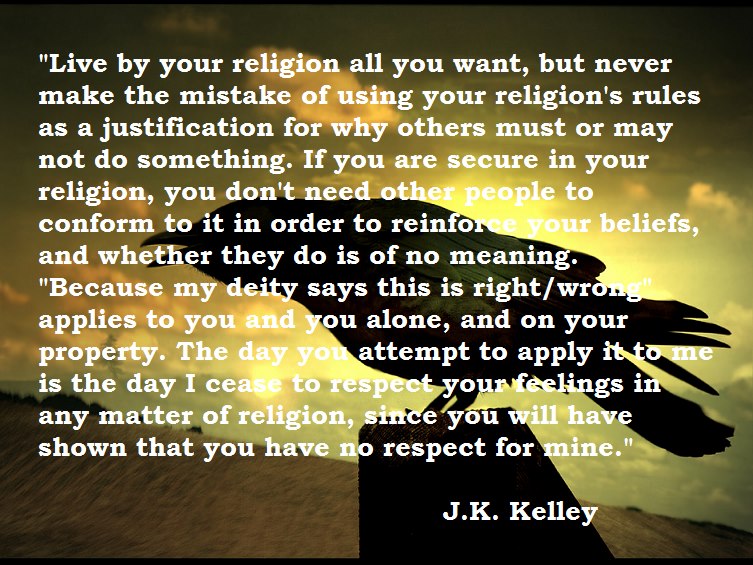
On religion and society

My comments on religion
Something I just blurted on Facepalm, made into a graphic by Magdalena Åkesson.

I didn’t make this graphic. My friend Mags Åkesson took a post I wrote on Facebook and assembled it.

The reaction caught me off guard, and in a positive way. I had anticipated some contention. Instead it has that vague feeling of something that’s about to get away from one, be associated with one.

Good. I don’t want control. If it resonated, then I am glad. I fling it joyfully onto the winds.

People who seek to control you, well, that’s the bad guys and gals.

The ‘Water Follies’

This weekend is what we in Kennewick call ‘Boat Race Weekend.’  It’s official name is ‘Water Follies.’  What it is, okay, is an air show and hydroplane races on the Columbia.  It’s the big annual event here, and happens in Columbia Park, which is one of the few things that was done right from the city’s earliest development. Our entire river shore, all 5-6 miles of it, is a park.  Some is nearly undeveloped, despite the best efforts of corporations to turn it into a profit center, and the best efforts of certain Distinguished Statespersons to permit this.  However, Boat Races isn’t really much happening anywhere else in the Tri-Cities, except on the opposite (Pasco) river shore. It’s fairly easy for most of us to avoid, long as we don’t have to go over the blue bridge at the wrong time.

“So what, J.K.? In what universe do we care?”

Credit to thefreedictionary.com:

fol·ly  (fl)

n. pl. fol·lies

1. A lack of good sense, understanding, or foresight.

2.

a. An act or instance of foolishness: regretted the follies of his youth.
b. A costly undertaking having an absurd or ruinous outcome.
3. follies (used with a sing. or pl. verb) An elaborate theatrical revue consisting of music, dance, and skits.

4. Obsolete

a. Perilously or criminally foolish action.
b. Evil; wickedness.
c. Lewdness; lasciviousness.

Well, we may certainly assume there will be a lack of good sense exercised. Why this should be a civic virtue eludes me. Then I look at the way the city runs, and maybe it’s just a frank moment of civic intellectual honesty. All right, but why celebrate foolishness? Why call these ‘follies?’ Aren’t we supposed to put our foolishness in the closet with Uncle Fred, not out on the lawn with the Travelocity gnomes for all creatures great and small to see?

I suppose it is a very costly undertaking, and does have ruinous outcomes. It somewhat ruins my weekend, for example, if I had hopes of going to the park.  Boats blow over, people get drunk and sunburned, and all this for the sake of a sport that has to rig itself; that sounds ruinous. As I understand it, if you win too often, the sport’s organizers nerf your boat so it doesn’t get boring. (Even though this is limiting, it’s technically called ‘unlimited’ hydroplane racing. Oh, okay.) Imagine requiring Michael Phelps to swim with ankle weights on. Essentially, though, hydro racing is Nascar on the water, in nearly every sense but the duration of action. Nascar takes a lot longer.

Okay, very well, there’s another meaning: a vaudeville show or its modern incarnation. Saturday Night Live is mostly ‘follies.’ Tony Orlando and Dawn also was. (And you had blocked them from your memory until this moment, hadn’t you?) That one doesn’t apply at all.

There will be perilous and criminally foolish action, such as young people drinking too much, and boats blowing over. Someone could break his neck, drown, etc. Evil and wickedness? Seems pushing it to me. There’ll be a few boat race pregnancies, and probably someone will end up in the ER for being drunk, but neither of those are evil or wicked, just folly. Lewdness and lascivious used to be the order of the day, where (I am told) “What happened at Boat Races, stayed at Boat Races.” Yeah.  This from most of the same people who call east Kennewick and east Pasco ‘bad areas.’ I do not really believe them. I think they remember it through a lens that imagines the event more bacchanalian than it really was. Populations are very capable of a collective dementia in which they distort the past perception.

In the end, though, the title ‘Follies’ is unintentionally candid. A bunch of people will get together and some of them will show great folly. They will watch a sport that meets a couple definitions of folly, though not the ones the event planners intended. About the only thing not a folly is the air show, which is cool.

Best of all, I can watch that from my deck, go nowhere near Columbia Park, and stay out of the way of folly. But if you like that stuff, hey, party on.

Why learning to drive stick still has value

This is simple.  The obvious reason is that you might need to drive a vehicle someday that has manual transmission.  If you cannot, you will be helpless when that day comes.

The less obvious reason is that it teaches you how the car works.  If you have never driven stick, you really have no idea what’s happening in your trannie. Why does your car go in and out of gear on hills? When are you close to lagging in gear, and when are you revving your RPMs? If you can drive stick, you understand the sounds you’re hearing.  You can drive with greater fuel efficiency, and make the vehicle last longer.

The least obvious reason is very subtle, but pervasive.  Our society lurches, increasingly, toward not knowing how to do things, letting things be done for us.  The complexity of things we use makes it so.  No, that cannot be stopped, but that does not mean we should yield tamely to it.  There is value in knowing how to do it yourself. The more you cannot do for yourself, the more you must depend upon others’ goodwill, honesty and efficiency. The more you can do for yourself, the freer you are.  No, you cannot learn to speak every language while learning to repair every vehicle, grow every crop, diagnose your own computer problems and re-plumb your own house.  It’s too much.  I get it.

That does not mean you should put up your hands and go calmly into dependency.  The sensible way to battle this is to do for yourself, at the very least, that which you can. That which you cannot, you cannot. Everyone sucks at something. We have to accept that, too. It does mean that learning to drive stick has value, because it makes a statement of refusal to ‘just let the machine do it for you.’ The machine may not always work, overall. Your cell phone doesn’t work everywhere.  Your Internet doesn’t work all the time.

When a crisis hits a city hard enough to trash its transportation infrastructure, starvation will begin in about 48 hours. At those times, the people who truly believe that food comes from grocery stores are in worse shape. They live in dependency, choosing to imagine that a grocery store is a farm, ranch and factory all in one. Sometimes, that which you depend upon fails you. Ask the people of New Orleans whether or not this is bullshit.

The mentality that insists on knowing how to drive stick is the freer mentality. That which yields tamely to the machine is the less free, the more dependent. It’s not so much about the off chance you might need to drive a vehicle.  It’s about your outlook on life, emblemized by the ways you can manipulate the gears of a vehicle.

What’ll it be…dependency or liberty?

What was it like growing up in the 1970s?

(This was originally a message board post people seemed to really enjoy, so I felt free to republish it here.)

When the 1970s began, Vietnam was still going on but the hippies were starting to thin out. It took pot a few years to grow mainstream (by my early high school years late in the decade it seemed like I was the only one not smoking it). Then Nixon got in trouble and resigned. I got a pretty good laugh over his later rehabilitation, given how deeply and nationally he was excoriated. In a sense, he was the initiator of the modern political climate, where the good of the nation has ceased to factor and the only thing that matters is beating the other guy. This was confirmed when Ford promptly turned around and pardoned him.

The energy crisis was just unreal. What most people do not realize today is that, in terms of relative purchasing power, the $4/gal spikes a couple years ago were probably less dramatic than what we saw in the early 70s, with gas lines around the block and rationing in place. Just as when gas was hovering around $0.80 in the late 1990s, it was actually a lot cheaper than the $0.25/gal I remember as the lowest price in my lifetime’s awareness (late 60s). As ever, most people simply have no idea how to compare costs and values from one era to the next.

One big kerfluffle was the gas pumps. They were not digital–the numbers rolled on a spindle inside–nor were they equipped to show prices over $0.99.9. When gas cleared a buck a gallon, just about every gas pump in the country required a retrofit. What a goat rodeo.

A lot of new stuff came along: the desktop digital calculator (we were awed), video games (wanting an Atari in the mid-70s was like wanting a PS3 a couple of years back, only more so because there was nothing before it), and the fadeout of party lines. (Yes, they were a prime tool for snooping on your neighbors’ conversations, and yes, that did occur. It was a punishable offense to fail to yield a party line if someone declared an emergency.)

Carter got elected just as the post-Vietnam national malaise was settling in. It lasted into the early 1980s. Might have been the worst president ever for the time in which we got him. Inflation up to double digits. Interest rates for borrowing up in the same neck of the woods. People with decent credit and income who do not buy houses now, at today’s depressed mortgage rates and prices, simply have no idea of the historic buying opportunity before them, perhaps because it was before they were born. Carter’s focus was to rag on the rest of the world to have better human rights. (Everyone ignored him.) That didn’t do jack for our flopping national morale. The modern deification of the troops? Unthinkable. Did not exist. The military was outdated, had too many druggies, and the junior officer corps in particular was shaky. Good thing the Soviets didn’t invade West Germany in 1976–they probably would have won. Happy Bicentennial.

Then comes the second defining event of the era after the energy crisis, the Iran hostage crisis. On top of that, we couldn’t even make a rescue attempt without a desert disaster. In 1979, “person who burns flags” became synonymous in many minds with “Iranian” in many minds, and the term “Iran” acquired a lasting toxicity akin to that which “Jane Fonda” has with Vietnam vets. Every night on the national news, Walter Cronkite: “And that’s the way it is, this 300th (or whatever) day of captivity for the American hostages in Iran.” When I see Iran talking about getting nuclear weapons, it proves to me that they understand us as poorly as we understand them. They truly believe that we think like them–like pragmatic Near Easterners interested in bargaining, who understand the game. They have no idea. A lot of us in those days felt so infuriated that we would have welcomed and endorsed an air attack on Iran’s population centers with weapons of mass destruction (not a chance under Carter), and some of us (emotionally, if not practically–and not everyone looks at such matters with a practical side) think it’s long overdue. That generation–mine–is now starting to run the country. If Iran had any idea of how much lasting loathing it created by taking and keeping the hostages, and how gladly some people would open up on them even thirty years later, they would turn pale. They would immediately shut down anything and everything nuclear. They would not do the least thing to give an excuse to people who, at least on an emotional level, would love a pretext to even that score with modern weapons. I’m not saying this is the right idea for us as a nation today (at least not with my rational side…), just pointing out what kind of fire they are playing with. If they knew, and they are sane (and I think they are, at least when it comes to their own survival), they would throw a bucket of water on that fire and never light it again.

That’s part of the reason the 1980 Olympic ice hockey victory meant so much, why everyone can remember where he or she was when we beat the USSR (probably glued to the TV; it should not be forgotten that we still had to beat a tough Finnish team to win the gold). We felt like a country that couldn’t do anything right, couldn’t even stop a bunch of radicals from invading our embassy and humiliating our people, couldn’t rescue them without screwing up, completely demoralized. Then came the Olympics and something finally went right. I would describe the 1970s as a time of national pessimism, a sense that we had already lost the Cold War and were just waiting to be the last non-socialist country in the world, a time of things going wrong and government unable or unwilling to do a thing to fix them. We know now, of course, that it didn’t all work out that way. But that’s how it felt at the time.

I disliked the 1970s deeply. I remember them as a nearly unbroken string of bad news, failed leadership, and general impotence. I’d never want them back again. While we had a lot more freedom as kids–we were essentially still as free-range as kids of earlier decades–I for one had the sense that my parents’ generation had completely boned the pooch and was going to leave it up to mine to clean up. And looking around at the people in my school, it seemed pretty obvious we would be too drunk, stoned and lazy to do that. (What I did not foresee was just how much worse they would screw it up; how, presented with golden opportunities, first the Boomers and then their successors would botch them.)

I graduated from high school in 1981 with a general sense of worse things to come, a very dystopian view of my country and even humanity. When the Berlin Wall fell, this dystopian view shook quite a bit–maybe I’d been wrong. Subsequent events proved that it had just been a temporary hiccup. I soon realized that our national psyche had to have its Emanuel Goldstein, a focus for regular sessions of the Two Minutes hate, and if the Soviet one were gone, we’d need a new one and we’d create it as necessary. Without an external enemy to direct the angst toward, it would find its direction inward, and a lot of people had a lot invested in that not happening.

Tom Sawyer

I just finished re-reading this eternal classic, and I hope some of you will do the same.  As a child, I had no idea of Clemens’ social commentary, which I can now appreciate a little more.

Then again, as a child of five, living in Kansas, I read it and immediately began to talk like a Missouri 1840s hillbilly kid.  What you may not know about Kansas is that while there is definitely a fair bit of Cletusism in the state, the population is rather divided about it.  As in:  there is one segment that embraces country everything, speaks with a rural drawl and makes no apologies for it.  My father comes from that stock, but more or less abandoned it to get an engineering degree.  My mother doesn’t, despite her ranching upbringing, and always wanted not to be identified with backwoods habits.  Not one bit.

Back home, this is somewhat accentuated by stereotypes and prejudices specific to Kansas and our Missourian neighbors, in which the perception is that Missouri has only one tooth and shares it out without even washing it.  Of course, it’s not true; it’s mostly good-natured joshing but underneath it lie some authentic prejudices with deep roots more terrible than the rest of the nation understands.  One of these days I’ll write about it.  Suffice it to say that the folk memory runs deep on both sides, and neither side was a wagonload of saints.  It’s a miracle we get along as well as we do now, probably because most sensible people realize the two states are not as different as the more prejudiced citizens of either would like to imagine.

So, along comes their son, a fairly precious little fellow whose idea of fun is to read through the whole encyclopedia, and he begins to talk like Tom Sawyer.  As you may know, erudition ain’t a feature of Tom’s character.

It did not go over well at all.  “But we wanted him to have access to great reading!”  Oops.

Fortunately, I got over it.  I still say ‘ain’t’ sometimes just to annoy her, or in cercles litteraires.  I’m at ease with both.  I like the down-to-earth rural life and basic practical wisdom of it all, and I like Brie.  Zero reason one can’t have both, as I see it.  If that doesn’t fit someone’s mailbox, they can refuse delivery and send it back.

This is the part where it’s about time to explain to why Tom Sawyer would be a good re-read.  Where Clemens shines for me is in his cynicism about mob mentality, stuffiness, pretense and the fickle nature of mass opinion.  The reader cannot miss it.  Clemens is laughing at his characters, which seems to be his literary wheelhouse.  In a lesser author, his laughter would come off mean-spirited and snooty; that’s probably how I’d ring if I set myself to the same storytelling task, which is why I don’t.  Clemens laughs at people without malice, and has you laughing at them too.  He ranks among our great.

Definitely a happy reunion.

How to do a labor protest wrong

Today I’m driving through one of our town’s major intersections, and out in front of Gold’s Gym I see three people holding up a large banner about a labor dispute with Gold’s.  Hmmm.  Okay, well, in general I tend to be friendly to labor in labor disputes, so I loop around and park nearby.  I wander over to find out what it’s about, radiating a friendly aspect.

The picket captain in her orange vest comes over, and it goes something like this:

“Hi, what’s the dispute about?”

“Well, we’re protesting blah blah blah which I can’t talk about for obvious legal reasons, blah blah, but here is a sheet about what the protest is about and it’ll tell you all right there.”  She clearly wanted me gone, mystifying to me, as it doesn’t take three people to hold up that sign.

“You can’t tell me about the dispute?”

“No.  Are in a union, or close to someone who is?”

A little smile.  “You might say that.”  And I’m thinking, Lady, I’m married to one of the most dynamic labor leaders in the whole state of Washington.  If you refuse to even have a conversation with me, your cause is doomed because you are too dumb.  You didn’t even probe that statement.  You should have.  My wife would have been interested.

“Well, everything is in the flyer, so hope you enjoy reading it, and have a nice day.”  She walks off on me.  I’ve barely said a word.  No discussion occurred, no accepting the opportunity to enlist support, not even from someone who walked up and showed interest.  There I am, standing on the grass alone, holding a piece of green paper.  Dismissed.

Bewildered, I walk away reading the flyer with the headline:  SHAME ON GOLD’S GYM For Desecration of the American Way of Life.  Underneath it, it has a rat eating the US flag.  Well, that’s about my personal opinion of both our major parties and their governing abilities, so if they are trying to shock me, that’s not very effective.  I get to reading it, and essentially Gold’s hired a contractor who hired a subcontractor that doesn’t pay the carpenters standard union wages and benefits.  How this is an issue she cannot discuss for ‘obvious legal reasons’ is beyond me.  Why she brushes off a gold-plated chance to make her union’s case to me is even farther beyond me.  It’s an area with very little foot traffic.

For the record, the flyer is authored by the Pacific Northwest Regional Council of Carpenters.  It urges me to call some guy and urge him to change the situation.  Yeah, I’m really sure he’s still taking calls today.

On second thought, at the rate these people are going, maybe he doesn’t even realize there’s a picket.

When I get home, I decide to call the information number to let them know what kind of shape their picket is in.  A recording: please leave your name and number and we’ll have someone call you.

You know what? Nah, I think not. Figure it out yourself.  No wonder organized labor can’t counter the negative propaganda about itself–when given the opportunity and a receptive audience, it won’t talk to it.  It hands it a piece of paper and walks off.

PS:  A friend of mine from Sweden, Mattias, has suggested that they may actually have been rental protesters.  I guess there are companies out there who can be hired to protest, and their own contracts forbid them to talk about the actual issues for legal reasons.  That would fill in a gap of understanding, although she was still an idiot, as the “obvious legal reasons” were hardly obvious to me.  Next time I’ll have a bolt in the quiver:

“So, are you rented protesters or are you actually union members and sympathizers?”

“We can’t talk about that for legal reasons.”

“Heh, thanks.  I have my answer.”

Why do sportswriters give free pimpage to bowl sponsors?

I don’t see how ESPN gets paid for doing this, but they do it.  Right here, we have Ted Miller calling every bowl game by its full sponsor name.  Miller is in general a very capable reporter, and I’m a regular reader, but this baffles me.

Some would say that the game should be called by its full name (whatever it is this year) on principle.  Why is that a principle? If you are going to watch the Rose Bowl (which is not being played properly this year, very sadly), you presumably do not care whether it’s sponsored by Coors, Berkshire Hathaway or Joe’s Quikki-Mart.  You care who wins, or if it’s an entertaining game.  Surely ESPN is not getting money to make its writers do it, which would mean that the worst that could happen would be that Rotten.com (or whoever is the sponsor) writes them a nastygram, and ESPN answers, “Pay up if you want advertising.  You bought the bowl, not the media reporting.”  Instead, Miller continues to do this, as he has done in years past.

I do not get it. Unless it’s a friend, or they pay me, I don’t advertise for anyone if I can help it.  Buying a new car? Won’t drive it off the lot with the dealer’s license plate frame in place.  Wear an Old Navy shirt? You’re kidding, I hope.  Old Navy should pay me to wear their shirts, not charge me for advertising.

Maybe Miller is ordered by the brass to do this.  Maybe he just adores our precious major corporations.  Either way, to me, it detracts from his journalism.  Because as far as I’m concerned, UW is playing Baylor in the Alamo Bowl.  I don’t even want to know who sponsors it.  I don’t care.