Category Archives: Adventures

Crápo Appliance

Back when I lived in Seattle, I hung out with a tinkery, Gyro Gearloose guy named Aaron. We had some common interests, including paganism and gaming. He had a strong creative streak and breath that had been known to slay raccoons at thirty paces. One has to take the rough with the smooth, as we say back home.

Alert: this story has me being astonishingly juvenile.

Sometimes Aaron’s tinkering didn’t go too well. His girlfriend lived up in Lynnwood, not far north of me in Shoreline. One day he phoned me to let me know that his efforts to accelerate the defrosting of his lady’s freezer had led to a malfunction. His notion to employ a flathead screwdriver seemed to have been the cause. He now needed to purchase her a new refrigerator, as she was rather a testy type. Budgetary concerns dictated that he select a used appliance, and getting to the heart of the matter, I owned a truck. (This was in about 1995. The truck, drolly nicknamed ‘the White Lightning,’ was five years old. I’m still driving it.)

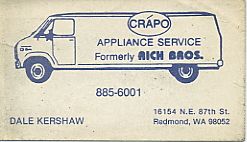
Sure, Aaron, I’ll go help you haul your used refrigerator. I drove up and picked him up in the Lightning. There was a place in Bellevue, somewhere out toward Redmond, that he felt would have what he needed. Off we headed, his directions mostly effective, and we pulled up at a little strip mall outside a business whose sign proclaimed it: CRAPO APPLIANCE SERVICE.

It did not occur to me at the time that this might be someone’s real name. I honestly thought that this was a shining episode of truth in advertising, like Rent-A-Dent. “You want a crappy appliance? We’ve got lots of truly crappo stuff! Best prices in town!” I wondered why I had not seen commercials for this place, with loud guys boasting that they’d beat anyone’s price.

I also fell apart laughing. Came completely unglued. Embarrassed hell out of Aaron, who was there to pick out a used refrigerator. I couldn’t stop. Tears flowed. I followed him around, doubled over and gasping for breath. I was still a hot mess as I helped him wrangle the device into my pickup, a miracle that I didn’t just drop my side and fall to the ground laughing. I was a complete spectacle. I complimented the store clerk (and possibly owner) on the forthright honesty of the name, at least in between gales of laughter. Thinking that no one would ever believe this without proof, I snagged a business card, which I carried in my wallet for years and still possess. On the card, there was an accent aigu (á) over the A in CRAPO (which is not the correct phonetic mark, by the way…it should be a horizontal line, like an en dash). The clerk grumbled at me, “It’s CRAY-po.” I must not have been the first sight of this kind that he’d seen, though I might have been the most shameless.

crapo

I didn’t find it easy to drive the truck back to Lynnwood, because I kept having giggle fits, guffaw seizures and high-pitched cackling events. I suppose Aaron was somewhat amused by how this struck me. In any case, since it was my truck, he didn’t ask me to shut up. It wouldn’t have worked anyway.

If karma exists, it may have caught up with me. Evidently ‘Crapo’ is a common and prominent LDS family name here in Idaho, like ‘Allred.’ In fact, one our distinguished solons by that name recently made the news. For getting a DWI at Christmas in D.C. Yeah. Sen. Mike Crapo (R-ID), stay classy and true to your beliefs. Keep telling us all how to live.

It’s a good thing that all happened before Youtube, or someone might have memorialized my transformation into a werehyena, and they could probably make trouble for me out here.

Oh, well.

D&J’s excellent adventures: Idaho State Capitol

I have never before lived in a state’s capital city. For me, it has never been a casual errand to visit a capitol. Now it is–and it’s more casual than I imagined it could be.

In Boise, the Capitol is laid out at the end of a very long, straight arterial that crosses the Boise River. Unshockingly, it is called Capitol Boulevard. Few capitols are easy to miss (Colorado’s gold-leaf dome is more like impossible to miss), but Idaho’s takes the visibility cake.

It also eats your accessibility cake, at least in terms of parking. We parked at a meter one block away. From the outside, it looks like an unremarkable American capitol with the traditional central dome. Given Idaho’s mining history, I’m surprised they didn’t gold-leaf this one. Maybe they thought it was too flashy. We climbed the high stairs. The only evidence of exterior security was an Idaho State Police cruiser pulled up outside, far enough away that I couldn’t see if it was occupied. If it was, its occupant showed no interest in us. I prepared for the metal detectors, interrogation, grim-looking State Police officers demanding ID, asking our business and making sure we went nowhere unescorted by an armed peace officer.

Nothing. No one. Silence.

Not just no police; no hired security. No one. We could have stripped to the skin and reclothed ourselves at some leisure without being interrupted (although I’ll bet there’s a security cam that would have thwarted that). Just a sign letting you know that this was the Idaho State Capitol, for those incapable of figuring that out on their own, and ‘please be respectful.’ (At least they did address the issue of nudity, however obliquely.) A map placard showed you how to find whichever office you sought: Attorney General, Lieutenant Governor, Governor, House Chamber, etc.

“So we can just wander around?” asked Deb.

“Yeah, evidently no one cares, but obviously we can’t go in any offices.”

“Screw that. I want to see ’em.”

“Not this again.” Deb is unshy and unprone to embarrassment. I am shy and very easily embarrassed in some ways, especially by excessive forwardness. I was in no way dressed to walk into any official office. Deb simply does not care.

A person or two happened by as we ogled the striated scagliola (a form of synthetic marble) Corinthian columns supporting the dome, the interior top of which we could see. Something up in the top looked like R2-D2, and I said so. She didn’t even call me a ‘nutburger.’ There was a lot of natural marble as well: some greyish with charcoal veining, some crimson with cream veins (Oklahoma fans might say that’s the only thing would like to remember about Boise, heh).  Credit to the designers, builders and recent remodelers: it was majestic, exquisite without being gaudy. They let the marble speak for itself.

We wandered down the east wing, then the west, where the door to the Governor’s office reception was open. No one attempted to prevent our entrance. A fiftyish bleach-blonde receptionist smiled at us while on a phone call. Immediately to our left was the Governor’s office, no one present. Farther away and to the right was a desk with a State Police officer doing something on a computer. Minesweeper, perhaps, maybe Candy Crush. Deb wandered back to his doorway and pointed to a shadow box full of bullets (not rounds) on the wall behind him. “Are those bullets that were used in action?” she asked as I winced. He said it was just a display of various calibers.

Now the receptionist was off the phone. “So is the Governor a Republican?” asked my bride. Oh, good lord. I shrank away and took intense interest in a map of Idaho by counties, made of various forms of polished stone.

It was like Deb had asked ‘Did Jesus really exist?’ The receptionist looked aghast at the question, almost drew herself up a bit. “Yes, definitely.” The Capitol needs a trap door exit capable of rescuing up hefty, bearded visiting husbands at times like this.

“You’re in Idaho now,” added a suited baldhead awaiting some form of audience, opening stigmata on the hands of Captain Obvious.

These days, you can’t get elected janitor in most of Idaho without the letter ‘R’ after your name. A dead Republican would beat a live anything else; even a Republican dog (live or dead) would beat a human from another party. If he ran as a Republican in Idaho, Charles Manson would beat Mother Teresa (unless the latter were also a Republican, or unless Charlie came out on a platform of forcible gun confiscation and raising the minimum wage). Nothing factors but the party, and the only valid platform question is the candidate’s degree of passionate gun love. The challenger who boasts about having actual sex with his or her forty-five firearms has a big advantage over the incumbent who owns and adores a mere forty boomsticks, and only uses them for boring, lukewarm, lefty stuff like hunting, fishing, biking, militiaing, self-defense and making donuts.

“Is that his office?” Deb asked, pointing. Somewhere, Captain Obvious wept.

“Yes, he’s not in right now.” So one could determine by the lack of a vaguely georgewbushian presence named ‘Butch’ behind the desk.

“What part of the state is he from?” I asked.

“Right here. Caldwell, actually,” answered the receptionist. (Only later did I read that, when popped for DWI, his earlier varioush excshuses to the nyshe offisher included a claim that he had soaked his chew with Jack Daniels. Evidently time heals these sorts of political wounds in Idaho.)

Deb’s curiosity satisfied, we wandered back down to the east wing. The Lieutenant Governor’s office had a keycard entry, making it evident that one had to have a reason for entry beyond simple sightseeing. Considering how little most lieutenant governors actually do, that seems pretentious. In Washington, we had a former Husky football coach as Lieutenant Governor for so many years that he was not so much an official, but a habit. One year, the Libertarian candidate’s platform was that if elected Lieutenant Governor, she would immediately move to abolish the office and save the state several hundreds of thousands of dollars per year. Delighted, I voted for her.

On our way back around the rotunda, a police officer stepped out of an elevator. “I wonder why they don’t have any security,” said Deb. “Maybe I can ask that guy.”

Oh, good lord. I whispered, “Deb, that’s not a ‘that guy.’ That’s an Idaho State Police officer.”

“I don’t care.” She means that. Over she went. “Excuse me. How come there isn’t any security at the entrance?”

The officer, a tall, close-cropped young blond, replied without missing a beat. “Because the Governor believes that this is the people’s house.” We thanked him and left. Far out in front of the building is a statue of Lincoln containing the Gettysburg Address. Abraham Lincoln is important to Idahoans. In 1863, he signed the act proclaiming Idaho a Territory. The day he was assassinated, he had considered issues related to Idaho. There’s also a statue of someone I’d never heard of, cited for ‘reimposing the rule of law.’ I’ll bet that if I looked it up, that was code for ‘busted unions by force.’ Some things don’t much change, some places. Trying to start a union in Idaho is like trying to start a gun show in England, or a pork barbecue place in Saudi Arabia.

And that was our trip to the Idaho State Capitol.

I wonder, in how many states, one can do just as we did without anyone even seeming to consider it odd.

===

I’m including a bonus section here. I rarely talk about the spam I get, because WP catches most of it. I just have to push the flush handle once a day or so. The need to approve the first post from a new commenter eliminates nearly all spam. The typical spam is either a page of Chinese characters, or a short note in bizarre English that says something like ‘I very much to appreciate your web page which is the helpfulmost and fastest of its type.’ Some are borderline gibberish. If a character gets left out, or something else screws up, one gets an illustrative view. Here’s one such that I saved:

{I have|I’ve} been {surfing|browsing} online more than {three|3|2|4}
hours today, yet I never found any interesting article like yours.
{It’s|It is} pretty worth enough ffor me. {In my opinion|Personally|In myy view}, if all {webmasters|site owners|website owners|web
owners} and bloggers made good content as yyou did, the {internet|net|web} will bbe {much
more|a loot more} useful thazn ever before.|
I {couldn’t|could not} {resist|refrain from} commenting.
{Very well|Perfectly|Well|Exceptionally well} written!|
{I will|I’ll} {right away|immediately} {take hold of|grab|clutch|grasp|seize|snatch} your {rss|rss feed} as I {can not|can’t} {in finding|find|to find} your {email|e-mail} subscription {link|hyperlink} or
{newsletter|e-newsletter} service. Do {you have|you’ve} any?
{Please|Kindly} {allow|permit|let} me {realize|recognize|understand|recognise|know} {so that|in order that} I{may just|may|could} subscribe.

Thanks.|

You probably drew the same conclusion I did: someone’s got a spam generator, and it’s set up to vary the text just enough to elude some Googling. Somehow, the sender left off a character and it sent the template rather than the letter the template was meant to generate. The English will seem almost right, but not quite be. And now you can see how it ends up that way.

How not to deal with high altitude summer sunshine

Or, one of the dumbest things I have ever done in my life. Even dumber than the ill-fated Everclear experiment. Please note: this story has disgusting parts. If you have a weak stomach, you may want to skip it.

Back around 1994, my good friend George and I decided to do a road trip. We were both about thirty. George was on a yearlong self-discovery adventure in his Jeep, driving around the country. I hadn’t been back to Colorado, a place of famous scenery and an old stomping ground, since 1990 when I went back to help my mother scatter my dad’s ashes at the Black Canyon of the Gunnison. That trip hadn’t gone well, mainly because the combination of my impatience and my mother’s personal foibles were not a good travel recipe, but we did what we set out to do. This would be better. I have been around much of Colorado and I’m a good tour guide, and it was a place in which George hadn’t done much sightseeing. I’d meet up with him and join him for the final leg of his yearlong journey back to Seattle.

The plan was for me to fly to Denver and meet him at the airport. Now, this took trust. This was before cell phones went really mainstream. He knew my flight information, but I had to count on him to be there. If my flights got messed up, the only assurance I had of connecting with him was twofold:

  1. I knew he would not leave the airport without me.
  2. I knew I would eventually reach the airport, and would not leave it without him.

If he knew the same things, we would somehow connect. So happened that my flight got canceled, and the most realistic way to Denver was on another airline. Other than the highly questionable airport PA, all hopes rested upon us wandering through the airport until we ran across one another. About five hours after I was supposed to have arrived, that occurred. In those days, that’s what you dealt with. Kids, next time some old person tells you how much better the old days were, ask them how fun it was not to be able to call people to let them know your flight was delayed/canceled/rebooked/otherwise messed up.

The next day, we set out for the glorious old video arcades of Manitou Springs, then Cañon City and the Royal Gorge of the Arkansas. I was a good tour guide, but I’d forgotten a couple of things. While Colorado doesn’t get all that hot, much of it is over 5000′ in elevation, and a good percentage is over 6500′. The air is thinner, with far less atmospheric protection from sunlight. Temperature means nothing; it could be 40º F outside, but at 13,000′, you will roast. I’d also managed to forget that I was a white, predominantly Nordic guy living in Seattle, where sunlight is infrequent and a sunburn is actually something of an achievement. Summers had been blistering where I’d gone to high school, but that was thirteen years in my past.

If you can believe this, I decided that the way to travel was in tennis shoes, shorts and a bandanna. No shirt. No hat (even though I knew I was already starting to go bald). George suggested some sunscreen. Macho man declined, pooh-poohing a little bit of reddened skin. By the end of the first day, I had the start of a decent burn. You’d expect that in an open Jeep. Day two came, with more of a burn, and by day three we were at Mesa Verde. I was scarlet. Still I wouldn’t put on a shirt, hat or sunscreen. By now this was really starting to hurt.

A funny side note: what I did not know at the time was that George was gay, and that this yearlong tour was more or less his coming-out tour (at least, to himself). Not that there weren’t signs, which I’d have seen had I possessed enough gaydar to detect a Pride parade. Rather, I simply didn’t make assumptions, and wouldn’t have cared anyway. I wasn’t concerned enough about it to stop and consider it. None of that is funny; what’s funny is that in the motel room each night, for amusement, I’d pull out the Gideons’ Bible and start reading all the sexual prohibitions in Leviticus. “And if a man lieth with mankind…” I was laughing the entire time, and George seemed to think it was a great joke as well. One of these days I need to ask him what he made of this comic proclivity of mine. I know it didn’t offend him, because he knew I wasn’t serious. It’s one of those things that makes one wonder if the subconscious picks up on stuff that we don’t process. We’re still laughing about it.

By the Highway to Hell, as we dubbed US 666 toward Monticello, Utah, I wasn’t laughing about much. I was broiled alive. My face, scalp, tops of arms, chest, shoulders and thighs were almost maroon, and the first burn was beginning to peel. Almost half my body was burned. Felt pretty much as if I’d been dunked in acid. This all could have been prevented, if I hadn’t been one of the world’s greater fools. Perhaps worst of all, it was detracting from my friend’s enjoyment, which I had zero right to have done. I have a photo of myself at Arches National Park, and it’s scary.

We headed for Salt Lake via Green River, and by that time it was getting disgusting. The second layer was coming off, leaving very raw skin exposed and weeping amber fluid. Did you know that the skin on your scalp is really, really thick? It was coming off like cornmeal mush, in big crispy slabs. I had amber fluid leaking out of my hair and much of my skin, drying in gross crusts. It hurt, rather badly. I finally yielded to a shirt, hat and sunblock. In the shower in Green River, I made the powerful error of trying to take a hot shower. I have a rather high tolerance for non-dental pain. This pain exceeded my tolerance by several notches. Half my body had second-degree burns, with blisters all over the place. It wouldn’t have been far-fetched for me to seek medical attention. For the rest of the trip, it was cold showers all the way.

In spite of my acute discomfort, we had some semblance of a good time. George wanted to go to Temple Square, and I’d never been, so we paid it a visit. For those who imagine bevies of missionaries bugging one non-stop, take it from me: that couldn’t be further from reality. It did have greeters (all young women, in pairs), and people walking around to help folks find stuff, but there was no hassle. This is the epicentre of the LDS Church, and you can see their pride in the attentive landscaping and appealing architecture. They also let me in, with my unappealing visage and very casually immodest dress. They were not required by law to do that. It is a beautiful place, and I was impressed by the way its caretakers express their faith through dedication to keeping it spotless, bursting with flowers, and welcoming to guests. Even if you aren’t Mormon and disagree with nearly every official and unofficial position taken by the LDS Church, the respect with which they maintain Temple Square inspires admiration for their industry.

George’s goofiest notion of the trip was yet to come. He wanted to head out to the Great Salt Lake, and gods knew I was in no moral position to obstruct anything he was eager to do, so we headed out there. There’s at least one causeway across part of it, leading to a peninsula where they have a wildlife refuge. It was simple to tell when we were getting close, because the lake smells like a paper mill. You can smell it for miles. As you go down to the ‘beach,’ you learn the second reason that lakefront property is not in demand: the brine flies. At first, I thought that the beach had brown sand. I then walked down to it, and saw the brownness scatter away from my feet in a circle that followed me. It was a literal carpet of brine flies. It’s a good thing they don’t bite, or one would be devoured. George then decided this was a great day to go wading in the lake, a pleasure I declined. (With half your skin charred away, would you willingly dunk yourself in water six times saltier than the ocean?) He then learned that the water leaves a fairly slimy scum on the skin, which ruded him out a lot. As a result, we had the one real moment of the trip where my judgment had been better. While he went into the men’s can at a Dairy Queen to scrub the slime off his legs, I relaxed with an ice cream treat and waited, far more smug than I had any right to be.

The last haul, from Burley, Idaho to Seattle, was a blur of pain for me. It was the sixth day, the first layer was long gone, and the second was bubbling off me. When we got back, for extra fun, I had some baseball games before I was recovered. Sweat-soaked uniform caked with dust which got ground into very raw flesh? I don’t recommend it. I’m not sure how I even managed to play. Somehow, in one game I was 4 for 4.

It’s been nearly twenty years. I still have the tan lines on my upper thighs; I can tell which they are, because I haven’t worn shorts that short in a very long time, and I don’t spend large amounts of time in the sun to begin with. The burn permanently darkened my skin. For the rest of my days, I’ll have to watch very carefully for melanoma. I simply can’t ever allow a serious burn again.

And I’m passionate about sunblock. I’ll trowel on the heaviest stuff I can find. Hatless in summer sun? Not unless I want to go through that again. I’d just as soon not.

Last year George and I celebrated our thirtieth year of friendship. We need to go on another road trip at some point. This time, I promise not to do anything imbecilic.

Defining Idaho

The definition is elusive. Idaho has a million and a half people, slightly more than a third of whom live in or around Boise (BOY-see, not BOY-zee). North Idaho has its own identity. Idaho is only something like 25% LDS, but in parts of southern Idaho you couldn’t get elected dogcatcher without a Temple Recommend. It’s famous for preppers, gun fanatics, precious metal trading and potatoes (even the license plates announce this). Many of you have only heard of Idaho, never really been there. What defines it?

One must resist, as always, the tendency to generalize too much on a small sample base, but I’ve spent the past month arranging business with Idahoans, meeting them, having them knock on my door, and otherwise getting a feel. What defines Idaho, in my observation so far?

Rawboned. Your typical Idahoan is spare, rugged and inured to economic and environmental hardship. These are a tough people. Life in Idaho can be physically challenging, and I think it tends to run out those who can’t handle that. I’m not thinking this is a big retirement state, although Boise’s climate is just a shade harsher than that of southeastern Washington. That of other parts (Idaho is the nation’s 14th largest state) can be much harsher. I’m talking Montana harsh, and Montana harsh can sneak up on you and end your life.

Unguarded. Idahoans do not anticipate that people will gratuitously do them wrong just because they can. I have seen many examples of this and it seems representative, from driving habits to knocking on my door. Many places are this way, but Idaho seems a bit more so: people seem to assume the good. I’ve been around much of the state over the years (you cannot really head east from Washington without passing through Idaho). There is a certain refreshing goodwill to it all. A good example might be the seller of our house, whose financing went pear-shaped thanks to US Bank’s mishandling. Could we have kicked her out at closing? Sure, but since we did not need to, we did not. We didn’t need the house for a couple more days, and some discussion with others confirmed that we had followed basic custom by not being insistent when we did not need to. Needless hardassery in human relations is just not the way here, that being counter to a live-and-let-live way of life. Surely there are exceptions, but they are neither approved nor embraced at large.

Friendly. Everywhere I have been in Idaho–even the parts where being a jackass can get your head run through a wall, like Sandpoint–I have generally found friendly people. Consider this: if you have followed the blog for a while, you probably read of my pitiful efforts to buy champagne in Rexburg. This is a town that exists mostly for BYU-Idaho, where something like 95% of the population isn’t supposed to drink at all. That didn’t stop people from helping us figure out where we could buy champagne (and there is no poorer selection of it outside Saudi Arabia). People treated us helpfully even after this glaringly obvious self-identification as outsiders. And I did find the champagne (kicking myself really hard for not buying it in Salt Lake when I had the chance for a better selection). I see this even in Boise, the state’s largest city. If you need help, people tend to offer it, whether or not it might agree with their own world views.

Characters. Idaho has lots. I am already meeting them. And since I qualify as one, and am encountering warm reactions to my quirkiness, it’s hard for me to escape a feeling that Idaho is used to characters, and kind of likes them, unless they are the type who call the cops every time someone is having fun, or who yell at kids (metaphorically) to get off the lawn. I would suggest that Idaho leans toward embracing characters, especially those who seem not to be overly guarded, and who show some evidence of a tolerant attitude (it being expected that there will also be other, very different characters, and if one wishes to be embraced, one has to plan to do some embracing).

Let’s be intellectually honest about inherent biases: I can’t say that much of the above isn’t true for observers who go to any place with a reasonably open mind and sense of goodwill. Perhaps it is. But it does seem to come freely and easily in Idaho.

I think we’re going to like this. I think we can fit in, and find our way here.

Basic education: Idaho’s nickname is ‘The Gem State,’ for the wide variety of precious stones found here. The motto is Esto perpetua (Let it be forever). I have no idea what they mean by that. It was the 43rd state (1890). The state song is Here We Have Idaho, which I’m not sure anyone can sing; it beats Washington, My Home, which I can attest that nearly no Washingtonians know, but shrivels compared to Kansas’s Home on the Range. The state bird is the Rocky Mountain Bluebird. The tree is the White Pine (also known as the Western White Pine), which in my lumber mill days we called the ‘Idaho pine’ and had to sort out from the Ponderosa Pine which was the mill’s focus. I told them from ponderosa by the lighter wood and the purplish knots, in contrast to the rusty brown of ponderosa knots. The flower is the Syringa (sah-RIN-gah), a broad white flower that grows from a big bush somewhat like a rhododendron (Washington’s state flower). Idaho’s state fish is the cutthroat trout.

My thinking is we could plant a couple bushes of syringa out back, without hurting anything, and it might be kind of nice.

Howdy, Idaho. Thanks for taking us in.

Nearly gone now

It is not my habit to write a whole lot about my personal life and feelings here, but right now they monopolize my mind and world, and it is time to write.

Two more days and I am gone from Washington, for thirty-nine years my state of residence.

The process is difficult mainly due to my personal quirks. I am most comfortable with non-change, and am often ill at ease when relative strangers are in my space. When that space has ceased to really be my own–when everything I own is either being carted away or is already packed up–the impact is greater. Plus, everyone you hire breaks things, and it is always guaranteed to be something problematic to repair or replace. I am not sure I have ever had a service provider not break something that was very annoying or impossible to put right. I do not know why; it is just so.

My preference would be to do as much as possible myself, but my knees simply will not permit that. Even what I have had to do has been painful. Naturally, we are doing this in the hottest part of summer, so that adds its own joy. While it’s okay to smell like sweat at the end of a day where one did honest work, that doesn’t mean it’s an entirely pleasant sensation.

So I sit with my computer all crammed into our breakfast bar, and I write, and I chat in Spanish with the cleaning service. They are friendly and polite. In fact, everyone’s been great, really. It’s just hard for me on any level, and there is nothing for it but to bear up.

Through this process, I wondered at what point this house would cease to be home. While it lost a lot when Deb headed for Idaho, it still had elements of the old life, comforting reminders. When they packed up the library, I just went somewhere else. When I came back, and it was gone, that was the point of fracture. If it has my wife and my books, it’s home on some level. With neither, it is not. Now we know.

It’s almost time to get the hell out of here.

For those of you who have never been to Washington, let’s close this phase of my life with a little education, and countering of misconceptions widely held. That’s always fun and usually entertaining. It should probably be a separate post, but nah.

  • Not all of Washington is rainy. Only the western side is rainy, and more so as one approaches the ocean. The southeast, where I will soon no longer live, is bone dry and would be barren but for irrigation.
  • Washington’s politics are viewed as left-wing by the nation because the Seattle area, with over half the state’s population, leans that direction. The central and eastern parts lean right.
  • Washington is that rare state where some of its Native Americans live on ancestral land. While there are conflicts over treaty rights, the Native Americans here have a sense of their political leverage and aren’t afraid to use it.
  • The eastern part of Washington has a significant Hispanic population, in some towns exceeding 90%. The sound of spoken Spanish is unremarkable east of the Cascades. The western part has a significant Asian population as well. As with all minorities, levels of assimilation vary by culture and individual and time their families have been here. I speak better Spanish than some Latinos who live here. There are some who speak English better than I.
  • What you have heard about the beauty of Washington is all true; what you have not heard is how diverse that beauty can be. The wheat country rolls and has its own agricultural beauty, as do hills completely girdled with vineyards, hop fields, acres and acres of orchards, and so on. The semi-dormant volcanoes have snow and glaciers year round. Washington has mountain passes that can be problematic to keep clear all winter, and roads that close entirely in winter. Near Bellingham are acres and acres of tulips. Seattle itself mostly looks like a forest with some buildings protruding. The walls of the Columbia Gorge are majestic, as is the view from Vantage looking out across the Columbia. We have rain forests, deserts, ranch country, jagged mountains, beaches, stands of scrub oak, many square miles of pine and fir and spruce.
  • Washington is one of the best places in the nation to be working for minimum wage, as ours is among the highest in the nation. It has no state income tax, just a high sales tax (not levied on grocery food). If you live near Oregon, you can go shop without any sales tax. Oregonians can shop in Washington without paying sales tax. It’s a rip for Washington, but the alternative is zero business from Oregonians, so that’s the best solution we could come up with. If you go down to Oregon to buy a car, though, there the Washington State Department of Revenue draws a line–you will have to pay the tax to license it.
  • Until last year, Washington had only what I called Soviet liquor stores–owned by the state. Now they are privatized. You could and still can buy beer and wine in any store. In fact, a Washington grocery store with a lousy wine selection is considered a fail. We are winos.
  • Washington is maybe the only state where the employer can make employees pay a portion of the premium for industrial (workmen’s comp) insurance. Varies by job type and occupational hazards. Computer jocks barely notice the bite, but ironworkers sure do. So do both our remaining loggers.
  • I believe Washington was one of the first states to elect a woman governor. Both Washington’s US senators are women.
  • There’s a little piece of Washington sticking out of the Canadian mainland, called Point Roberts. It’s only a few square miles, and is more or less a weekend getaway and gas station community for Vancouverites. Washington also has a Vancouver, which is a suburb of Portland, Oregon.
  • Washington has some amazingly odd place names, and I’ll help you pronounce them: Sequim (SKWIM rhyming with ‘swim’), Puyallup (pyu-OWL-up), Enumclaw (EE-num-klaw), Snohomish (snuh-HOE-mish), Humptulips (HUMP-two-lups), Poulsbo (PAULS-boe), Camas (KAMM-us), Washougal (wa-SHOE-gull), Kalama (kah-LAMM-uh), Spokane (spo-CAN), Colville (CALL-vul), Mattawa (MATT-uh-wuh), Wahluke (wa-LUKE), Methow (MET-how), Hoquiam (HO-kwee-um), Wenatchee (wuh-NATCH-ee), Yakima (YACK-uh-muh), Chehalis (sha-HAY-liss), Tulalip (two-LAY-lip), Camano (kuh-MAY-no), Skykomish (sky-KOE-mish), Kittitas (KITT-ih-tass), Husum (HEW-some), Bingen (BINN-jen), Stehekin (sta-HEE-kin), Cle Elum (klee ELL-um), Pe Ell (pee ELL), Naches (nah-CHEESE), Tieton (TY-uh-ton), Selah (SEE-luh), Naselle (NAY-sell), Satus (SAY-tuss), Ephrata (uh-FRAY-tah), Touchet (TOOSH-ee), Kahlotus (ka-LOH-tuss), Washtucna (wash-TUCK-na), Asotin (ah-SO-tin), Palouse (pah-LOOSE), Chewelah (cha-WHEE-lah), Nespelem (ness-PEE-lum), Tonasket (tuh-NASS-ket), Tekoa (TEE-ko). As you can see, the trend is toward the stress on the second syllable, but it’s by no means universal.
  • Washington’s highest point is Mt. Rainier, fifth highest peak in the lower 48 states. Only three in Colorado and one in California top it, at least outside Alaska. Its lowest, of course, is where the surf meets the sand.
  • It is true that Seattleites can’t drive on snow and ice, because a) they get very little practice at it; b) the city has wholly inadequate means of snow and ice remediation; c) ice can come very suddenly and dangerously when the temp hits freezing in such a wet climate; d) the whole Seattle area is very hilly. Most years we have the annual ritual where the east side laughs at the west’s paralysis, though not at the traffic deaths that are sure to result when idiots in 4x4s think “this is my time, I am master of my environment.”
  • Both sides of the state tend to sneer at one another. To the east, the west is full of tree-hugging hippies who jump into their gas-hogging SUVs to drive (when they could bus) to their cruelty-free fair trade vegan lunches. The east sees the west as effete and self-superior. The west in turn mocks the east for growing food, being backward, voting for Republicans, going to church, and surviving in blistering heat and bitter cold. As with all stereotypes, both have bases in fact yet go very wide of the mark for most people. Not all of the west is that wet, nor is most of it urban. The east has good universities and high levels of education in many places. Seattle has a lot of thriving churches. You’ll see plenty of Priuses out east (including my wife’s, until very recently).
  • Washington is a very outdoorsy state with lots of water, forests, fishing, hunting, hiking and climbing. Hang gliding, ballooning, kayaking, canoeing and wind surfing are popular. No one goes surfing at the beach, though–too often cold and windy, and there are dangerous riptides in places. There are a limited number of days in the year on which you can see bikinis on Washington beaches.
  • Washington provides ready access to all that British Columbia has to offer. Vancouver is larger than Seattle, and might be described as ‘Seattle, only more so.’ The BC interior is inexhaustibly beautiful and wild. Vacations up north are common, though Canadian border control has tightened of late. Likewise, it is unremarkable to meet Canadians all over Washington. The province and the state have much in common on all levels, including a live-and-let-live Western ethic that just doesn’t get in people’s faces without a compelling reason. Oregon is likewise much like Washington with many of the same issues and climates, although I’d say Oregon is slightly more granola overall than Washington.
  • The college football rivalry between the University of Oregon and the University of Washington is the most venomous one you haven’t heard about. Objectivity demands that I give Oregon its due: it has some excellent programs, a great college town atmosphere and some of the most rabid fans in college football. That said, there can be no peace in the Northwest until Oregon is crushed. This is not something we have even come close to achieving in recent years. The Washington-Washington State rivalry reflects the internal division of the state, and is hotly contested, but without quite the same deep loathing as Washington-Oregon. There’s no love lost between WSU and Oregon, either.
  • Far and away the worst trend in Washington, besides a congenital ability to balance the state budget and a tendency to ignore passed initiatives that the legislature just decides are icky, is the political polarization. It’s divided the state much worse than before, with businesses getting into the act and fishing in conversation with customers for signs of political sympathies. Political incontinence is a plague here. Politics is like bodily waste: when handled in the suitable facilities in sanitary fashion, it’s a bearable and necessary aspect of human civilization. When it’s allowed anywhere, disease and suffering predominate. It’s getting worse.
  • If you haven’t visited Washington, there’s a lot ahead for you to discover. Come on out sometime. Most Washingtonians are helpful to tourists, especially if they aren’t littering or holding up traffic.

Confessions of a closet wannabe vandal

Like the song says, everyone has a little secret s/he keeps. Mine is that I am a closet wannabe vandal. I can admit this because I know I’ll never actually do any of it.

I want to sneak around town at night editing marquees so that they read something sophomorically hilarious in the morning, with one of those sucker poles and a box of letters. I wouldn’t steal their letters, of course. I’m a closet wannabe vandal; no thief in me.

I want to print up my own bumper stickers or license plate frames, then affix them to deserving vehicles:

  • JACKASS TAILGATER–DEAL WITH IT
  • YEAH, IT’S A HEMMIE, AND I HAVE NO PREPARATION H
  • THIS TRUCK COMPENSATES FOR MY MINIATURE PENIS
  • I USE MUDFLAPS WITH BARBIES TO REMIND ME WHAT REJECTS ME
  • POLITICAL INCONTINENT ON BOARD–DO NOT APPROACH
  • MY CHILD IS INMATE-OF-THE-MONTH IN BENTON COUNTY JUVIE
  • I’M NOT RACIST; I JUST DON’T LIKE ANYONE WHO’S DIFFERENT FROM ME
  • MOUTH-BREATHER (with pic of clamped nose)
  • LOVE IT OR LEASE IT
  • NOTHING IN THIS TRUCK IS WORTH YOUR LIFE–OR, IN FACT, ANY MONEY
  • SHIT HAPPENS. THAT’S THE LIMIT OF MY PHILOSOPHICAL OUTLOOK.
  • LOOK AT THE BRIGHT SIDE: DRIVING WHILE TALKING ON MY CELL PHONE MIGHT KILL ONLY ME
  • GOD IS MY CO-PILOT. I JUST IGNORE ALL HIS INSTRUCTIONS.
  • GET OUT, STAND UP, SPEAK OUT AND LET GO
  • VISUALIZE DIPPY ENVIRONMENTAL HOMONYMS
  • I USED TO HAVE TRUCK NUTS, BUT I GOT IT FIXED
  • IN CASE OF RUPTURE THIS DRIVER WILL NEED A TRUSS
  • NRA: BECAUSE WAVING YOUR GUNS AROUND LIKE A FOOL IS THE BEST WAY TO REASSURE PEOPLE YOU SHOULD HAVE THEM.
  • OCCUPY SPACE. YOU’RE DOING IT ANYWAY.
  • SHARE THE ROAD–WITH PEOPLE WHO SCOFF AT ITS RULES
  • WHAT COLOR RIBBON IS FOR A CURE FOR THE RIBBON PLAGUE?
  • LIVE SIMPLY–SO CEOs CAN HAVE THE GOOD STUFF
  • YES, WE SCAN (Obama logo)
  • IF YOU HAD TIME TO GRADE HOMEWORK, THANK MY MOTHER FOR SENDING ME TO SCHOOL LITERATE.
  • YES, I’M A TRUCKER. I LEAVE GALLON JUGS OF PEE AND RETREAD SHREDS ALL OVER. BE GRATEFUL TO ME FOR DOING A JOB I GET PAID TO DO.

I wouldn’t be much into the spray paint concept. Although it might be fun to spraypaint rainbows over gang tags. Or emblems like I used to see in Seattle for a punk/grunge band called the Limp Richerds: a male symbol with the arrow hanging down. The slogan was ‘GET LIMP’.

It’d also be fun to make some up for various corporate-logo cars. This particular idea goes all the way back to Dudley Moore in Crazy People. I’ve thought about this every since my freshman year in college when I was on crutches and an AT&T car almost ran me down. (I got the satisfaction of raking the crutch’s wingnut across his fender, but that wasn’t enough to make up for it.)

  • AT&T: ARROGANT TWITS & TORMENTORS
  • Wal-Mart: POVERTY BREEDING POVERTY
  • Charter Cable: YOU’LL HATE US ALL DAY LONG
  • Bank of America: THANKS FOR OVERLOOKING HOW WE HELPED CRASH THE ECONOMY.
  • Frontier: LIVING UP TO OUR NAME WITH TIN-CAN-AND-STRING DSL
  • American Express: PAY OUR FEE TO LOOK COOL
  • ExxonMobil: REMEMBER THE EXXON VALDEZ
  • IBM: WE OWNED AND LOST THE PERSONAL COMPUTER
  • McDonalds: THE FOOD THAT NEARLY KILLED A GUY WHO ATE IT ALL MONTH
  • Pfizer: DON’T WORRY, JUST TAKE THE DRUG
  • American Airlines: DARE YOU TO CHECK YOUR BAGS!
  • Kraft: WE GAVE YOU POLYMER CHEESE, YOU INGRATES
  • Electronic Arts: YOU SAY THERE IS NO GAME WE CAN’T DESTROY? CHALLENGE ACCEPTED, BITCHES
  • Nike: TRY TO FORGET THE SLAVE LABOR. JUST DO IT.
  • Diebold: VOTE YOUR CONSCIENCE. WE CAN FIX IT LATER.
  • TicketMaster: TICKETBASTARD
  • Comcast: CRAPCASTIC!
  • Capital One: CAPITAL PUNISHMENT FOR YOUR FINANCES
  • Geek Squad: JUST HIRE RANDOM COLLEGE KIDS. THAT’S ALL WE DID.
  • Sears: LESS RELEVANCE. LESS REASON TO GO.
  • Apple: SUPERIOR TO YOU.
  • Chase: BANK IN PAIN.
  • UPS: UNIVERSALLY PLODDING SHIPMENTS
  • Equifax: WHEN WE SCREW UP, IT’S YOUR PROBLEM.
  • Anheuser-Bush: WITH LIBERTY AND CRAPPY BEER FOR ALL
  • Sprint: ENTERING ROAMING AREA
  • Unilever: YOU DON’T KNOW WHAT ALL WE DO, AND IT’S BETTER THAT WAY
  • Monsanto: IGOR, SHOW THEM OUR NEW SEEDS

If only.

Lollapalousa

This past weekend I took a trip out to Hrafnstead, the residence of our good friends Rebekah and Forrest. They’re very different folk, but fun and interesting in their own ways.

Forrest is deceptively willowy strong, even-keeled, and grounded. He does blacksmithing and woodworking, helps with the animals, and has a day job. I could see him teaching yoga and quietly advocating peaceful co-existence.

Rebekah is physically powerful, boisterous, vocal and incredibly craft-oriented, and also has a day job. When most people want feta, they go to the grocery store. I wouldn’t put it past Rebekah to make her own feta–and it would be good. I could see her teaching drinking, and noisily advocating many things from natural fabrics to chickens.

Hrafnstead is near Princeton, Idaho (north of Moscow, pronounced MOSS-coe). If you don’t know much about Idaho, a good starting point is that north Idaho differs in many ways from the widest, southern part of the state. If north Idahoans perceive that you do not grasp this distinction, they consider it well worth their time to clarify for you. For one thing, north Idaho is mountainous and has a lot of timber, which is not true of southern Idaho; southern Idaho has most of the people, and is far more heavily influenced by the LDS church. In Rexburg, and many other towns, I’m pretty sure you couldn’t get elected dogcatcher if you weren’t Mormon.

Oh, my heck.

Princeton is solidly in north Idaho, in Latah (LAY-tah) County. Not far south of Latah County is Idaho County, which only has 12,000-odd people, and I’m pretty sure could hold Massachusetts, Connecticut and Rhode Island.

To get to Hrafnstead from where I live, it’s three hours’ driving. Most is through the Palouse (pa-LOOSE): Washington’s wheat country. Farms only look boring to those who do not understand what they’re seeing, because they paint and highlight the land in gorgeous colors. Now, granted, this is not Kansas, where most of the wheat country is fairly flat. The Palouse is hilly and its roads wind around and over many small hills, so it presents the sort of vistas Kansas rarely unrolls before the motorist. Right now, with the wheat high, is one of the prettiest times in the Palouse. Perhaps I can help you to absorb a bit more of what you see; if you are going to drive through it, you may as well like it, if we can arrange that.

After not quite an hour of freeway driving north toward Ritzville (which is not ritzy) and Spokane (which wishes it were ritzy), WA-26 heads east toward Colfax, WA, home of the state’s most infamous speed traps. However, its first portion takes you up a rocky depression called Washtucna Coulee, palisaded by black basalt outcrops, buttes, walls and fortifications. The land is thus because, some eleven thousand years ago, the Ice Age Floods backed sullenly up into the growing coulee as they filled ancient Lake Lewis (which covered much of the Palouse for a few days during each calamitous flood). This tore merry hell out of the basalt flows that dominated the region. Six hundred cubic miles is plenty to drink.

Like most Palouse towns, Washtucna itself isn’t very memorable; after you pass it, you enter the portion of Washington that makes it sixth in the nation in wheat production despite only a quarter (at most) of the state’s area cultivating the crop. Around and before you roll hills in several predominant colors, sometimes with splashy boundaries, sometimes firm: sepia/grey  for fallow land, the remnants of last year’s wheat stubble still visible. Sometimes the fields are striped, so that full crop fields lie right next to resting earth. Harvested fields are pale buff, fresh stubble with birds gleaning and gorging. Most people know the luscious deep golden amber color of ripe wheat, a hue radiating life, the color of an old $20 gold piece, but sometimes it’s still green and won’t be ready just yet. Often vehicle tracks and tramped-down areas make me wonder: I can see why someone might have had to drive out into the field at some point, but how and why did they mash down perfectly good crops? Those spots look like someone shoved a load of wood out of the truck, left it for a couple of days, then came and hauled it off again. It doesn’t look like some kids went out and did cookies or anything.

The prettiest (and probably most frustrating for farmers) are fields with a splattery mix of gold and green, right now mostly gold with green highlights. Imagine a woman with spring green hair, a mature mother whose hair has mostly turned golden rather than the conventional silver. Streaks and splashes of green show how her locks once looked; gold is its future and will eventually claim her entire mane. Or imagine that a painter set forth to describe wheaty hills, but painted the amber over the green, and in haste missed a number of spots. That is how parts of the Palouse look now. And yes, the Palouse is a woman, bearing life annually and tended with gentle admiration and care for her miracle of fertility and the giving of life. As you drive through, you admire her belly, and you may touch it in spots, but with respect.

Buildings here are nearly all farm structures, or the houses of those who tend farms. In most parts of the country, a big crimson barn or silo has little significance. Here, expect grey trim on that building, to symbolize locals’ allegiance to Washington State University in Pullman. In the Palouse, a deeply rusted roof that is still part silvery is a way to represent. WSU logos decorate mailboxes, silos, homes. Many locals are alumni, for in today’s agriculture, you do not know only what Grandpa, Dad and Uncle Vern taught you. You know those things, plus your degree in agronomy or animal husbandry. The nation’s agricultural bounties owe everything to the land grant universities, offering the application of current research and experimentation to the practical realities of agriculture, from soil conservation to making excellent cheese.

The locals are not readily hostile to outsiders. Most are friendly, even to outsiders wearing rival colors (in my case, purple and gold). At most, one should expect some friendly ribbing, essentially a test to see if you are a) jovial and friendly, or b) stuffy, fearful and condescending. I’ve tested this in a number of Palouse taverns, and like most places on earth, you don’t have trouble unless you brought it along and sought it out. More likely they will be very glad to talk football recruiting, coaching and upcoming season outlooks. Anyone from a very urban environment (say, Seattle) who gets a Deliverance vibe here is plain paranoid and silly. Wave to people, say howdy, be at ease. And if you stop in Dusty, WA, there’s no need to point out how aptly named the place is. I reckon they know it as well as anyone.

I indulged in the marvelous colors, gave the rural two-finger steering wheel wave to everyone, and dreaded Colfax. The route to Princeton through Colfax is particularly winding and irritating, with speed limits carefully crafted to create citation opportunities (particularly after turning onto WA-272 toward the actual town of Palouse). Forewarned and experienced, I snailed along at 2-3 mph under the limit no matter who was tailgating me. If everyone drove like me through Colfax, they’d have to lower the speed limits or enact taxes. As I approached Palouse (two miles shy of Idaho), the road took on a video game windingness. I slowed going up hills because I had zero idea what the road did on the other slope, and could live without rolling my truck in some guy’s wheat to create a new crop stomp.

Palouse, WA is only a couple miles shy of the Idaho line. In this region I began to see forests and foothills, increasing as one transitions to ID-6. Logging country. Bad place to wear your GUN CONFISCATION NOW t-shirt. Potlatch, Idaho was having its community day, whatever that may entail, and I cruised on through to Princeton before taking a right over the Palouse River. When the side road’s paving petered out, I knew I was back in the bush.

At first glance from outside, Hrafnstead was more like a county fair than a homestead. A warm welcome from R&F and at least a couple gallons of their home-squeezed cider, and I was rather renewed despite the heat. Considering I’d just done three hours in an un-air-conditioned truck on a hot July day in the Palouse, it wasn’t very hot up in the hills. I got the Hrafnstead tour, including textile workshop and technology center (first Samtron monitor I’ve seen in a decade), forge, various animal enclosures and barn (including guest room). As Rebekah is fond of saying, “this isn’t Martha Stewart Living.” And thank the gods.

Since I was basically not doing anything useful, Rebekah taught me how to card wool. All of it was under 21 and none of its fake IDs fooled me, so I did a good job. Then came a hearty dinner of potatoes (we were in Idaho), cheese pancake and grilled mutton. I had never before had mutton. Tasty, fairly chewy. A great dinner, then a couple hours of conversation and mead in front of a bonfire. Then Rebekah tried very hard to interest me in some comic videos and Game of Thrones, with mixed results. The best part of all of it was the company, their balance of ideas and keen intellects.

I headed up to the barn to sleep. The futon was very comfortable, though there are limited pathways among piles o’ textiles, and plumbing required improvisation. No matter; I conked out fast. Next morning, they don’t do coffee so I just drove into Potlatch for some, and we had a great breakfast on my return. Forrest made, and ate, at least twenty pancakes besides the ones Rebekah and I chowed on. If I ate that many on any consistent basis, I’d be watching out for Japanese harpoon guns. I think Forrest could eat forty and never gain a pound.

We then three-way disagreed completely on guns and gun control for a while (always a great sport in north Idaho), with barnyard sounds seeming to take my side on various aspects of the issue. It’s hard to imagine a more calm, hospitable retreat from the urban world than Hrafnstead, with its kindly hosts, backdrop of hard work to build self-reliance, homegrown/made refreshments and forested quiet.

Struck out for Kennewick by the same return path, and a dirty little secret of blogging is that this is how we help our brains remember all the details we wanted to write about. Especially older bloggers with questionable memories who need refreshers, or who want another try to come up with the right words. Go back the same way and re-prompt your deteriorating recall.

Thank you, Hrafnstead. Thanks, north Idaho. And thank you, Palouse, for the sort of color display too few people will take time to absorb. If you have ever had the urge to ask to touch the swollen belly of a woman great with child, you can grasp what is magical and mystical about this part of the world.

Doubled off second on an infield fly

In my thirties and early forties, I played adult baseball. Most of the people I played with were younger than me, which made it challenging, but for the most part I had a great time. Well, except for the torn cartilage, and the ruptured achilles, and a few other bummers. There were two comebacks, sort of similar to Jim Bouton’s career. I even learned to throw a knuckleball, as did Bouton, and in my last go-round wore his #56 as well.

You can’t play very much baseball for very long without seeing some humorous situations on and off the field. There was the time Frenchy, desperate for a toilet at Bellevue CC (which didn’t even have sani-cans), climbed atop a stack of old tires and had a particularly disappointing bowel movement in them. The league almost got kicked off using BCC’s field. There was Riggs, an old fellow and a great baseball mind who looked a little bit like Burleigh Grimes, especially when his face got all red and he complained to umpires. We would all be in the dugout making the Riggs complaint face and laughing. There was the time I got my very first print credit in a book, and told my team at practice. A couple of them spat sunflower seeds or chew, and I think one muttered, “Will it help you hit a good curveball?” They didn’t care. This was a baseball dugout.

One funny story had a tragic coda, and I wouldn’t have laughed about it in the same way for years had I known. When I was on the Rattlers in my early forties, we had a kid named Andy Hyde. Andy was one of those unpredictable loose cannons, and was not especially popular. He had a way of saying things that stung, making petty complaints, ignoring direction. He once tailgated me most of the way home on his motorcycle, so close that I had to resist the temptation to tap the brakes. One time I was watching July 4 fireworks with our catcher, Josh Langlois, and some of his friends. As we were walking back, we saw someone on a motorcycle being arrested. It was Andy; for what offense, I never learned.

Andy resisted base coaching. I don’t mean that he listened, then did something else. I mean that he yelled at you to shut up, complaining that he couldn’t run the bases and listen to a base coach at the same time. Well, in baseball, you kind of have to accept some coaching. Now, in case you aren’t familiar with the rule, in baseball there’s an infield fly rule. If there are less than two out with a force play at third base, and the batter pops up a fair ball in the infield, an umpire bellows: “Infield fly! Batter’s out!” It doesn’t matter whether anyone catches the ball; the batter is out. No runners are forced. If someone does catch the ball, however, the runners may tag up and advance at their peril, just as with any caught fly ball. (If they let it drop, the runners don’t have to tag up.)

One day I was coaching third base, with someone on first and Andy on second. Thus, if our batter popped up in the infield, this rule would apply. In such a case, the runners should hold if a fielder even looks like he might catch the ball. Sure enough, our hitter popped one up to second. The umpire called the infield fly rule–but Andy had taken off for third base on contact. He got 3/4 of the way to third base before finally paying attention to my very colorful exhortations to return to second. While a speedy base runner, not even most major leaguers could have come that far and then gotten back to second in time. Their second baseman made the catch, flipped it to the shortstop covering second base. Andy was out by at least five feet. Double play! It was one of the dumbest plays I’d ever seen. Perhaps the very dumbest.

Andy didn’t stay with the Rattlers that long, and we didn’t hear much about him after that. A few years later, our self-adopted daughter called with some very sad news. Not too far from her home in Burbank, late at night, Andy had driven his car up to a fenced transformer. He’d scaled the fence, climbed over the inclined barbed wire at the top, walked over and grabbed the transformer. As I recall, she wasn’t the one who had found him, and gods be thanked for that. There was no other plausible explanation except suicide.

I hadn’t really considered Andy a friend, but I felt someone from the league should be at his funeral. I wore my jersey. I learned that he had been a star athlete in school, but had battled mental problems in young adulthood. He heard voices, did erratic things, perceived dangers that didn’t actually exist. He had gone into the Navy, and it had worsened his condition to the point where they discharged him. For years he had struggled to see the world with basic clarity, hold some form of employment, and avoid letting his demons lead him into trouble. As for whether he climbed into the transformer intent on suicide, or simply perceived it as something other than thousands of volts of live current, that we can’t ever know. We didn’t know the world his mind knew. His family grieved him, though years of trying to help him had worn on them. He had been just functional enough to get himself into serious predicaments, without the clarity to extricate himself. Nice family, compassionate people; one could not watch and hear them without feeling some of their pain.

In a way, it’s still funny, simply because of the preternatural dumbness of getting doubled up on a play where all one has to do is stay put. But it’s more unfunny than funny, because now I know why he couldn’t listen to base coaches. They were just more voices adding to his clamor. He lived in a world of pain and fear and confusion, one none of us could see.

I guess sometimes we only later come to grasp the rest of the story. What it has meant to me, I guess, is that I should generally try to hold a part of my judgment back. There may be another 2/3 of the story I never knew.

A European’s guide to podunk American café dining

If you’re from Europe (including the UK; if Cuba counts as Latin American, you count as European), and you visit the United States as it was meant to be visited, you will drive across some emptinesses. You will get hungry, and there won’t be many restaurants. While passing through Marmot Creek, West Dakota or Beauregard, East Carolina, you will get hungry enough to stop and eat in a podunk (small-town) café.

Americans will tell you, over and over, that podunk little diners are always the best places to eat. It’s not true. Some of them are great, some are all right, and some need to be closed down–and probably would be, if there were anywhere else in town to eat, and if small-county administrations and health departments weren’t so corrupt in general. Most podunk diners have kind, friendly people and decent food, but some have surly crabby types and haphazard food. I grew up in Kansas and have traveled by road around a lot of the country, so I have visited many such places. I’m here to help you have a good experience.

To have a good experience, you’re going to have to get over some things that may be quite alien to you, but don’t affect you too much. Let’s make a list:

  • The likelihood that some of the patrons are armed. With live ammunition–stuff that would get you arrested at once at home, and sent to counseling or something. Many of us are used to it, but I understand you probably aren’t.
  • The near-certainty that no one in the cafe speaks your native language (including British English), can name your country’s leader, or could even find the nation on a globe. (Don’t feel bad; they don’t speak their own native language well, they can’t name their Congressthief, and they would be hard pressed to find their own nation’s capital on a globe. If we can’t be multilingual, we can be multi-ignorant.)
  • Belying the stereotype of us as loud, vapid grinners, in some parts of the country no one is smiling like an imbecile, nor raising their voice. We act worse abroad than at home. This may mess with your perceptions.
  • A lot of the food is fried, and definitely would not get your cardiologist’s seal of approval. You should brace for a crise de foie.
  • To them, football is played by people wearing helmets who want to crush each other; far as they’re concerned, the version where you can’t touch the ball with your hands is for people afraid of properly violent combat.
  • In most cases, you stand out as if covered in neon lights proclaiming your Euroness, so expect to be noticed even before you say anything. That’s okay. What matters is what you do with it.
  • Nothing is, or will be, the way you are used to it. More to the point, the phrase “it should be this way” is fruitless. In fact, ‘should’ is generally fruitless. You are better off dealing with ‘is’ and ‘is not’ than ‘should’ and ‘should not.’ Should I have been able to flush the toilet paper in Greece? Doesn’t matter what I think. One can’t, and that’s that.
  • Every American in the café is absolutely convinced that his or her country is the greatest and strongest in all world history, and that the world wants only to be just like them, and that if you don’t have Jesus, you are for sure destined for eternity in Hell. If you plan to argue openly with them on any of these points, my advice is ‘don’t go.’ I happen to agree with you that they are wrong on absolutely every count, but my agreement changes nothing. This is what is.

You can get over these. Or not, if having a good time is less important than feeling superior. They’re ready for either way, and thus they do not care which stance you adopt, as you’re going to be interesting either way. Thus, it begins with making some acceptance of these differences, or at least not stressing over them. The ideal approach would be an open mind and good cheer, if you packed that.

Now that you got over the rough stuff, let’s talk about the stuff you’ll like:

  • They value courtesy, if it’s honest and not forced. Good manners, especially toward elders, will warm everyone who sees them, and will generally be shown to you.
  • None of them plan to pull out the guns, much less use them. They are armed; they aren’t stupid or mean. The people who use guns in insane fashion aren’t tolerated here; realize also that if they did so in such a place, someone’s in a position to put a stop to that. You’re very safe.
  • Most are warm-hearted and kind, even if gruff. If you were stuck along the road with a flat tire, or any other problem, most would stop and help you without a second thought. If you were lost, most would take the time to lead you back to your intended path. If you tried to pay them, you would offend them beyond measure; they did it out of kindness, desiring no recompense. Given any excuse, they mean you well.
  • They may be ignorant as all hell, and often tactless (“Germany? Is that so! My grandaddy was in Germany, he helped liberate some concentration camp named Byoukenwald or Ossawich. Said it was real bad.”), but they are interested in what brought you to their town. They have ideas for things for you to see and experience. You may find yourself having a very nice conversation.
  • They can tell if you relax. If you relax, they relax. That’s just human nature. You have it in your power to put the situation at ease. They tend to be curious about outsiders, but not fundamentally suspicious in most places.
  • They have no expectations of dress, other than that you not show up nude. Come as you are. They judge people more on behavior than fashion.

Sizing up cafés like a native

Okay. You just pulled into Varmint Flats, Wyorado, hungry enough that your arm is starting to look appetizing sautéed in garlic butter, and there is only one café in sight. The building looks old and kind of rundown. There are four pickup trucks and two passenger cars parked outside, all with Wyorado license plates. A couple of them have political stickers hating liberals and heckling Obama (our political right is your equivalent of a fascist religious party; our political left is your moderate right wing; we don’t have a left wing at all, as you define the term), liking Jesus, or adoring country music. Should you be worried?

Nah. But you should check it out, and here is my method. Park and go inside, glance around. Ignore the dead animal heads on the wall, and count the number of calendars hanging on it. More is better. Try for a four-calendar place, ideally five or six. Two is lame. I learned this from reading William Least Heat-Moon’s books, and he’s right. Then (noting the sign that says you can sit wherever you like) hang back just a moment to see if the waitress greets you. She is probably named Rhonda, and addresses you as ‘hon’ or ‘sugar’ or ‘sweetie’, exactly as tradition specifies. If Rhonda has kind eyes and seems friendly, she sets that tone for the entire diner. If it has no calendars, or Rhonda seems indifferent and crabby, or you just get a creepy nasty feeling, move on. I know it’s your habitual mealtime, and the world will end if you do not eat precisely at half seven, but you’ll survive to the next town.

Getting acquainted

Okay, you are satisfied with the calendars and waitress and overall feel, and you sit down. If they have a breakfast bar (and they all do), sit up there on one of the barstools; this is a gesture of sociability. Tell Rhonda ‘howdy.’ As soon as she hears your accent, she’ll ask where you’re from, what brings you to this part of the world, general small talk. Just explain that you’re exploring the USA, and wanted to get away from big cities and see the good parts. Everyone who hears that will warm a bit, because they are all convinced (as am I, doubly so after sixteen years living in one) that our big cities are barbarous, rude, fast-talking places full of sin and sneaky car thieves. Plus, it may even be true–this may really be why you’re passing through. But even if it’s not, it’s okay to fib a little.

Socially, it is now permissible and normal for anyone in the diner to initiate conversation with you (easier at the breakfast bar). They think you are glad to be there, and are not judging them, so it would be bad manners for them to start judging you. With few exceptions, they won’t know anything about your country of origin, but they’ll know a lot about their own area. Ask for suggestions on what to see. Ask if there’s a high school sports event going on today–high school sports are as much a civic pastime in small town America as church. If there is one, consider attending: you will see the real America. (I would support the home team if I were you. In winter it might be basketball, which you actually understand.) Ask where the worst speed traps are; avoiding these is one of our national pastimes. Ask about local wildlife, the area’s industries or agriculture, scenic attractions, historical sites and curiosities.

Say nothing about religion or politics, even if they bring it up (some jackass often does). You can’t have a good result from discussing those. (Yes, it is the precise opposite of Europe, where the visiting American immediately becomes held to account by all s/he meets for everything wrong his or her country has done, and is pitied as a hopeless fool if he or she says “Sorry, not into politics.”) If some pushy slob asks why you don’t talk about it, tell them that you read a blog that said, “Any European who comes into a small American town and gets involved in talking religion or politics is a moron. I don’t want to be a moron.” They know that’s true, so it should break the ice and make them laugh, deftly evading a pitfall.

Don’t take offense if people ask you what work you do for a living. This is customary, unlike many parts of the world where it is unbearably rude. At least you can be sure they will not ask how much money you earn, for in the United States, that question is as rude as asking Rhonda her age. Need a WC/toilet? If you can’t spot the sign indicating the toilets, ask Rhonda for the restroom (if you’re male) or the ladies’ room (if female). Some places just have a unisex private restroom. Just don’t ask her for the toilets, even though that’s obviously what you want. If you ask for the washroom, like Canadians do, Rhonda won’t understand. If you ask for the WC, Rhonda will wonder what W.C. Fields has to do with diners.

Most of your jokes aren’t funny to Americans (not offensive, just that they won’t see what’s funny). Most of ours probably aren’t funny to you either, since most of ours aren’t very funny to begin with. Chuckling anyway would be appropriate, unless it’s a racist joke, or otherwise deeply offensive. There’s a species of bigoted redneck, I’m afraid, who cannot resist making offensive statements just to make outsiders squirm. In that case, I’d just not laugh, and move on to another topic, since you can’t win a debate. There’s no other good option.

Expect Westerners and upper Midwesterners to be a little more taciturn and less smiley, which does not mean they are not warm and kind; they are just less demonstrative about it. Expect Southerners and lower Midwesterners to be more outwardly friendly and approachable. They aren’t really very different; it just looks and sounds that way.

Customs

Unless told otherwise, anyone you reckon is old enough to be your parent, call ‘sir’ or ‘ma’am.’ Never mind that they don’t much do it among themselves; they all know each other. However, don’t do it (or anything else) with stiff formality. Also, when greeting someone, don’t say ‘hello’ or ‘hullo’. Practice the word: ‘Howdy.’ If you smile and say ‘howdy’ to people you meet, you cannot fail. Yeah, I know it sounds like a bad cowboy movie. Take my word: if you manage to have a hard time in a small American town when you smile and say ‘howdy’ to people, that’s a real bad town, and other Americans are also eager avoid such a churlish dump. This is not to say you should attempt to adopt a rural accent in your accented English, as a good Swedish friend of mine is always tempted to do. You will sound mocking. It’s okay if you sound foreign and basically British. That’s being your authentic self, which they respect.

Hold doors for people when it seems natural, especially elders, especially women. Remember also that we are a people with a lot of room to maneuver (the way some of us eat, we need it), and we need a good reason to intrude on anyone else’s personal space. Thank Rhonda for bringing you things, even though this is stupid, since it’s her job to do that. Doesn’t matter; it’s the custom and she expects it, and thinks you are rude if you do not. If a man puts out his hand, shake it firmly and look him in the eye. If a woman puts out her hand to shake, do what I do: dread it. Some of them worked in sales, and they shake hands just as men are expected to do. Others just sort of hang down their fingers and you’re supposed to grasp them briefly. If you are a woman, you are safe, because men typically will not reach out to shake your hand (we dread it, and it’s not good manners), and women will do whatever women do (I’m not in a position to know those subtleties). I can only speak with surety about man to man: we expect the other man to meet our eyes and shake firmly. Men who shake weakly, or without eye contact, are registered as weak. Men who try to crush your hand are registered as bullies compensating for small penises. Unfortunately, there are some of those in rural America. Pretend it didn’t hurt.

Menu choices

For breakfast, they usually have some good omelets. I suggest a Spanish or taco omelet, out west. Anywhere else, pancakes are a good bet. In the South, they will bring grits unless you plead with them not to. Ask Rhonda what she likes to put on her grits, and try them that way. They’re still lousy, but don’t tell Rhonda that (a serious faux pas). One of the tribulations of breakfast in the South is that you have to eat and pretend to like your grits. Don’t ask if they have quiche, or what kind of cheese they use. Such petty questions will mark you as a snooty city slicker; this is a country diner, not a food boutique. Biscuits and gravy are a staple, and taste better than you imagine.

For lunch, sandwiches are usually pretty good, especially reubens and patty melts. Don’t ask if they have arugula salad; they might think it’s the Latin name for some internal organ. If you want to make everyone laugh (even kindly Rhonda), eat your French fries with a fork, smearing ketchup on them individually with a knife. A French couple I dined with actually did this. It won’t offend the onlookers, but expect to get kidded about it. If you are kidded about anything, laugh along. They kid each other, so if they kid you, it’s because they like you and are showing you acceptance. In any case, take my word that in the United States you are allowed to eat your fries with your hands. If you want vinegar for them, they probably have some. Rhonda will think it’s funny, but she won’t mind.

If it’s dinner, I’d avoid the liver and onions unless you’re up for a cultural experience. Steaks at diners are often surprisingly lousy for the price. They usually do a great job with chicken, though, and anything that says barbecue or BBQ is probably excellent. I realize that in Europe, maize (which we call corn; if you ask for maize, Rhonda will look at you as if you were an extra-terrestrial) is animal fodder, but you might be surprised how good it is with butter. When in doubt, ask Rhonda what is the best thing on the menu. She knows what the cook does well, and what he does badly, and what takes forever. Trust her.

Should you happen to have ‘saved room for dessert,’ as Rhonda will probably ask you, my advice is to go with pie. Ask her which pie is most popular. She probably baked it herself. In fact, in some small diners, she’s also your cook for everything. If there is one art that is done spectacularly well in small-town America, it is pie. However, you probably won’t have room for dessert because American portions are very large. If you are too full, Rhonda understands and isn’t hurt.

Leaving

When you’re ready to pay and leave, tip Rhonda 15-20%, minimum $2. Europeans are terrible tippers, but the good news is that Rhonda has hardly met any Europeans, so she doesn’t know that. Over 20% implies that you feel sorry for the poor country people, and is thus too much. Under 15% implies that you’re a cheap bastard. If you use a credit card–if they take cards–you can put it on the card, though Rhonda will be happier if you tip in cash because then she can avoid some of the tax. If you pay cash, set the tip in a discreet spot on the table. Rhonda lives on tips; in most states, she gets about 1/3 of the normal minimum hourly wage. She gets taxed on her tips as if they were all at least 9% of the check, so if she gets less than that, it stings both her pride and her budget. Rhonda probably has three children and her ex-husband is probably behind on his child support, and she works hard and tries to smile even when she’s had a bad day. Unless she did a very lousy job, she deserves a decent tip.

Exchange brief goodbyes with everyone you spoke with, and let them know you’re glad you stopped there, thanking them for any guidance they offered. No need to be ostentatious, but if you conversed with people, it is against custom to leave without acknowledging them. Wish Rhonda a good day/evening, or if it’s Friday, a good weekend. If anyone encourages you to ‘come back any time,’ or says ‘hope to see you again sometime,’ you should believe him or her. Yes, I know that you have heard and read a great deal about our vapid casual superficiality, where we supposedly mean nothing we say. This is an exception. We only say that when we truly want to make the point that we enjoyed visiting with you. If this occurs, you are mastering the art of Being European In Rural America.

Summary

If I had to summarize the key to good dining experiences in small town America, I’d say the key is to relax and not be afraid. Unless you’re rude to them, they mean you well. They hope you will tell people what a nice town it was, and that its people are pleasant. Just avoid a few taboos, trust your instincts, and you’ll find that eating is part of the American exploration adventure. After a few experiences, you’ll start to get good at this, and you’ll be looking forward to the next one.

A treatise on Tri-Cities: what I will and will not miss

As some of you know, we live in the Tri-Cities (Richland, Kennewick, Pasco) of Washington, and will be moving to Boise, Idaho later this year. We weren’t eager to relocate, but we’re embracing it–kind of a shock for my system, after thirty-nine years in Washington. This has gotten me to thinking about what I will miss and what I won’t.

In Washington (economically dominated by the Seattle region), the stereotype is that Tri-Cities are full of dullness, wind, meth, Republicans, Mormons, Mormon Republicans, nuke-lovers, and Mexicans. To Tri-Cities, of course, Seattle is full of Democrats, hippies, atheists, sneering snobs, junk science anti-nuke kooks, tree huggers, vegans, weed, and so on. Like most stereotypes, all of the above are overblown but with bases in fact. As always, I find myself caught in no-man’s-land between the extremes, finding both of questionable credibility, which is my typical ideological comfort zone on any topic. I’ve lived about the same amount of my life in both regions. When I left Seattle, I didn’t miss that much about it, whereas there’s a fair bit I’ll miss about the Dry Cities.

I will miss:

Great Mexican food. It’s not all good, but enough of it is great, and that meets my needs.

Great neighbors. Except for the idiot who puts up the 12′ lighted cross at Christmas (showing that, in his need to advertise his faith, he has fully missed the point of the holiday), I would take them all with me if I could. Most Tri-Citians really don’t get to know their neighbors, which I consider to be cheating themselves. Home security system? Every one of my neighbors would call 911 at the slightest indication something were wrong. None of them solve mutual concerns with lawyers, even those whose children are lawyers; they come over to talk about it, and we figure something out.

Cheap hydroelectric and nuclear power. We get off very easy.

The option to be in Seattle or Portland in a little over three hours.

A remarkable resiliency and interdependency in crises. The huge fire at Benton City, some years back, was a great example. The Red Cross’s main problem was not helping the few refugees, but trying to figure out how to direct everyone who called in wanting to help. When they could not get through, they drove down to the Red Cross, bringing anything from bundles of clothing to horse trailers. These are a remarkably kind people, and if you had to ride out a rough time, you could not ask for a better place.

High levels of volunteerism even when there isn’t a crisis. For a long time we had a bi-county volunteer center just to find things for them to do. If told they would have to pay for their own training, they paid it. As quiet as this place seems, there’s steel in there. Good example: some time back, the ‘mayor’ of Kennewick led a initiative to build a great play area in the park for kids, which looks a lot like a fort with lots of stuff to climb on and slide down. Contractors willingly donated materials; citizens showed up in dozens with their own tools. It was wonderful. Then some vandal burnt it down one night. The people just went out and built another one, right in the same spot. Not doing so wasn’t even open to question.

Three hundred days of sunshine a year, with just enough cold weather to make me happy. Roads rarely get icy.

Triple-digit temperatures in summer, which toughen you up if they don’t kill you by sunstroke. It truly is a dry heat. Speaking of which, I will miss such a dry climate. You can hang stuff up and it actually dries, which was not the case in Seattle.

Friendly politeness. Whatever faults some here might have, malice is rarely among them. Disabled? You can’t avoid having the door held for you if you try. Even clods who block the shopping aisle smile about it, not realizing that makes it twice as annoying. I have to give them credit for good hearts, anyway.

A live-and-let-live mentality. Whatever your difference is, in Tri-Cities, no one will care about it unless you more or less wad it up and wash their faces in it. If you do that, yeah, you’ll get their opinion. But if you just live your life gay/atheist/pagan/vegan/Raelian/Klingon, no one gives even half a damn what you do. I remember when the porno shop moved in where a rowdy bar closed down. It wasn’t festooned with gaudy signage; it was just there. For a while, a couple of protestors tried standing outside it on the sidewalk; they soon gave up. Whether locals liked it or not, it wasn’t washing everyone’s face in it, thus it should be left alone–if you don’t like that stuff, hey, don’t shop there. The gay bar in east Pasco remains completely unbothered, and has been since I’ve lived here, on the same principle.

Great dental care. I have no idea why, but this area is loaded with quality dentistry and nearly everyone seems happy with it.

Hearing Spanish now and then, and knowing that if I want to practice mine, I can simply go hang out in east Pasco–where I’ll be doubly safe, a) because it’s pretty safe to begin with, and b) because a friendly Anglo speaking Spanish is not an outsider. I don’t like when businesses pander with bilingual signs, but I have no problem with what people want to speak among themselves. If someone has enough English to get by at need, that’s all that concerns me.

Lots of wineries. There are 160 wineries within fifty miles of my office, and many of them earn international recognition. This is wine snob heaven.

Some urban rurality. Just down the hill from me is the proudly proclaimed Tri-City Polo Club, with horse barns on one side of the street, a grange on the other and a small cattle pasture across from both. Only in Tri-Cities. I love it. Going into West Richland (with its famously speed-trappy police force), crossing the Yakima River, a sign orders: DISMOUNT AND LEAD HORSES.

A remarkably good airport in which it is impossible to get lost, and where parking is relatively cheap.

Radcon, at least when I’m not mobility impaired.

Ralph Blair of Tri-City Battery (west Kennewick) and the whole crew of the company–they authentically solve car problems. I don’t know why anyone takes their car to Cheapo Lube when they could have it glanced at by honest professionals for the same cost. Dr. Ronald Schwartz (ear/nose/throat, Richland)–solved a perplexing balance issue for my wife, and was always honest with a great staff. Monica and the staff at the UPS Store (2839 W Kennewick Ave), who have always gone the extra mile. The WSU Master Gardeners at the extension office, an excellent resource allowing us to tap into the best knowledge available concerning things that grow in the ground–this is precisely what the land grant concept was supposed to bring us, and it does.

Living in a city where about five miles of the northern boundary is a park along a river, some of it nearly undeveloped except for a few picnic benches and a nice walking/cycling path. Oh, and the river is about half a mile wide. If you like to sit by a river in complete peace, Kennewick can arrange that. So can Pasco, and so can Richland.

I will not miss:

So much mediocre Mexican food. How can so many people patronize so many crappy places when there are enough great ones handy?

Minimal other ethnic dining, and much of it mediocre. Chinese food here is a joke. The Greek restaurant specializes in ‘Greek style pasta.’ Seriously?

The Hanford mentality of “never complain” and “don’t make waves.” This complacency and silence assures the mediocrity of local municipalities and businesses. You see, the Hanford nuclear site’s main form of employment involves not cleaning up the nuclear waste from the Cold War. This assures that their children will still have jobs not cleaning it up, which will be good for when their grandchildren need jobs not cleaning it up. Much of the work is heavily overpaid and ridiculously bureaucratic. As for not cleaning it up, that’s all blamed on the Department of Energy and unions. Never mind that government money is the area’s economic base; they want government to butt out, and want me to believe that this would create some kind of Nirvana in which they would immediately work themselves out of jobs. Never mind that there has never been a union contract that was not also signed by management. Nope, all the fault of DOE and unions. I’ve long been fond of saying that while I believe we ultimately will need nuclear energy, I hope to the gods they expand its use anywhere but here, because these are the people who made a massive mess during the Cold War here and now are taking the longest possible time cleaning it up. Don’t ever give more responsibility to a business culture in whose best economic interest it is to cause problems and then be inefficient at fixing them. That’s like paying mechanics to break your vehicle, then mill around it doing nothing.

Dust storms. Sometimes this is like living near a giant hair dryer filled with beige talcum powder.

Most of the local vendors one is stuck with. I will feel joy the day I never again have to send money to Waste Management, Sprint, Frontier Communications (they might just be the worst of all), Cascade Natural Gas, DefectivTV, Pemco, the City of Kennewick, and the Kennewick Irrigation District. Some I will actually get to fire, and it will feel good.

Monumental business boneheadedness, such as Richland using some of their best real estate not for a convention center (next to a nice golf course and the river), but for a Winco (discount grocery) and some crappy strip malls. Such as Kennewick building a convention center, wondering why it didn’t thrive, and only then learning that you need hotels near convention centers in order for the concept to work. Such as the Kennewick School District thinking they needed to renovate a whole new building because they were ‘really cramped’.

Meanderthals. You see, Tri-Cities are in the middle of a huge high desert. Without human activity, everywhere but river coasts there would be nothing but sagebrush and sand. As a result, the local mentality does not register that anyone else really exists, let alone is also trying to get to a destination, be they on foot, pushing a grocery cart or behind the wheel. Driving here is very dangerous because one must assume that everyone else thinks there is no one else on the road. Grocery shopping is a pain in the ass, with constant aisle blockages. Walking through the mall is even obstructed, usually by packs of eight people who have decided to have a discussion completely blocking the throughway. Costco is a nightmare. And if you’re crabby about it, no one understands why. A New Yorker transplanted here would be dead of a stroke in one week, unless s/he smoked about six joints before leaving the house.

A terrible medical situation. I have come to believe that, while there are a minority of competent and caring local medical providers, most are here because it’s easier to practice in an area where expectations are so low. I think most of them simply couldn’t make it anywhere that crappy and apathetic didn’t cut it. It’s bad enough that, despite three fully equipped hospitals, a shocking number of Tri-Citians go to Spokane or Seattle for surgery if they value their health. Medical offices have a tendency to hire bored, lazy office personnel who really don’t care. The key to getting decent medical care here is word-of-mouth combined with willingness to shop around–and once you get a decent doctor in a given area, you don’t endanger that.

Racism. Richland used to be a ‘sundown town’ by virtue of its status as a company town–you couldn’t live there unless you worked for Westinghouse, and they generally didn’t hire blacks. Kennewick was worse: it had actual signs at the bridge with Pasco (where most of the rather small African American community lived and still lives) requiring all blacks to be out by sunset. They came down sometime around 1965, but ask any older black Pasconian: they have by no means forgotten, and most of them loathe Kennewick. Considering that some Kennewick neighborhoods still have racially restrictive covenants on paper (though unenforceable), I can’t blame anyone who lived through that time. (The title companies are slowly magic-markering that part out of the covenants, but some persistent irritant found an unexpurgated one.) It’s one thing that there is significant racism here, especially with police very prone to profile Hispanic and black men as potential criminals, but the worst part is the denial of history. Kennewick does its very best to say as little as possible about the covenants and sundown town history, essentially waiting for all the witnesses to die off so they can pretend it never happened. (I bet they think that when a certain local gadfly moves away, he will stop bringing this up all the time. They had best think again. All it will mean now is that even if they wanted to retaliate, they’ll lack the means.) The other racism here has to do with Hispanics (mostly of Mexican heritage, many being US citizens who not only speak native English, but speak less Spanish than I do), and it’s in a sort of sneaky way. When Tri-Citians speak of a “bad area” or “dangerous part of town,” that’s code. It means “has Hispanics.” I once heard east Kennewick described with a straight face as ‘Beirut’–but what the person really meant was ‘has lots of non-white, non-Asian people.’ (And by the way, comparing east Kennewick to Beirut is like comparing the oil you spilled in your garage to the Exxon Valdez.)

Indifference to literacy and reading. The area simply doesn’t read much and doesn’t care much about it.

Indifference to the world at large. Yesterday on the Amazing Race, I watched a fairly Cletus couple try to figure out where the Kalahari Desert was. You could ask 90% of Tri-Citians which continent it was on, and most would guess wrong–and it would be a guess. They don’t know, and they largely don’t care. We have a whole lot of insular ignorance here, and we do little to ameliorate it.

Remarkably stupid speed limits designed purely to raise speed trap revenue. It has nothing to do with safety. Same for school zone lights that operate when there is not a child in sight–it’s just a way to nab people for ‘speeding.’

Lack of a major university campus. Pasco has a relatively blah community college, and at the extreme north of Richland is a branch campus of Washington State University (enrollment less than 1000). A full-dress, sizable university brings with it so much, and that is largely denied to the Tri-Cities. Oh, sure, on average the level of education appears high, but that’s mainly because of all the nuclear engineers working at Hanford and all the Aspies out at Battelle with physics Ph.Ds. In reality, local kids seeking a serious degree mostly leave town, and many of them will never be back unless they’re nuclear engineers or physicists.

Crappy local businesses that continue to succeed simply because they are more habits than enterprises. I could name half a dozen such without effort. Longtime Tri-Citians keep going there. It’s where they’ve always gone, and where they continue to go.

The combined reek from Wallula of the IBP feedlot and the Boise Cascade paper mill. When there’s an inversion, smells like something died. Richland is spared this, but southeast Kennewick sure isn’t.

Finding ways to be short of water despite living next to the confluence of two great rivers (Snake and Columbia). This is like living by the ocean and not being able to get salt for your food, or freezing to death near a big pile of deadfall with a functional lighter on your person.

Boat Race Weekend. Unlimited hydroplane racing (which is strictly limited) is sort of like Nascar on the water. I don’t begrudge it to anyone, but it doesn’t interest me, and turns the place into a madhouse one weekend a year.

Lousy contractors and mechanics. Like the doctors, once you find a good one, you don’t let go. Many consider that they are doing you a favor just by showing up or accepting the job. Many do very shoddy work. Unless you have the ability and will to raise tremendous hell–which will stun them, because everyone else just accepts the shoddy work (“so why can’t you?”)–you will become a do-it-yourselfer simply because you often can do a better job than the so-called professionals. Plus, at least you are likely to show up for your own work. They often won’t.

Having only one independent local bookstore that quietly makes sure that males know they are barely tolerated, without good grace. Your call, Book Worm. It takes a lot to make me avoid a bookstore, but you were up to the challenge.

The look of fear when I mentioned to a serving city employee how corrupt Kennewick’s government was. It told me a lot. I learned a lot about Kennewick’s government when their piping contractor behaved disgracefully on my property and they told me that I’d have to pay to fix everything myself, then their insurance company would decide if I got reimbursed. Kennewick’s citizens tolerate this. Remember when I was telling you that this area will swallow any mediocrity without a complaint, the Hanford mentality? Exhibit A. Guess what, Kennewick. I will move away, but my words will not.

Ridiculous provincialism leading to failure to merge three cities into a combined city with much larger political pull. They all complain that they would lose their ‘unique cultures’. Seriously? Let’s get real: Richland is whiter than Kennewick which is whiter than Pasco. That’s the difference, though you aren’t supposed to put it that way, nor to correlate it with the historic tendency of Richland to look down on Kennewick which looked down on Pasco. Beyond that, there is hardly any difference, but this does ensure three different bureaucracies, three different police forces, and a whole lot of wasted tax money. There is so much that Three Rivers, WA could do united, yet it doesn’t. And it won’t.