Tag Archives: editing services

Notes from the carriage-room, #5

We have already explored the carriage-room as a symbol of where old meets new, past meets present, archaic meets modern. It is all that. That is not all it is. It is also where indoor meets outdoor. This is about the outdoors.

It is about a doe and her twin fawns, white spots mostly faded now, watching us as we watched her. If you can believe it, under her gaze, I managed to sneak up to the car, open the door, extract the camera and hand it to my wife to start snapping photos.

It is about a flock of wild turkeys in the soybeans down near the creek, great big things.

It is about a box turtle on the highway as we drove back to the ranch. Those turtles have got to learn not to do that. But it tells you something that they think they will survive that crossing. Evidently it’s not the first time.

It is about a cottontail in the chokecherries, freezing and hoping no one would notice it.

That was a day’s wildlife haul, not counting grackles, vultures, hawks, scissortails and the pigeons we scared up in the middle barn.

It is about the carven inscription of the stonemason who worked on the first barn, dated 1896, who evidently could not spell his own last name. To judge by the status of the barn, that didn’t impact his masonry skill. We are still using it, and he must be over half a century dead. When he chiseled his name and the year in that limestone block, Victoria was Queen of England, there was a country called Austria-Hungary, Teddy Roosevelt had not yet done his thing in the Span-Am War, and the Titanic‘s keel had not yet even been laid down.

It is about the gate my grandfather and I installed in the corral, still standing.

It is about the elm tree that split in the ice storm, which I got partly cleaned up on one visit, and still need to finish up sometime if it’s still here when I show up ready to work.

It is about everything you can’t see from I-70 or the Turnpike. In the words of my Aunt Jaque: “You have to walk the prairie to see what is in the grass.” Our ancestors had to understand the land and its creatures, a matter of life and death for them. No matter what metropolis you live in, that is still inside you, in your wiring. Food does not originate at Whole Foods, Safeway or Wal-Mart. This is where it comes from. To understand it, to touch it, is to touch what is deep inside you, even if you live in Lake Oswego and make your own mayonnaise (and it’s stellar). No matter how urbanized you are, here is where you touch on your sustenance, your very roots as a human woman or man.

In the carriage-room, you can see and feel that.

This is also the final installment from the carriage-room. To those of you who have sat with me here, well, thank you. It has been a pleasure.

Notes from the carriage-room, #4

It has rained all day tonight, conferring muuuud upon the ranch. And welcome, too, all over Kansas. They have had an eastern Washington summer minus the irrigation. No more starscapes; overcast but no chance of serious thunderstorms. This isn’t twister season. Many comments about us bringing rain from Washington to Kansas. I’m willing that we might have done so. I went out to the rain gauge, .33″. Hope it rains all night so we get more.

Reflecting on the many odd juxtapositions of the carriage-room, as Deb watches Dance Moms on a TV sitting six inches below a rack of well-used saddle blankets. Horses came down from the pasture this afternoon and Deb rushed out to see them, like a girl of seven. Deer in the vineyard today, and she zipped out along the muddy driveway to try and photograph them. A little too swiftly, causing the deer to make their “stay the hell away from us, you faecolith” noise. It’s kind of a brief low sputtered moo. I wisecracked to Uncle Mike that they were fed up with paparazzi.

Tonight was Deb’s night to probe Aunt Jaque and Uncle Mike for their knowledge of the cattle industry. They described one time they took exception to a group of cowboys who treated the stock too roughly during loading. Remember, these aren’t their cattle, though it is their property and they don’t have to tolerate behavior they find unbearable. The cowboys weren’t allowed back. Looks like some family principles traverse many generations.

The power just cycled, probably to do with the rainstorm. Common event out here. Kept right on typing. Laptop battery power is a win.

A lamed old part-Dalmatian named Rowdy is having weird dreams on one of the rugs in here. He is the current beneficiary of Aunt Jaque’s Ad Hoc Homeless Animal Shelter, in which any dog or cat who can achieve this sanctuary and doesn’t belong to someone else is granted automatic lifetime employment slaying varmints (cat) or patrolling the premises and barking at everything (dog) or running the barn (cat of great agility and survival skill). I can’t even keep track of ’em all over the years.

I never gave the stone walls of this place a just description. They are limestone, a light creamy color, held together with gray mortar. Kansas limestone comes in several hues, but nearly all of it is found in strata of the same thickness. Most of the rocks are either 4″ or 8″ thick, depending on whether the rocks were quarried with care, or just picked up nearby. They make mosaics that look like state county maps if the state had a bunch of fairly elongated counties. It is routine to spot an ancient seashell in a piece of the wall, a fossil from the days when this was a massive seabed. They contrast oddly with the perfect light beige 1′ square tiles of the floor, a fairly apt metaphor for the room overall. Notice I said all four walls. Some of the interior walls of the house are stone as well.

Limestone construction is not rare in Kansas, and in the 1800s and early 1900s was quite the norm. A good many old churches, civic buildings, and the bulk of Kansas State University are built from limestone. It is an emblem. It means a great many cream-colored buildings, often in very stately and appealing architecture. And they last. Here is a good example, sitting approximately four miles from me.

This one has lasted 126 years, and it shows zero sign of failing. If in 1898 I sat where I sit now, I’d have a big horse-drawn carriage pretty much blocking the TV and harness case.

I could live with blocking the TV.

Notes from the carriage-room, #3

Well, Uncle Mike (my host) is a reader of the blog, so tonight he volunteered the answer to one mystery. What’s in the big cedar chest? No, it’s not tintypes; no, it’s not quilts. It is antique beer signs. Well, we wouldn’t have guessed that. By the way, want to thank all of you who have been joining me in the carriage-room. Glad to have you.

Today’s main activity was first visiting Grandma and Mom, who took us out to lunch. Anyone who has ever seen me knows that’s not a tough sell with me. A bit of shopping in Emporia and a generally quiet afternoon, something we could use after a lot of going and going. Tonight, spaghetti and meatballs kindly provided by cousins Melissa and Adam bringing young cousin Aidan with his interesting gestures and comic manner. A very family evening with folks we so rarely get to see.

In case you think I’m out here in Hayseedville accepting wheat stalks to chew in my teeth, living a Beverly Hillbillies episode, consider this. I’m under-educated in this crowd. Uncle Mike: BS, Civil Engineering. Aunt Jaque: BS, Zoology, Ph.D, Counseling, probably a MA in it as well (I lose track). Mom, BA in Education and Home Economics. Grandma, I forget what it’s in. Melissa, MS in Speech Pathology. Adam, not sure what it’s in, something that makes him a successful IT professional. This is a gifted group, granted, but such a concentration of education isn’t that rare here. My relatives are not here because they lack for options. They’re here because they love it here, because they see in it what I see, and have committed themselves to the land. They’d rather stay here and battle the multiple challenges of Kansas, thus they do. I understand. It often makes me feel like a bit of a lamer, living far away.

So here I sit in the carriage-room, and tonight I spent some time among the saddles and tack, inhaling the weathered leather scent. It is not powerful, but subtle and earthy, solid and reliable. Hard to the touch, a bit dusty but having received good care before and after riding. Nothing fancy, nothing flashy; suitable working gear for cowboying, or cowgirling, if that were necessary. Let me walk you around the outside, so you can get a better feel for all this.

We’re on a thousand acres of land, all but about 70 acres unsuitable for the plow. Let’s dispense with that question right now. Why put cattle here, rather than farm it and feed so many more? You can’t, not without causing serious erosion and environmental damage. You’d wreck not only this land, but you’d harm others. This is prairie grassland, and it is suitable for herd animal grazing, as it was suitable for the buffalo herds. It can pasture roughly one head per four acres without damage–and those who custody it care a great deal about avoiding damage. Irony: the eco-sensitive, good stewardship option here is cattle (or some other livestock, or nothing). We step outside the carriage-room, pulling shut the extra wide Dutch door. Ahead to the left, the guesthouse/mother-in-law apartment, built by my aunt and uncle just so my grandmother could live out here at her birthplace as long as health and safety permitted. Beyond them, three huge stone barns with rusty metal roofs, each about fifty yards long. Well, two have roofs. A twister ran off with one of them, and since three barns were not a desperate need, it wasn’t replaced. Dead ahead, the granary and the vineyard. No grain has been stored in the granary for decades, certainly not in my forty-eight years of life; never mind. It will only cease to be called the granary if it should fall down. Uncle Mike and I saved some snakes in that granary, a story we enjoy recalling.

Moving clockwise, the former vineyard sits forlorn, then the driveway (a place that has less muuuud right now than usual, thanks to a drouth). Then the earthen dam that impounds the pond, with salt licks out for the deer, simply because deer are liked. The pond, of course, circling now around the quarried stone walls. For the same reason there isn’t much muuuud in the driveway (several hundred yards long, between stone fenceposts twined with old ribbon barbed wire some eighty years old), the pond is low. Lowest I’ve ever seen it. The back yard is tranquil and looks out through woods toward the pasture. At night, coyotes howl up the draw. Then the muddy road out toward the pastures (please be sure to shut all gates), the gate my grandfather and I put up, and the corral and barns–a 360-degree walkaround. Welcome to Kansas as I understand it.

A note on muuuud. ‘Mud’ is a substance that washes off with water. The Flint Hills don’t have mud. They have muuuud, which does not wash off with water. It accumulates on your boots like ankle weights, and one had better not track muuuud onto the carpet or else. My family is greatly amused by the way I spell and pronounce it, so I keep doing it.

Someone once told a Flint Hills cowhand that the flint here (it’s the color of a new baseball mitt, medium golden brown) was actually chert. His answer, from William Least Heat-Moon’s PrairyErth: “Like hell. I ain’t livin’ in no Chert Hills.” Heat-Moon is a good guy, by the way, and if you like these notes, you’d probably like that book. It is entirely about this county, Chase, one of the poorest and toughest in the state. I approve of its depiction.

Tonight I was reminding Uncle Mike of when only daughter Melissa was a young college-age lady, and I was helping him and Aunt Jaque schlep all their stuff out from Emporia, must be seventeen years ago, and I found a cattle castrator laying around in the barn. Looks about like this. (What, you don’t keep those around your house? How do you manage? A pocket-knife is really cruel. Please be humane–the future steers didn’t ask for this.) I stashed it until Mike showed up and then offhandedly said, “Hey, Mike, I figured out what we can do if we don’t like Melissa’s boyfriends.” “What’s that, John?” I pulled out the castrator and smiled.

He guffawed then, and he guffawed tonight. Adam, Melissa’s husband, did not guffaw at the retelling.

Don’t worry, Adam. If we’d have known you were coming along, we wouldn’t have worried. We had to consider many eventualities. We reckon we lucked out on that. You notice we are just telling the story, not actually waving the thing around at you.

Notes from the carriage-room, #2

This morning dawned a lazy, blissful Kansas morning with strong coffee and no schedule. I write later as my wife ogles Shemar in the carriage-room indoors from another brilliant starscape. (“Yeah, the stars are amazing again. Ho hum. Is there any brisket left?”)

Today Deb decided she would like to visit Topeka (the state capital). Probably the first time that’s ever happened in history, but I was amenable. Naturally, the old Kansas boy missed the turnpike entry and sent us around via small towns named after 1800s women (in which Kansas annually leads the league, just as we are annually last per capita in tourism). Thanks to your ace navigator, it took longer…but it led us to the Combat Air Museum. I only had to emit a small quantity of whines for Deb to accede to a visit. One of the cooler military air museums I’ve seen, with planes crammed into two hangars about as tightly as if someone planned a jigsaw puzzle of maximum aircraft density. For Deb, it was an hour and a half she’d never get back (she later admitted some enjoyment). While going between hangars, we watched a Blackhawk medevac helicopter training flight, with the bird coming in, setting it light on the gear, then climbing again. “So that others may live.”

9/11 today, so most flags at half-mast. Except for one car dealer with about twenty flagpoles around his lot, with the large one at half-mast and the other twenty-odd at full hoist. I guess there are limits to how much work some folks are willing to expend in the area of flag-waving. A traffic detour led to a great moment as we were routed down a side street past a body shop with a marquee advertising PANTLESS DENT REMOVAL. With a pack of grouches behind us, we couldn’t stop for a photo, but we could circle around. Got ‘im. Imagine the service advisor’s world:  “Hey, Fred, we got a client. Drop trou and come on out here!”

Topeka was every bit as underwhelming as I’d expected of a city that basically cowers before Fred Phelps rather than answering his batteries of lawsuits with ten times as much of the same until he begs for mercy. Even the imposing state capital dome was surrounded by scaffolding, which makes sense as it looked like someone should hose it off. Stopped in Emporia to visit with mom and grandma, a pleasant visit. Home for brisket barbecue–and in Kansas, weak barbecue sauce simply will not do.

Now I sit here in the carriage-room, listening to the dog bark in the dark at some imagined threat (probably a skunk, which could have ramifications) in the vineyard. Yes. The ranch had a vineyard in the past, obstinately growing grapes and making wine, until basic health troubles made it just too much. The only good place to set my beer would be on a century-old school desk next to me, which seems like four kinds of sacrilege, so it’s on the floor. I look left at the stairway rails my grandfather cleaned up and refinished, right at a massive cedar chest containing gods only know what (probably quilts or old tintypes…that’s what I’d put in there), ahead at saddle blankets. A massive Dutch door is the exit. The limestone wall behind me seems the most ancient in the house, as is natural; that’s the part that was living quarters when what is now a living room and dining room was where they drove the wagons to load up sheep wool circa 1886.

The grandmother I visited this afternoon was born in 1919. In this house. About thirty feet away from where I sit. In my childhood, the woman who bore her made me apple pie in the same kitchen she had used since she was an intense-eyed young matron (and we have pictures of her on side-saddles), by then ancient and half blind, all the motions by habit of seventy years in the same place. Her sister, very elderly and soon to pass on in the late 1960s, gave me her old 1955 World Book encyclopedia set. By the time I went to kindergarten I had devoured it.

I wonder if Aunt Nell even guessed the impact those would make. She had been a teacher for many years. I suspect she knew exactly what she was doing.

Notes from the carriage-room, #1

Old meets new. Here I sit in the carriage-room of the ranch house. The walls about me are Kansas limestone, neatly quarried out (or in some cases just found laying around and used as is) and built up over a century ago. Across from me is a large case/rack holding saddles, tack, harness, a TV and a pet carrier. Sometimes we see Otis, retired dean of the barn cats (his story told here), now 18 and aging and an indoor cat, but doing well for a slightly lamed, ancient cat and a true prairie survivor. I sit on a plush modern couch, laptop perched on an antique dining room chair tole painted by my mother, glancing up at a harness case which still held side-saddles as late as the 1980s, when it finally occurred to folks that no women were going to ride that way any more and had not for sixty years.

Some places try to be rustic. Some try to be modern. Some are just themselves, modern where they can be, rustic where they should be, new where they need to be, old where old is beautiful or still functional. This is one such place, where past lives alongside present and no one finds it odd. In fact, it’s something to love.

The prairie starscape is a thing to behold, away from light pollution and studded in sapphires with a creamy band dead across the top of the sky. The warm night is alive as the insect and animal life carries on a survival battle.

Welcome to my Kansas.

Kennewick to Manhattan

With an early start Friday, Deb and I set forth in her car (because it gets better mileage, has AC, and mainly because she stamped a huge Wife Veto on my bill proposing we take my truck), destination Strong City, Kansas. I have family around Strong and Emporia, and in the Wichita area, so any such trip is a good excuse to see everyone who can put up with us. We also have plans to meet some people in person I’ve only known online, and to duck down Zona way to see our niece and nephew. Plus, we love road trips.

Deb is the better, safer driver and does most of the driving. I’m the better navigator and do most of the navigating, fetching of stuff from the back, and anything else that can make her more comfortable (includes relief driving on request). The night before we left, we had a general moment of panic about Deb’s missing phone, which turned up at the Italian restaurant we’d eaten at earlier that day. Large props to our nephew and niece for running down there at 9 PM to get it for us while we were packing and trying to remember everything. I had an interesting conversation with Sprint before that, confirming my low opinion of the company. It occurred to me: if the FBI showed up with a warrant and said, “Locate this person’s phone, right now,” Sprint would do it. Thus, they can do it. I asked them to do it. They wouldn’t, basically proving one of my basic points, which is that major corporations care far more about helping government with surveillance than about making life better for a paying customer. Welcome to the world where you’re just a measly bill-paying peon, and the surveillance apparatus rules.

Off early Friday, therefore, destination Bozeman, Montana. We’re doing this as much on the cheap as Deb’s medical issues and comfort will allow, which means a car loaded with Costco-bought junk food and a cooler full of beverages, cooled by two 1 gallon milk jugs of water Deb froze before we left. I was pretty skeptical they would last a day, but no harm letting her try. A drive across the Idaho panhandle, where we learned that the favorite Idaho hobby (besides buying guns and ammunition, and grousing about the government) is changing the speed limit for no evident reason. 75, 45, 60, 55, 75, 65, 50…the list would read like a recording of my pre-calculus test scores. Last time we did Montana, we got a piece of bone through a tire sidewall, so we hoped to avoid that. Missoula looks like a great town–one can see why people want to live there, especially when one adds in the university. While we’d have liked to push past Bozeman that first day, the problem there is that the next significant town (except for Livingston) is Billings, a stretch to consider and decline if one can for a single day’s drive. If you ever want to see something you just know is leaching some kind of toxins into the water, drive past Butte sometime and ogle the shut-down open-pit copper mine just behind the town.

A real early start Saturday, and a bit of a painful one as I would normally prioritize college football on a September Saturday, but not as painful as it might have been with UW scheduled to be destroyed in Baton Rouge by LSU, which of course would preface and follow up the pounding with the braggartry and self-satisfaction that makes the rest of the nation hate most of the SEC. At least I would have a valid excuse not to watch that and get my blood pressure worked up. The plan was to head to the Little Bighorn battlefield site, then south to the Black Hills. I’d never been to the Little Bighorn, which is on Crow land. First surprise: it is as much a national cemetery as a battlefield park. Second surprise: so many men, most of whom would no doubt grumpily insist on their hearty patriotism, who do not remove their headgear as they walk among the graves of dead soldiers. Not kids, either; men of middle age and older, most of whom I’d bet would scowl in anger if someone didn’t take his hat off for a song and a flag. I guess someone who thinks actual people are more significant than ceremonial gestures are just out of step with the times. Third surprise: a lot of those interred at Little Bighorn are civilians, so it’s not just a military cemetery. A number of former Indian scouts are buried there.

It has a nice little museum, including some rather precious relics of Custer donated by his widow Libbie, examples of Indian dress and weaponry (it may surprise you that the Lakota and Cheyenne rather outgunned the 7th Cavalry with not just more weapons, but better), and of course a quality interpretation of the campaign and its climactic battle. Last Stand Hill is a very short walk away from the visitors’ center. Interesting: sites where Indian warriors fell are marked with stones similar to US military gravestones, but in a really pretty dark brown stone and with a tribal emblem instead of the customary cross/star of David/crescent/etc. Very classy-looking, and we may presume the Indians approve, since I’m pretty sure they got a major say in the concept and design. Looking around Last Stand Hill, I agreed with what my father-in-law (a retired Ranger and senior NCO) had told me about the position: “You wouldn’t never defend that if you had any other option, it’s just a little hill. No wonder they got wiped out.” Of course, the Lakota had the 7th where it wanted them: divided and in deep trouble. The overall presentation felt balanced and considerate to both sides, though as I learned from Vine DeLoria while reading during the drive, that may be just how it looks through my cultural filter. All I can say is that I hope the Indians feel the modern presentation is an improvement over the past, seeing it through their own cultural filters.

We now had a good long drive toward Rapid City via Gillette, Sheridan and Newcastle (Wyoming). We had a special mission there. As I told some time ago in this post, something special happened the last time we were there. We received a beautiful and moving gift, and wanted to say hello again, plus give something precious to us. The way we do that is wander around until Deb feels like ‘this’ is the spot, stop and do our thing. Both of us felt a great calm while we motored around, which we did until she felt what she feels in such cases. We had brought a very nice thick crystal of which we were fond, plus one of the very nicest granite heart-shaped rocks from our long accumulation. These we left in a quiet spot, and as we did, something like it happened again. Ten feet away, Deb spied two radiant white quartzes, the size of golf balls. While we had seen another beautiful stone, she felt sure we should take the quartzes and leave the other, so we did with thanks and a warm feeling. I do not want, plan to try and be, or imagine myself an Indian; I’m a visitor in that place, one that does not belong to me. But some places feel very good to be a visitor, at least to some people, and that includes us at the Black Hills. Our main desire was to say howdy and share, and Paha Sapa accepted. The place was full of bees, yet my apiphobic bride was barely disturbed–this would be like an acrophobe walking up to the edge of a steep canyon and gazing in without hesitation.

Most of the development in the area, especially the theme parks and naming a town for Custer, made me want to throw up. With all the mountains in the West into which to carve presidents’ heads, why choose these? One strongly suspects that it was a deliberate in-yo-face to the rightful owners who had the temerity to refuse to sell the hills, and to resent gold-seekers rushing in to exploit its wealth. I don’t like Mt. Rushmore, and I don’t like the rest of the associated crap, and I guess if people find that bewildering, they’ll just have to find it bewildering.

Would that Rapid City had felt as serene as the Black Hills. Most of what we met there–lodgings, food, etc.–was mediocre and somewhat laced with apathy. I get the impression that since Rapid City is guaranteed a heavy flow of tourist money thanks to Mt. Rushmore, it doesn’t really care because it doesn’t really have to. In a perfect world, there’d have been someplace further down the interstate where we could reliably hope to stay, but after Rapid City there’s not much for many miles. We just declined to let it spoil our generally happy time, but we also knew that the next driving day would be a marathon if we wanted to reach Strong City at all, much less before nightfall.

That didn’t happen. Getting between I-90 and I-80 (we took the route that gets you there at North Platte) is a long and empty haul almost no matter where you do it short of the Iowa border. Deb loves Nebraska, mainly because she had a great experience there as a young woman. I like it myself, a friendly and polite place overall (except for terrible tailgating on I-90, and I must say, the Nebraska tags were the most notorious). I can think of a lot worse places to spend nine hours driving, that’s for sure. One highlight of the transit was stopping in Kearney for Runza. Not many people outside Nebraska seem to know what this is. Brought to the region by Volga German immigrants, a runza is a sort of ground, cheese and cabbage pastry. Don’t even begin to compare one to Hot Pockets except via superficial resemblance. The Runza fast food chain sells these plus more conventional stuff, but I can’t imagine why anyone would go there for a hamburger when one could have a runza. Deb remembered them, I had heard of them, and we were definitely going to chow down. A must-try for any non-vegetarian visiting Nebraska.

I took over driving (finally) at Lincoln, where we headed for Kansas. Managed not to start crying when we crossed the state line. Came close to it later, for the opposite reason. Various delays, mostly construction-related, had cost us a lot of time. Despite waking at 5 AM and getting on the road well before 7 AM, our chances of making it by dark dwindled with each mile and construction zone. Called ahead with time estimates, which proved unrealistic. Neither Deb nor I are spring chickens, and neither of us feels great about our night vision. She had returned to the wheel in northern Kansas, about which I was dubious but I don’t contest that without some compelling reason. When we got turned around in Manhattan and seemed to miss the turnoff in the full darkness, stopped at a Denny’s for directions, managed to screw those up also despite the best kindness of the staff, it was 4th and 21. Time to punt. We stopped at a motel, called my aunt to confess failure and heavy fatigue, and packed it in for the night.

A very long three days, but ones filled with much beauty and mostly good encounters.
Recent project: _Feels Like the First Time_, by Shawn Inmon

Inmon’s first foray into print (if that link doesn’t work: http://www.amazon.com/Feels-Like-First-Time-Story/dp/1479258946/ ) is deeply personal, telling about how he lost and later rediscovered a true love. I was his proofreader, for which he has lauded me way out of proportion to my contribution, Shawn being a fundamentally generous and thoughtful guy.

I came to the project in a very interesting way. As some of my dear readers know, I cut my comic writing teeth at Epinions (a product review site) just after the millennium. One fellow I met there, I sort of stayed in touch with him and spouse, in part motivated by a mutual small-town-Washington-1970s upbringing. A few years back, I happened to touch base with the lady I did not then know was his widow. She caught me up. I tried to provide what inadequate support I could to her, and in the process, met some of their high school friends. One was the author of this story, Shawn Inmon.

So, when Shawn had a book he wanted proofread, I was glad to sign on. I liked him and his attitude toward life, and was pretty sure I could help him achieve his goal. He wanted to publish a book to a higher standard than the avalanche of self-published dubiousness that is the rage today. How could that not resonate with me? I quickly found Shawn a very coachable and soulful fellow, with a lot of guts to put this very personal story out before the world. I probably did a little more than your standard em dash and comma police work, but I’m glad I did. He was dead serious about publishing the story and I was glad that the final set of eyes would be mine, because proofreading is something I can do. We had a rollicking good time, bantering and discussing passages as I sent the chapters in.

I believe that Shawn’s book will succeed because its fundamental honesty will resonate with the readership. For one thing, I’m not a big true-love story enthusiast, and I found myself wanting to know what happened next. This is remarkable. For another, yesterday I handed my wife the printed, red-spattered, sticky-noted manuscript with which I worked. (I really needed to get it off the office floor, where I had stacked up the pages as I finished dosing them.) Today I asked her how she liked it. “I can’t put it down! This is great! I want to find out what happens!” (And, be it noted, that was the unproofread version, which may have improved before printing thanks to Shawn’s tolerance and endurance of my dry, occasionally caustic notes.)

The reason Shawn’s book jazzed my wife is easy for me to see. Honesty. If you read love stories, you want honesty, candor, the real deal. You want the author to damn well come across, be s/he overjoyed, embarrassed, bored, frustrated, furious, whatever. For what do you read love stories, if not for authentic emotion? As I proofed the ms, my most common sentiment was: “This will ring honest. Readers can spot a phony or a candy-ass, and they would and do barbecue those kind. They will feel the reality here, and it will grab them as it grabbed me.”

Link posted earlier is to the print version, but Shawn’s with the times, also providing a Kindle version (search Amazon on ‘shawn inmon’). If you resonate with honest love stories by a man unafraid to share what he truly felt, you’re going to like Shawn Inmon’s writing as much as I liked working with him.

The Pac-12 Networks, a.k.a. the Not-works

In July 2011, with many college sports programs playing musical conferences and engaging in games of chicken with each other, the recently expanded Pacific-12 Conference (UW, WSU, the Zeroes, OSU, Utah, Colorado, Cal-Berkeley, Stepford, ASU, UA, USC and UCLA) announced plans for a TV network like what the Big 10 (which has more than ten schools) has deployed. Great, we said, we want to see more football and have our conference doing what big-time conferences do. Revenue sharing would help the smaller market schools, etc., etc. Let’s see the show!

The assumption, which we could not know was flawed, was that we would be able to see the show. In the words of the immortal, unbearable Lee Corso:  “Not so fast, my friend.”

Fourteen months later, the 2012 college football season kicks off. The Pac-12 has failed to reach agreement with just about everyone, which is a pretty good sign the conference got very greedy. A number of games are televised on the Pac-12 Not-works, but very few people can watch them on TV. A few clever souls find other ways, naturally, but only the hardest core of fans would do that. Those who do, find out that the Pac-12 Not-works have sold zero advertising, so the not-work fills the space with commercials for itself. Yes. I must have seen the Stanford swimmer’s segment a dozen times. Every few minutes, its ten viewers are treated to advertising telling us how fantastic the not-work is.

That isn’t marketing. It’s masturbation, and comical masturbation at that. Seriously: while having failed in your most basic mission, which is to get on TV so you can sell advertising, rather than spare me a bunch of commercial breaks, you are going to go on and on about your virtues? Do you not understand that when the only advertising content you have to offer is to rhapsodize yourself, you have failed? You are a conference comprised of twelve research universities, all with educational claims to fame and pride, which attract some of the best and brightest people in the world, and you leave the house without your pants? Mr. Larry Scott, you are a Harvard graduate. For the gods’ sake, put some trousers on. No one needs to see you this way.

Not that the satellite and cable providers are any prizes in the area of doing what’s best for viewers. DefectiveTV, which is what I have, engages in a ‘playground recess hair-pulling skirmish of the month’ with some content provider just about every month, taking its message to the blacked-out channels to explain how those nasty stupids at (insert network name) have been unreasonable, pulled their content, and tried to force us all to pay through the nose, but only DefectiveTV stands Promethean in defense of our fair prices and sweet reason. Yeah. When every recess, the same kid is always in a fight with someone, always comes whining, and never takes any responsibility for even being half the problem, guess what. It’s obvious where most of the problem lies.

The much-vaunted Pac-12 Networks are Not-works. They are a failure. At this point, we would be better off without them, since the games they show would otherwise be picked up on other channels, all of which seem not to consider themselves too ultra-special to get a deal worked out and be on the air.

Every year, it is a little more about pure greed and big money, and a little less about athletics and education. I will always wish UW well, but I can see a day where, if this trend continues, I simply won’t care about watching the sport. At which time I will cease to be an advertising consumer, be it for idiotic pickup truck commercials appealing to my machismo, idiotic insurance commercials appealing to my gullibility, or idiotic beer commercials appealing to my pedestrian tastes.

Mr. Scott, you and your networks are a failure.

The best ass-covering you could come up with was to blame it all on the other side, and sick your athletic directors on the public, encouraging them to switch providers. (For some of us, with no provider in our areas that carries the Not-works, a non-starter.) “Waaaaaaah! They started it! Waaaah! Punish them!

It’s looking positively Congressional.

Just another area of America in which the stupidity of the public is taken on faith by the wealthy and powerful, and where, if said public notices something wrong and complains that ‘this is bullshit,’ the public is fed a line of crap and told to stop being difficult.

I’ll give you difficult. Mr. Scott, so far you have boloed this exercise. You are a no go at this station. You snubbed BYU/Utah, the perfect regional, rivalry and research fit for the conference, simply because a Mormon school icks out Left Coast schools, with all that honor code and right-wing political stuff–as if that were relevant at all to research or athleticism. Instead, you brought in Colorado, which is about as Pacific as Wyoming and has a minimal existing rivalry relationship with Utah. Mr. Scott, if this is how you roll, I wouldn’t hire you to manage a Division 5 conference, much less a I-A BCS conference. You have failed. The results speak for themselves. You are the John Boehner and Nancy Pelosi of collegiate athletics. Enjoy that prestigious distinction.

In the meantime, Commissioner Scott, go to hell.

On religion and society

My comments on religion
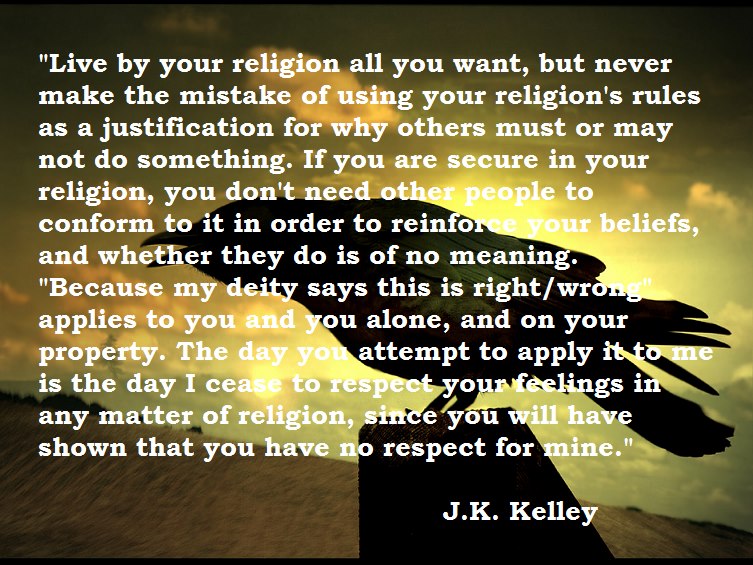
Something I just blurted on Facepalm, made into a graphic by Magdalena Åkesson.

I didn’t make this graphic. My friend Mags Åkesson took a post I wrote on Facebook and assembled it.

The reaction caught me off guard, and in a positive way. I had anticipated some contention. Instead it has that vague feeling of something that’s about to get away from one, be associated with one.

Good. I don’t want control. If it resonated, then I am glad. I fling it joyfully onto the winds.

People who seek to control you, well, that’s the bad guys and gals.

“I’m the Have-Nots for the week.”

This morning I was brushing my teeth while Deb attempted to blow-dry all that hair. I brush my teeth reliably, but I dislike it. The mess, the taste, the gagging that will happen when I do it for the proper length of time. Deb is going camping with friends, and I’m going to go hang out with friends, staying with the delightfully hospitable McCall clan. (And no, I have not opened a can of dumbass posting on the blog that we are out of town. There’s still a family of five living here in our absence.)

When I’m trying to brush my teeth with Deb around, she takes advantage of the fact that I can’t talk by heckling me. When she found out I was going to Steve and Melissa’s, she had visions of culinary delights, so the Heckling-of-the-Day concerned the fact that I was varying unflattering epithets for going without her. I should also mention that we sometimes watch a trashy reality show called Big Brother, in which people live in a sound stage that the show calls a ‘house,’ compete for food and powers, and try not to get evicted. If they are Have-Nots, they have to eat ‘Big Brother Slop,’ a nutritious but unappetizing wallpaper paste.

So I’m brushing my teeth. “You are such a faecolith for this,” she groused. “I’m on slop. I am the Have-Nots for the week.”

As hastily and poorly as I set that line up before leaving, it probably won’t do to you as it did to me. I was overcome. Ever try laughing with a mouth full of toothpaste while brushing? I was doubling over, causing toothpaste foam to come dripping down my beard (which I hate), pouring out down the toothbrush onto my hand (which I abhor), messing up my orderly brushing routine (which annoys me). The whole mess made it funnier, my fastidious brushing turned into a hydrophobic-looking FAIL.

Have a good weekend.