Category Archives: Social comment

What your keys used to do, long ago

What did they do? Why did they have weird names? Why on earth are some of our current computer keys called as they are?

This is an IBM Selectric typewriter. If you think electric typewriters sound painful to write with, you need to try a manual. For one thing, on a manual, light strokes would produce light or no impressions. You had to try for a consistent level of physical force when hitting keys; if you didn’t produce enough power, the type character might not make it to the ribbon at all.

I included this picture so that you didn’t have to guess what my 1980s writing implement looked like.


Starting along the top, the Mar Rel stood for Margin Release. Once you set your margins, the carriage (the typing ball and its mechanism) would not move past them. If you wanted to finish a word that went one character past the margin, you hit Mar Rel so that it would let you past just this once.

I’m serious.

The Tab worked much as it does today, except that it relied upon ‘tab stops’ which one set wherever one wanted to indent. Typical was five spaces in from the left margin, for para indents, but one could set more tab stops. As the web came along, this morphed into a way to cycle through links and fields, as one does now on a fillable PDF or online form.

I don’t even remember how we got [brackets] on the 1. On the number keys, of course, we got the symbols instead by holding down the Shift key–not different from now. For the alphabet, of course, that’s how we did upper case on a letter-by-letter basis. To get italics, we had to change out the ball, which was easy enough but tedious to do very often–if, of course, one had a ball with italic type of the same style. I never did, but I assume they existed. The Selectric was way ahead of other typewriters because you could change out the ball. Different fonts! Miraculous!

Notice that the shifted 6 is the ¢ sign, which one now has to hunt up in the ASCII character set. Nowadays you get the ^ (caret) for a shifted 6. The caret was unknown on the electric typewriter.

See the with the _ above it? Since we didn’t have italics or bold, by and large, we did emphasis using the underbar. We typed the text, backspaced to where we wanted to start underlining, and held down Shift and the hyphen. In both its forms, that key was one of the machinegun keys–if you held it down, it kept striking until you let up (as all modern computer keys seem to do). Very good when you wanted to underline a whole sentence. I do not remember the full inventory of machinegun keys from that era, but my hands would remember them. If you held down a key that was not a machinegun key, it typed its symbol once and did nothing further.

Backspace backed you up one space without deleting anything. In effect, it was the left arrow key. To delete something, you either painted it with white-out, or put tape over it or slipped in a sort of white carbon paper, and re-struck the key. Since photocopies cost $0.10 each in 1978 dollars (minimum wage was about $2.20 or so per hour; imagine if copies cost about $0.40 now), we used carbon paper, or ditto machines. Some forms still use carbons, mostly in government. Of course, if you made a mistake, you’d have to fix it on all the carbons. Sensibly, Backspace was a machinegun key.

Index has vanished as a concept. What did that thing do? It turned the carriage roller–advancing the paper one line–without returning the carriage to the left margin. It was more precise than turning the roller by hand, since the roller could be turned less than a full line. It clicked as one turned it, unless one released the catch that kept it in synch–then it rolled smoothly with nothing keeping it in horizontal alignment. Do that, and you would have a hell of a time getting it back into perfect alignment.

On the second row, notice that the ! has its own key, which shifted to °. For years, typewriter manufacturers varied on what symbol belonged with the number 1. (We obviously did not have a separate number pad, arrows, num lock, or accompanying mathematical operators. Had the number pad not come along early in the computer world, I’m not sure what accountants would have done. Seppuku, perhaps.) In any case, this is where IBM was putting the exclamation point on this model of the Selectric.

Return has become the Enter key, but you still hear people call it by the old name; early in the PC days, it retained that label. That was an important key because it advanced the roller one line and ran the carriage back to the left margin; one did it at the end of each line. On manual typewriters, this was truly manual. They had a bar one grabbed and ran the carriage back with physical effort. As word processors came along, we got the soft return and the hard return as concepts. Soft returns change positions with margin, font, etc. changes. A hard return says: “Start a new para no matter what.” Novice authors usually clutter their mss with loose hard returns. You’d be amazed how many create these awesome title pages (which should have been their very last act, not their first) and use a bunch of hard returns to center the title rather than use the software’s functions correctly.

Some writers don’t know how to tab or indent. They instead just hit the space bar five times. Dirty secret of editing: when I first begin to edit a ms, I clean up all the incontinent extra hard returns littering the place. I then do a global search and replace for two spaces with one, which fixes all the archaic and novice misuses of two spaces. Except that sometimes it’s ten spaces. I re-run the S&R until it makes no corrections. Even dirtier editing secret: I judge my client’s word processing software usage competence by the quantity of loose spaces and hard returns. If there are a lot of these, I know that my client doesn’t really understand much about document creation’s technical details. She may be a superb writer, but that’s not coupled to her user level on software. I’ve had clients come out and call themselves techno-doofuses, even those whose uses of English were at high levels.

This affects me because clients generally expect me to provide them with free Word tech support, especially with regard to tracking changes. I dread this; since this feature is central to my work, I don’t really have a choice. If they can’t use it, they can’t process my efforts efficiently, but it’s also hard to make people understand that I am not necessarily seeing what they see and can’t always just walk them through changes. The only place where I flat decline is typesetting; i.e. finishing the document. I don’t know the software well enough to help with that, it is beyond my scope, and I may punt.

The Clr/Set rocker was how we set our tab stops. The On/Off rocker is self-explanatory. When typing, things were clackety-clack noisy; when not typing, there was a quiet whirring hum.

The Lock you see at left, third row, is the caps lock. Num lock and scroll lock came along with computers.

Shift, of course, got us the upper case or other shifted character outcome. We needed one on each side because we were coached to station our fingers on the home row: asdf jkl; . Thus, if you wanted an A, your right hand did the shifting. If you wanted a P, your left pinky held down shift (if you were doing it exactly as taught). My high school had a yearbook advisor who had lost an arm in some accident, and having two Shifts must have been pivotal for him.

They called it the Space Bar because that’s what we used it for, much as now: advance the carriage one space without any image. Except there’s a big difference that I don’t think a majority of computer users grasp. While the space looks to people like an absence of something, to a computer jock or sophisticated user, it’s a character. It has more in common with an ñ or F or ^ than with nothingness. When you hit the space bar now, you type a character; it just happens to be a blank character.

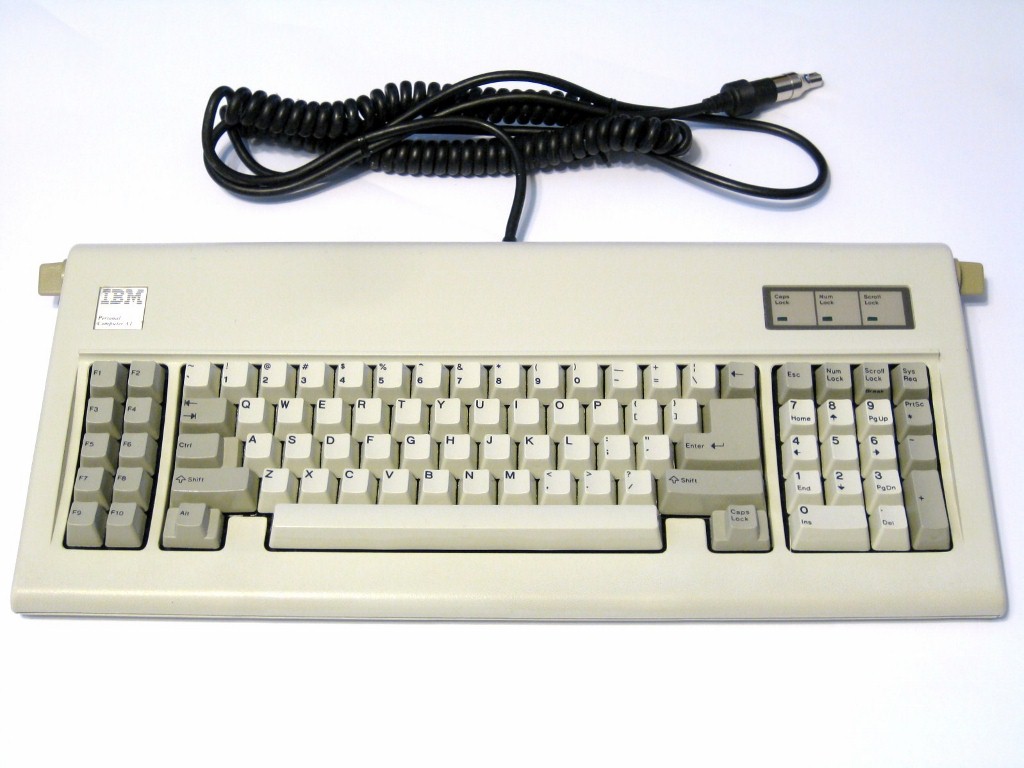
We did not have: Esc, Ctrl, Alt, any of the F keys, `/~, \ / | (the backslash and vertical bar, in case that looks weird), Ins, Home, PgUp, PgDn, Del, End, Pause, or the stupid Windows keys I always pop off my keyboards. A typist circa 1975 would have wondered what in hell all those weird keys did.

“Pause? It pauses any time I do nothing. I don’t need a key for that!”

“PgDn? Page down, you mean? That’ll just spit the current sheet out. Pointless.”

“Esc? I’d like to escape, all right; I’d like to escape back into what I know, which isn’t this.”

Thing is, the transition happened by degrees and with variations before the advent of the 84-key keyboard (had only ten function keys, arrayed at left; combined directional keys with number pad). Only portables, then laptops had the number pad mushed into the main keyboard (which sucked then and sucks now). Each time there has been change, it has taken time to absorb. Some have made sense, but some have made none.

In any case, if you’re looking at a fiftysomething, now you see where he or she learned to type. And that fiftysomething probably learned on an electric typewriter; imagine the heckling he or she took from the die-hard manual typewriter oldsters as to how easy it was now.

I assure you of this: I completed a degree in history, resulting in a stack of term and other papers an inch and a half thick. And I typed every one of them three times (at least) on an electric typewriter. There actually was college before an Internet, and you’d be surprised how much we managed to learn without the ability to google anything.

I know that’s what they taught you in school; I don’t care

We still use language for the same purposes we did when I was a child. For that reason, I’m generally averse to changing a term’s definition, especially when we need that word (like ‘literally’; without it, we have no way to separate metaphor and exaggeration from accurate recitation), or when the word has been redefined not because it needed redefinition, but due to basic sociopolitical cowardice.

What we don’t do the same is commit language to record. We do not type on manual typewriters, where it took physical effort to begin a new line. We do not type on electric typewriters, where one used to hit a button for that purpose. If we wanted center justification, we did elementary mathematics. Younger people who never used typewriters would be astonished at how much of Word’s superficial presentation originates in the typewriter, such as tab stops. The earliest word processing was meant to imitate what people understood best, and that was the typewriter.

We also don’t write with a pencil or pen in our dominant hand. Many of us can no longer write a word of cursive English beyond our own signatures, and schools are discontinuing its instruction. One day the ability to read cursive English will be a specialized skill for wonks only.

Nowadays, we either type on a computer keyboard, a laptop keyboard (I only consider laptops as half a computer), or some tiny chiclet-sized key images on a glass surface. We do have to hit the space bar after a word or punctuation–the space itself is a character–and we have had some more years to debate the way punctuation inflects meaning.

We also don’t so often print the words on paper. We often send them electronically. No one–at least, no one whose hands are not too arthritic to type in the first place–is going to type several hundred pages of text, revise it with multiple rewrites, and send this ream-sized manuscript to one publisher at a time, awaiting its return and enduring its entire loss if it is not returned. We can wave the mouse and make the whole document double-spaced. We can enforce a paragraph-opening indent. We don’t need underlines or caps for emphasis. We have proportional fonts with automatic kerning. We don’t even need font cartridges, as we used to use in the earlier days of inkjet printers.

What we learned as kids, and in typing class, was what teachers of the day were conditioned to teach us. Some of it made sense. Some really didn’t. We got marked down if we did it differently, conditioning us to consider it ‘correct.’ Then: the way we committed language to record transformed. Those of us in ‘the industry’ transformed with it. Those not, mostly did not, obstinately insisting that what they learned in 1963 must still be right, and if you don’t like it, get off my lawn and stay off my Social Security.

It is time they–you, if you are reading this, and you are over fifty–awaken to what you are doing wrong. This is especially true if you start a blog, or start shopping your manuscript. If your editor tells you we don’t do it that way any more, believe him or her and cooperate. I would not lie to you about the industry standards, and if I tried, I could not get away with it.

Most people over fifty are doing some things wrong.

The Comma Formerly Known As Oxford. I have often vented about my refusal to recognize Oxford’s moral authority over the English language, but this comma phenomenon exists by any name. When presenting a listing with commas, our grade school teachers taught us to omit the comma before the conjunction (typically ‘and’ or ‘or’). Thus, “Seattle, Pullman, Eugene and Corvallis have I-A football teams.” They and we were doing it wrong most of the time, and here is why: failure to use this comma creates an association between the last two items in the list. If we want that association, we should omit it. If we do not, we should use the comma. There is no mindless rule yea or nay. So no, TCFKAO is not always required, but is usually appropriate; intended meaning must govern.  We were taught wrong, and rather than continue to do it wrong, we must improve. I don’t care what Miss Unruh taught you back in school. Start doing it right.

Two spaces vs. one space. This did not exist for me until I began to type. Our typing teachers taught us: two spaces after a period, exclamation point, or colon. One after everything else. For some reason, my age group and those older cling to this obsolete usage as though it were heavenly gospel. It existed because, on the typewriter, all fonts were fixed-pitch. A font consists of a typeface (Arial, Times Roman, Courier) and a pitch (size; typical number of characters per inch of printed text). Courier 12 is a font, as is Arial 8 or Times Roman 24. A typeface is proportional or fixed-pitch as one of its basic properties; most are proportional, because proportional was what we always wanted but could not do on a typewriter. Professional typesetting used proportional fonts because it could, and because it was more readable. To see what every one of my college history papers looked like, pull up a document in your word processor and change a paragraph to Courier 12, which is a fixed-pitch font. Our typewriters could not handle proportional fonts, like this blog’s. Because they could not, Courier was harder to read, and we learned to use two spaces after certain punctuation marks. This is no longer Mrs. Overley’s freshman typing class. In modern documents, an extra space is just pointless air. Let it go. Even Mrs. Overley probably has.

Underlines and caps. Gather round, children, for a tale of the days when we were one step above writing with flint knives, burins, mastodon grease, harvested ochre, and dried stretched deerskin. We could not make text bold on a typewriter. We could not italicize it. Only on later typewriters could we change fonts at all. Even then, we could not change their size as issued. If we wanted emphasis, and we were too lazy or illiterate to make our word choices convey the emphasis–or, in fairness, we were writing dialogue and needed the occasional emphasis–we had underlines, and we had all caps. This led a generation of kids, mine as it happens, to use these methods even into their middle age–when italics were available and didn’t cost a nickel. Stop it. There are very few reasons to use underlines. Debate goes on about book titles, but I think the underline is a holdover from when we would backspace and hold down the underbar key. There are even fewer reasons to use all caps, unless one wants to scream in text. When I see underlines and caps, I don’t see a good writer. I don’t give a damn what your IBM Selectric let you do; start doing it right, won’t you?

Thanks.

The dumbness of single-bit binary logic: everything that is not this, is not necessarily that

My bro JT, one of the most unconventional thinkers I know, has long commented upon the problems with single-bit binary logic. I understood this, but I’m embarrassed at my failure to process it until very recently.

In binary notation, everything is a 0 or a 1. They is a this or a that, as the old umpire used to say. This is a base two system, and it is the basis for digital electronics. If you don’t know what base two means, that means there are two numbers before you have to start a new column. We count in base ten, logically since we have ten fingers.

Binary notation works fine as the basis for our electronics. In the world of humanity and issues, where things are rarely so clear and exclusive, it is an indicator of feeble-mindedness. Consider: “If you aren’t for us, you are against us.” “If you aren’t part of the solution, you’re part of the problem.” Stop and think, as I believe in doing any time someone trots out a glib saying repeated so many times that people assume it wise. This is dumb. Just because I am not for you does not mean I am against you. If you’re dumb enough to construe me as your enemy because you can’t bully me into signing onto your cause, that’s your problem and mistake. And just because I am not participating in a solution does not automatically signify that I am part of the problem. I may be neither. I might be a little of both. I might be in the process of using my brain to make up my own mind without consulting you. And this attitude isn’t adding luster to your side, I might add.

The fundamental problem with single-bit binary reasoning: it allows only two categories, choices, alignments, what have you. When applied to a human issue, that’s feeble-minded. It oversimplifies the human condition down to a moronic level. It works only for those who yearn to be spared all nuance. Is Bill Gates an evil man or a good man? He made a fortune by monopolizing our computing environment with increasing mediocrity. Then he decided to retire and use his wealth for such good causes Warren Buffett said “here, take mine, too.” He left behind his company still doing all the same things, growing more mediocre by the year, but no less monopolistic. Hate or love? Respect or disrespect? It is not so easy. It confounds feeble thinking. It makes modern America’s brain hurt, so its members just apply selective amnesia. They derided him back when his software company was strangling every possible competitor, and he was an evil guy, but now that’s old hat and he is a good guy. Nuance is hard. Absolutes provide comfort of the shallowest kind.

Look at the United States’ political system, which embeds and defends single-bit binary logic. If you aren’t one of these, you are one of those. This is idiotic. There are lots of things to be other than those two. Single-bit binary logic works fairly well on life and death (it’s very rare to be neither dead nor alive, I’ll concede), sports events on the field (can’t really play for both teams at once, I’ll go along with that), and other such clear-cut situations. Most matters of opinion are not so.

Thus it is with public demonstrations. Not every failure to join in a public demonstration of homage amounts to disrespect. Only single-bit binary logic can conclude that it does. Suppose that my national anthem is on television before a hockey game. I could choose to stand, interrupt my activities, pay attention, even sing the song: that would be respectful. I could choose not to pay attention, but to avoid doing anything overtly self-indulgent or gross. I could talk with someone about the imminent game, look at a magazine article, or simply sit in silent passivity; that would be somewhere in between. Or I could choose to scratch my groin, flip off the TV, use bad language, drink cheap beer, chomp tortilla chips, and/or make a snide remark; that would be disrespectful. It’s feeble-minded to think that all non-respect is disrespect, just as it is feeble-minded to think that all the different forms of respect can be conflated into one term.

(One of these days I will go into depth on that. There is the respect born of fear (s/he can and might hurt me), that born of affectionate regard (s/he has done great deeds I admire), and that stemming from positive regard without affection (s/he may be a bastard, but in some ways I respect him or her). In some situations, more than one may apply in some proportion. Our error occurs when we fail to qualify what we mean by respect.)

Single-bit binary logic works fine for dogs. If you are a dog, I recommend it without reservation. In most cases, a dog not mistreated either likes you (you are best pal for life) or hates you (you are intruder, competitor for scarce affection, etc.). My friend Jim had a rather ratty little dog named Willie. Willie liked everyone. I mostly don’t like dogs, and I didn’t like Willie. Willie didn’t care; he liked me.

(And lest you think Willie had no importance, let me tell you, Willie was an impact player in one of the funniest pizza-related instances in the history of the faux-Italian menu. I think I’ve told that story on here. If I have not, I must. If I haven’t, you are permitted to rag on me until I do.)

Why are so many issues presented to us in single-bit binary logic? Because it’s easy–and because it makes us easier to manipulate.

Who’s a good boy? Good boy!

The dumbest criticism of writing I ever hear

Book reviews are great places to see people say dumb things. Some of those dumb things are also common in message board posts, comment sections, and ordinary face-to-face speech. I have a passionate loathing for “dumb things everyone repeats as if they were automatically true,” but this one is the dumbest of the dumb:

“Profanity is a sign of a limited vocabulary.”

The ability to rub together four brain cells would dispel this bromide at its birth, but since that ability seems so lacking, let’s perforate it once and for all with a volley of logic bullets.

In the first place, while I have been accused of many faults–some, with cause–a small vocabulary has never been among them. I don’t normally brag about it because it’s nothing for which I may take credit; it is the residue of fifty-one years of avid reading, 99% of which I enjoyed with gusto. I also have active vocabularies in foreign languages ranging from five to five thousand words depending on the tongue, with inactive vocabularies rather larger. There are few times to show off in an effort to humiliate someone, and that would be one.

I swear. I curse. I use bad words. I use them in speech and writing. Do I have a limited vocabulary? Pretty certain I do not.

People swear for many reasons. Some do it to release frustration. It’s better to swear than to break something, hurt someone, or bottle it all up inside. It can be used to intimidate, and intimidation is not always a bad thing. Some people will not do the right thing except when legitimately frightened, and a bad word or two says “I do not care what you think of me.” Some do it for comic purposes. Some swear just because it happens to feel good right about then. Some would not get through freeway and arterial traffic with sanity and language purity both intact. Some do it for effect in writing. I am sure you could think of other cases.

None of those reasons speak to a limited vocabulary. Claiming that swearing does so indicate only announces one’s own lack of reasoning capacity. Nice going. Look, if it offends you to hear or read profanity, just admit that it offends you. It’s okay to be offended. I’m offended by the foolishness of the claim about limited vocabulary, and I’m not going to apologize, so if you want to say that profanity offends you, fine. Be offended when you feel it necessary.

In our single-bit binary logic republic, perhaps a fair number of people will look at that and say: “Ah, so you advocate unlimited profanity without restraint. Classy.” Now that’s going from the frying pan of dumbth into the fire of stoopid. I advocate nothing of the kind.

In speech, as anyone not jumping into or out of frying pans of dumbth will grasp, times and places occur where profanity is appropriate or inappropriate. On the phone doing business? Mostly inappropriate, unless the situation is special. If my listing agent calls me to tell me that the buyer has bilged out of the deal for a stupid reason, and I have a long, collegial relationship with that agent, I may be entitled to a cussing-of-the-situation. If I’m calling the sheriff’s deputies to request their assistance, and there’s no reason for me to be worked up, gratuitous profanity would be a lousy idea. Let’s say I’m making a sales call on the Sisters of Perpetual Outrage convent; I probably shouldn’t drop bad words on Mother Superior, nor even on Daughter Inferior.

In writing, the rule would be: depends on the situation, but on balance one should consider profanity a chip one may play when and where it will have best effect. Like em dashes, ellipses, italics, caps, adverbs, passive voice, and all the other quirks that bad writers seem to mistake for ‘style,’ profanity loses its effect in high concentrations. Like all those chips, profanity has its place in the language. Its place is not in formal historical writing, for example, nor in a legal brief, nor in a cover letter. In a travel narrative? It may have its place. In fictional narrative? Same. In dialogue? If credible. How could one write credible stories involving bikers or ironworkers without profanity? “You better walk that stuff back, you child of a prostitute, or I’ll kick your backside!”

Telling people when to curse aloud is beyond the scope of what I do, but I can speak to the place of profanity in writing. The best approach I can suggest is: consider appropriateness and effect. Have you been burning lots of chips? If so, you should not tack on another bad habit. If not, then consider whether the likely impact is worth burning one of your precious deviations from good orthography. Would this naughty word make a real difference, enhance your narrative? If it would, let fly. But don’t do it just to indulge yet another lazy novice writing habit. Don’t waste the chip.

Admit it: you were waiting to see whether I would swear, weren’t you? Why would I? The goal of this article is to educate and persuade (with the secondary goal of shaming, in a few cases). Profanity would not do that. It would be as trite, predictable, and amateurish as the typical Facebook meme.

Not that I am incapable of triteness, predictability, or amateurism, of course. I’ve even been known to combine the three. I would like to think I rarely use them without reason. And I don’t need profanity to curse out the mentality that imagines profanity a sign of limited vocabulary. It would be fun for me, but less persuasive.

That is the point.


Eclipalypse 2017: Oregon is Doomed, Damned, Sure to be Destroyed by Barbarian Hordes

On August 21, 2017, a total eclipse of the sun has been scheduled for the United States. The timing is inconvenient in some ways, pretty nice in others. For us in western Oregon, where the eclipse will make first landfall, there is benefit in that our oft-overcast skies are likeliest to be clear in summer. If the eclipse had been scheduled for January, no one in western Oregon would get excited; the odds of seeing anything but two minutes of darkness would be minimal.

Since we no longer have education to speak of, I suppose I have little choice but to explain what a solar eclipse is. A solar eclipse occurs when the moon (which must necessarily be ‘new’ at this time) gets between Earth and the sun. Since the lunar disc is just a bit larger than the solar disc from our perspective, for about a hundred seconds the spot of totality is plunged into nightfall. As Earth rotates, of course, the current spot of totality rolls eastward. In this case, it will begin off the Oregon coast and pass through southern Idaho, smack across Wyoming and Nebraska and Missouri, then across Tennessee and South Carolina. The totality spot is seventy miles in diameter; the closer you are to its precise center, the better the show. The farther you are from the path, the farther from totality your view will be.

Oregon has a population of four million, and her authorities are in Eclipalypse Panic Mode. They expect a full million people to swarm into the state, mostly in the western part (I live about an hour north of the totality path). To hear them tell it, we are all going to die horribly. Power will fail. Cell phone towers will be overloaded. There are already no places to stay; farmers are renting little pieces of pasture for big money. All roads are to be so gridlocked that you could easily end up running out of gas (which of course will be unavailable) and dying of sunstroke when your A/C goes out while stuck on the I-5 traffic, emergency vehicles completely unable to reach you, the 911 system in collapse. The governor has called out the Oregon National Guard, and I’d bet she’ll summon the State Guard as well. Sensible Oregonians who cannot afford to flee now are committing suicide after a last meal of cruelty-free quinoa salad with a side of suburban guilt. There are quite a few preppers in Oregon, and I’m sure they are all battening down, locking and loading.

I think it’s hilarious, except of course for all the garbage people will throw on the ground (I hope the Oregon State Police catch and prosecute every single litterbug). The traffic may make Portland traffic bearable for once, with so many people drawn an hour south. Yeah, the roads should be busy down toward the totality path, but most people will go away that same day. Would it be smart to fill up one’s car beforehand? I will. Should we prepare to run screaming into the two minutes of misplaced nightfall (beginning around 10:15 AM)? I find the notion amusing. Have you all yet built your sandbag forts? Why not, you fools? We are all going to die, right?

What a fearful society we live in. Ever stop to ask who can profit most from keeping you in constant terror of your fellow humans?

Worth your time, sometime.

I doubt we are all really going to die. But I’ve been through a total eclipse. This is the first one in a long time that passes across the full width of the United States, but it’s not the first one in my lifetime to pass over part of the nation. We had one when and where I was in high school, and based on that experience, I can help prepare you for what it’ll feel like.

  • The occlusion of the sun’s disc takes a couple hours to reach totality, and a couple more for the moon to get completely clear after totality. During the before-and-after, the sun is still pretty bright, but it’s dangerously easier than usual to gaze at. The authorities warning you to be careful of imitation eclipse glasses? Believe them. The problem is that, especially if the disc is just visible through overcast, it’s easy enough to stare at the sun long enough for permanent eye damage. Even when it’s easy to look–most especially when it is–treat it as if this were not an eclipse, taking suitable precautions. It’s not worth going blind over.
  • Because this whole process takes about four hours, a lot of eager beavers will get in position very early, see the full onset of occlusion, and be bored stupid by the time the eclipse is total. See, an eclipse doesn’t have any sudden drama except for the short period of full totality; the rest of it is gradual. Once it’s over, I expect most of their attention spans to be well past exhaustion, and that’s probably when the traffic will really blow. I’d say expect about an hour of pretty slow going after totality, after which it should ease up.
  • No matter where you are in the path–even in a city–you will be amazed how many animals are around you of which you had no idea. As totality approaches, for about half a minute, the daylight will fade very quickly to a dusk. For the animals, this dusk is happening way off schedule, and it rattles the hell out of them. They will all speak up at once, and it’ll amaze you. The sudden nightfall will occur after that, and the animals will truly be freaked. If it’s not overcast, you’ll get a good show in the totality path. We can’t normally see it, but the radiant energy from the sun extends out at least as far as the width of its disc. When totality ends, you get a dusky dawn, then daylight again. With the disc itself covered up, in darkness, you can see the full corona (as we call this radiant energy). I didn’t get to see it due to overcast, but I heard they saw quite a show out at Stonehenge.

And therein lies a tale.

I attended high school at a very small place in south-central Washington. The area is sparsely populated and received minimal overrun from eclipse hunters, which is partly why I think the Eclipalypse Panic is overdone this time. Some thirty miles from where I lived, there stands a tycoon’s full-size concrete conception of what Stonehenge must have looked like before rocks began to fall off one another. Sam Hill built this replica as a World War I memorial, not far from his mansion, and it offers breathtaking overlooks of the Columbia River as well as several other solemn war memorials at which one may pay tribute to locals who lost their lives in American service.

I was raised by a family of religious fanatics whose psychological stranglehold I would not escape until my mid-twenties. When we heard that a bunch of weird hippie pagans were going to go out and have a ritual of some sort at Stonehenge, I accepted the conventional wisdom: they’ll all probably get naked, have an orgy, load up on LSD and likely OD, stare at the sun until they go blind, and not understand what’s wrong with all this, all while clawing their faces off in the throes of bad trips. As we were in the path of totality, we ourselves did not need to travel to Stonehenge or anywhere else. A friend from school came up to our front yard to watch it with me, a good excuse to play hooky for the morning. In our callous teen male manner, intolerant of difference and immune to empathy, we joked how it would serve the doped-up weirdos right. Dumbass hippies.

I did mention, right, that it was a pretty small town?

The eclipse itself was a damp squib, as I mentioned, and we all went about our lives. Now advance the clock a dozen years, give or take, bringing me to the age of perhaps twenty-eight. Not long before, I had broken up with my ex-fiancée (and we all know how that turned out). A few years earlier, I had left Christianity and become a practicing Wiccan. Go ahead and say it, whatever it may be; I have it all coming. I’ll take my due hazing. I was studying Irish with a druid group led by my (then-new acquaintance, today longtime friend) Domi O’Brien. A scholarly lady of legendary hospitality and generosity, Domi hosted (and still hosts) amazing feasts to accompany spiritual events. Her sons have since grown into the wise, compassionate men I expected they would.

At one such event, I met a delightful lady named Cyndie. She was from Oklahoma, with a comforting gentle drawl a bit stronger than my own part-time rural Kansas twang. Her interest in me was obvious if decorous. This adjective is not always the case at pagan events, where there is often a shortage of obviously masculine straight males. There is absolutely zero in Wiccan culture to shame women from taking any initiative they might deem fit. Put another way, any straight, single young man in paganism doesn’t have to take a lot of initiative of his own in the gender relations department. If he’s not a complete jerk or moron, the only reason he’s going to stay by himself is by making an obstinate effort to do so. I wasn’t making an obstinate effort to do so.

Cyndie being a few years my senior, and a somewhat old-fashioned Midwestern daughter, when I mentioned my many times cleaning eave-troughs at the ranch with Grandpa, she saw her opening and played her best card. She told me that her house’s eave-troughs were well past due for a cleaning, but she just could never make time to get up there and do it.

Well, you don’t have to hit me over the head with a mallet. You all know the drill: the man gallantly offers to come over and do the dirty, unpleasant job. After pro forma protests, the woman agrees with thanks. She would not have invited him anywhere near her home if she didn’t feel pretty good about the whole situation, but the only certain thing is that she’ll make up a nice hearty dinner which they will share. Anything else that may occur depends purely upon how they both feel. This has probably been going on since Homo erectus, when demure young Ugha hinted to testosteroney young Gruk that the rocks in her firepit were misaligned, and perhaps he might find time to come over and straighten them up.

The eave-trough job turned out to be much worse than I expected. The ladder was in poor repair and a couple of rungs broke, once nearly dropping me all the way to the ground. It poured, of course, triggering her gallant duty to offer me absolution from the muddy, chilly task. The script called for me to carry the job through at all hazards and discomforts. (This satisfies the woman that the man is stupid enough, or interested enough in her–or both–to put some pain and broken skin into the game.) But before we even got to that part, I got the first shock of my day when I stepped inside her front door.

On her living room wall was a large painting the size of a modern big screen TV. It depicted a crowd of robed backs and mostly hooded heads gathered inside Stonehenge. Above them was a sun in a state of total eclipse, corona splattered about the black central disc.

Captain Obvious was on point, of course: “Oh. That’s the eclipse in 1979 seen from Stonehenge!”

“Yes,” said Cyndie, pointing in sequence. “That’s me, and over there is Isaac Bonewits, and here is Shadowstar Breakwind, and this is Silver Raven Moontime, and…” (Not actual names, those last two. In Wicca, there seems to be a hard and fast rule that everyone must incorporate into one’s pagan name as many of the words ‘star,’ ‘shadow,’ ‘silver,’ ‘raven,’ and ‘wolf’ as one can arrange. Other words are allowed in the name, provided at least one of those five is in use. Otherwise, it’s a foul.)

How much can shift in a dozen years. Before, I had dismissed a bunch of people I’d never met, all based upon inherited prejudices and juvenile arrogance. Now I was not only one of ‘those people,’ I was on a dinner date with one.

Cyndie and I dated for over a year. We weren’t really fated for the long term due to very divergent ideas on life, but it was a good time; she remains the only former flame with whom I keep in some contact. I can still hear that gentle Oklahoma drawl in my mind; she is a considerate, warm, and wise lady who taught me a lot. And I did do a good job on the eave-troughs.

I’d better, or my grandfather might reincarnate and start critiquing me.

Enjoy Eclipalypse 2017, all hundred and twenty seconds of it.

If we all die horribly, please send me an email informing me, so I can decide how to proceed from there.

The Depression Americans who went to the USSR

Back in the early 1930s, several thousand Americans packed up and went to work in the Soviet Union. Few ever returned. Few survived to the Cold War era.

When we look back on an historical decision that might seem nuts to us, we should subtract our hindsight and seek to understand what was known at the time before making judgments. In this case:

  • While there was some information about the large-scale suffering and death of the Holodomor and the liquidation of private agriculture, few Americans understood how bad it truly was, and few cared. We’re ass-ignorant of the world today, even though a network connects us with the news sources of our choice via devices held in our hands. Who would expect us to be less ass-ignorant back when the information was pre-selected by a newspaper publisher?
  • In 1933, the USSR was just sixteen years old. It presented itself as the fiery champion of working-class interests. In those days, working-class people were willing to strike, fight, and die for better conditions. It wasn’t insane for a typical American worker to wonder whether those Russians might not have come up with something good, even if at first they’d had a messy civil war. The more educated Americans realized that, to a large degree, our own revolution was a civil war with foreign intervention as much as it was a revolt against a foreign power. If our independence came with a civil war, why not that of other countries?
  • 1933 could be described as the heart of the Great Depression. Unemployment was the norm. Homelessness was commonplace. Workers with skills, such as laid-off Ford automotive employees, wanted only a place to use what they knew. The USSR was playing industrial catch-up, and that made them very receptive to Ford technology and those who understood it.
  • Aleksandr Solzhenitsyn had not yet written The Gulag Archipelago. There was no way to foresee the purges of the late 1930s, still less the long-term pathology of penology as an economic and social control mechanism lasting into the 1960s. No one knew, either, that a wildly gesticulating little World War I Austrian corporal would, within six years, launch a war of genocidal conquest, much less who would be on which side. Americans were more concerned about ending Prohibition so that those who could afford to do so could legally escape into alcohol, long a very American habit. Hoover had failed, new leadership was in place, and it was hard to imagine anything worse.
  • There were no nuclear weapons; there was no Cold War; there was only one avowedly communist country in the world; the United States professed non-alignment. Eastern Europe had not been handed off to Stalin, who was relatively new to power. Mao Zedong was holed up in the mountains of northern China figuring out how to get into power against a powerful foe like Chiang Kai-Shek.
  • This country seems always to have had, and even to require, a designated enemy. Sometimes it’s a race, sometimes it’s an ideology, sometimes it’s a country–but this country has rarely if ever not had an enemy and I’m not sure it would know what to do without one. (Some of us think that if it doesn’t have one, one is designated for us, just to keep us marching along, but that’s a personal view.) The specter of world communism was an easy demonization, because: it tied into our own social dissent, it promised to run absolutely counter to the ruling interests, and it had already been seen–at least by those in the know–to bring on convulsion, shortage, repression, and state-sponsored murder. (That not everyone believed those tales is also a factor, but in this case the stories were if anything an understatement.)
  • With any designated enemy, there are two sides, usually both about half wrong. One side will always be making that enemy out to be less than human, meritless, the ultimate enemy of all that is decent, unworthy of the least sympathy. The other side will always be looking for mitigating factors, exceptions, reasons to believe otherwise. It’s still with us today. There are still people, for example, who will try to deny or minimize the Holocaust. But there are also still people who will make any excuse necessary for any people or nation that opposed the Holocaust. In 1930s US society, the side demonizing the USSR was obvious enough, though it also went so far as to view the average Russian (or other Soviet citizen; barely half were Russian) as a half-civilized Asiatic. The side mitigating for the USSR was not too ignorant to realize that the side demonizing the USSR and its constituent peoples had a vested economic interest in avoiding state-planned economics, in breaking organized labor, and in continuing to sit on its pile of inherited wealth. Reality: while some of the Soviet government’s actions were barbaric, a people who produce the cultural landmarks of Tchaikovsky, Dostoyevsky, Tolstoi, and many more, are certainly not barbarians. And while a massive slave labor camp system and a period of mass starvation almost defying comprehension may fairly be said to overshadow any social advances, social advances there still were; they just were not sufficient for a balanced mind to consider them worth enduring mass starvation. I’m not sure what could be, since the dead are no longer around to enjoy social advances.

Our view of past times will always be more balanced when we remember what the people of the times did not know.

In this timeframe, in this economic situation, several thousand working-class Americans, mostly out-of-work automotive laborers, accepted the Soviets’ open invitation to come and work. A few were communist ideologues who had bought into one extreme of the pro-Soviet narrative, but most were more interested in a better way to provide for their families. The USSR was buying one of Ford’s old plants, and it would need workers familiar with auto manufacture. (The Soviet weakness in this area would persist for many years. During WWII, they considered our Lend-Lease tanks and fighter planes mostly substandard, but without our humble trucks, the Soviet Army would have had a far harder logistical time.)

The US government and industrial leadership generally did not care if a bunch of laid-off laborers wanted to move overseas. If they didn’t want to be at home, great; they were no longer our problem. If they represented useful propaganda for the USSR, oh well; there weren’t very many, and with or without them, domestic conditions were such that it was best not to draw the competing propaganda sword with a country lacking a free press. (Even into the 1970s, the USSR would use old Depression breadline photos and footage as anti-US propaganda. Then again, in the 1970s, I very well remember that we were still talking of the USSR as if the Stalin purges had never abated.)

What most of those Americans did not realize was that the Soviet government automatically granted most Soviet citizenship upon landing, whether or not they applied for it. According to US law, accepting a foreign citizenship meant renunciation of US citizenship. Ah, but what if they never accepted Soviet citizenship? If they were in prison, and the State Department asked about them, and the USSR said “They have become Soviet citizens and are no longer your concern,” there wasn’t much State could do about it unless permitted into prison to verify the situation.

In order to do that, the State Department–seen from its perspective of the time–would have to care about a bunch of lousy commie sympathizers who actually thought it was better to have a job with the commies than to be at home starving in the land of apple pie and baseball. (The Americans in the USSR in fact missed baseball enough to establish a league.) While the USA has rarely done much to prevent anyone from expatriating, it also rarely continues to care about anyone who does so. That went double for anyone who expatriated to a society whose ideology proclaimed capitalism an evil to be torn down, and most Americans felt likewise. They don’t want to be at home? Hope the door hit them in the ass, and they don’t come back.

Americans have never taken especially well to the notion that anyone would voluntarily choose to be anywhere but the United States, given a choice in the matter, because Americans have never taken too well to the notion that there could ever be any better place. Thus, in a case like that of these American expatriates, there would neither be government interest in their cause, nor any public groundswell to pressure it. Just a few isolated relatives writing to the State Department to beg its intervention on behalf of people it fundamentally did not want to assist, let alone get back.

Stalin’s purges began in 1937. They decapitated the Soviet Army, leaving corporals leading platoons (normally led by junior lieutenants) and majors commanding brigades (normally led by brigadier generals). They ripped through every ethnicity and social class, a concept the USSR had done nothing to eliminate. The pattern was arrest, beatings and torture, confession and implication of others, a show trial, and a sentence either of death or a quarter century at labor intended to cause death. Many were shipped to the Kolyma gold fields in eastern Siberia, where they died by the thousands. A good many were sent to mine uranium, with predictable outcomes. They came in waves, and it continued into World War II and after.

Against a sum of arrests reaching mid-eight figures, and eventual deaths estimated around twenty million, a few thousand Americans didn’t even count as an arrest wave. Many of the arrests were by quota in any case, with people picked up simply because this or that region had been estimated to contain 200 Enemies of the People, thus that many must be arrested. Any NKVD officer declining to do this was guaranteed arrest. Anyone who did comply would probably be arrested in turn later. It wasn’t genocidal in that it wasn’t specific or discriminate enough to target a particular class, ethnicity, faith, or whatever. Just because it doesn’t meet the definition of a genocide does not lessen its enormous brutality.

What of the American embassy? There was no help there. Ambassador Davies, a political appointee who had married into a fortune, said and did nothing to upset Stalin or his Soviet hosts. He did spend a lot of time collecting artworks, but he and his staff generally ignored or dismissed the representations of family members concerned for relatives who had vanished. While the record indicates that Davies was a nest-feathering toady and complete invertebrate, we should remember that there was limited effective pressure at our disposal, as there would always be. Americans have the tendency to think of their country as all-powerful, that if we do not do something, it’s because we choose not to rather than we cannot. Let’s imagine an interview with the shade of Ambassador Davies, in which I come ready to blister his bureaucratic ass and have an accounting:

“Ambassador, the charge is simple. Americans went to the Gulag, most died, and you flitted about collecting art. Every one of those Americans deserved less than you to be in a Gulag.”

“That’s a very harsh charge, young man. Would you have had me go to Stalin and demand the handover of Soviet citizens?”

“They were not Soviet citizens by choice. It had been assigned to them.”

“So you say. You may well be correct. The only way for us to know that would be to interview the captives in a setting where it was safe for them to speak the truth, and you can say all you wish that we should have demanded that, but the demand would have been refused. And angrily; we would have been accused of calling them liars. Again, probably they were–but if they were, what then would you have had us do?”

“You’re telling me we had no economic pressure to bring to bear?”

“Not without harming our own country. Our ability to guide the economy through the late Depression depended in part on our ability to buy gold, and the Soviets were selling.”

“Gold often mined by your countrymen until their deaths from starvation, disease, and protracted abuse.”

“My former countrymen, all of whom on some level chose to live under the Communists rather than stay home. Just to put this in perspective.”

“All right; I’ll accept that you had no practical leverage to verify their changes in citizenship. You were appointed a diplomat. Could you not have made at least some representations on behalf of people?”

“I could have done more of that, at the risk of being expelled and the Russians completely cutting off all communication. They weren’t in a very forthcoming mood. As you may recall, they were killing their own people by the millions. But very well; let’s say we did that, and they told us to butt out of their internal affairs. What then? You cannot seriously be proposing that the United States should have gone to war over it. We had little economic leverage. Furthermore, there was the risk of driving them into Hitler’s camp, and with the Molotov/Ribbentrop Pact in 1939 it looked as though that had happened. Do you, my inquisitor from the lands of lumberjacks and cowboys, in your hindsight, believe that US interests would have been well served by forcing a longer and more enduring cooperation between a resource-rich USSR and a resource-poor but technologically advanced Nazi Germany?”

I would not be able to help seeing the old bastard’s points. That is why we put our history in the context of its times, so that we subtract our modern hindsight in the effort to make a reasonably informed evaluation of the past.

Few of the Americans ever saw home again, and those who did typically didn’t get home until the Khrushchyov era (beginning mid-fifties, ending mid-sixties). While the Gulags didn’t go away by magic when Khrushchyov admitted they’d gone way too far, they gradually became less brutal, less prevalent, and less indiscriminate. Make no mistake; a Soviet citizen still had to watch his or her words, and the Lubyanka and Lefortovo would remain dreaded into the 1990s. But there’s no evidence the repression maintained the Stalinist level. As a practical matter, it could not have; lest they run out of people to kill, or to guard those on their way to die.

And what of later inquiries into the fates of Americans, during and after Khrushchyov? In the first place, admitting an embarrassing truth with comfortable ease is not naturally a human trait, and it is especially not a Russian cultural trait. Where records had been kept in full, many had been destroyed by people seeking to cover their own culpability. Many were falsified, as in “died of stomach cancer” could mean “died during gang rape when thrown to criminals” or “starved and fell dead on the spot while mining gold.” Sometimes it helps to ask nicely, rather than make demands; the one making demands may puff up with his or her Great Moral Rightness, but s/he doesn’t get what is desired. A lot of French nationals all went missing, and the evidence indicates that many of their fates were eventually learned. Many of ours’ fates still remain unknown or obscure. It may be that the French weren’t as pushy and rude as our people.

But even then, in the second place, here’s the question that can’t be evaded. Suppose we had become insistent, from the 1950s even to today. Fine; and what if they just said “go to hell”? Would we then move closer to a potential nuclear exchange? Invade? Stop selling them grain (hardly good news for our farming industry)? In the end, if the Soviets or their successors didn’t or don’t want to answer, nothing realistic could compel them. And there’s more, one of the most uncomfortable realities to face, one with implications hard to face even today.

To wit: let’s imagine you are a foreign leader aware of an embarrassing number of carefully sequestered American prisoners your country holds. If proof were released of their survival–that your country had held them all this time just because letting them go would be to release a thousand accounts condemning your country’s deceit and inhumanity–what would you do? At some point, acting in brutal self-interest and national interest, what is there to stop you from doing the most logical but brutal thing? I think it very likely that this occurred in Vietnam, for example, that some of our POWs remained in captivity into the 1980s, and that when it came time for relations to thaw, the Vietnamese government most likely made all traces of them disappear. How much easier would this be in a country whose territory includes the vast expanse of Siberia?

It follows that, if that had occurred, there will never be an admission of it. If proof even exists, it may always be beyond our reach.

So yes: several thousand Americans disappeared into the Gulag system. Most may safely be presumed to have died before Stalin, based upon those fates we do know. A few eventually found their ways home during political thaws. Yes, they were naïve to buy into the bright future offered by Stalin’s USSR, but very few ever renounced US citizenship in a conscious way, nor ever meant harm to the country most still considered theirs. And they were fools indeed if they imagined that FDR would aggravate Stalin by lifting one finger on their behalf, especially (as we now know) with presidential advisor Harry Hopkins either a Soviet agent or near enough to render the difference unimportant. I find it very uncomfortable to face, but some truths are uncomfortable: as much as my evidence about Davies makes me loathe everything the man stood for, I don’t have an answer for the ultimate question in any era: “Okay, smart guy. Tell us how we do that without blowing up the world and screwing our whole country. I’ll wait.”

It doesn’t make Davies a fundamentally decent man who wanted to do the right thing. He wasn’t and didn’t; he didn’t want to do anything for anyone but himself, as it looks to me.

Perhaps you know you are getting near to some historical understanding when you uncover enough nuances to destroy any clear-cut feelgood angels-vs-demons outcome.

Even if you uncover demons, their enemies are not always angels.

There is a thing you can do for immigrants

Now and then, Americans go through a spasm of nativism. It happened when the Irish immigration waves began in the 1840s, it happened again in the World War I era, and it is happening now. The gist of nativism is that immigration is bad, we should reduce it, that ‘those people’ are not like ‘us’ because they look/sound/worship/eat ‘differently.’ And of course, that they will be the death and destruction of us.

Protip: the problem is not when people are waiting in long lines, following years-long processes, and sneaking across borders to get into your country. That is a sign of health. The problem is when they cease coming, and when your own people begin leaving.

We may differ on the definition of ‘immigrant.’ Fine; use your own definition. Myself, I have reached the point where I no longer care whether a person followed the process; I care only that, if I know about a person only his or her immigration/legality status, and his or her level of xenophobia and hatred, I know I’d rather have the xenophobic hatred go somewhere else, and I’d rather the non-native took that spot. Put another way, I like even the illegal aliens better than I like the native-born people who have made it a life’s mission to hate them. I would rather live next to the illegal aliens than those who have made xenophobia a philosophy. I feel that even the illegal aliens are doing more good for my country than people who would turn it to a police state to get rid of them. And thanks both to the stupid, pernicious redefinition of the word ‘immigrant’ to include people who did not actually follow an immigration process, which was a wrapped gift to nativist xenophobia, here’s the reality: everyone who wasn’t born here is feeling scared, hated, rejected, unwanted, disrespected, unvalued, and seriously rethinking the decision to live here. Even those who have become citizens.

I’m not taking this shit.

That is not my country. If it’s war to the knife for the American soul, then it’s time to draw the rhetorical steel. Xenophobia has already drawn and slashed away. It isn’t owed a warning.

If your vision of America is a diverse nation that embraces many accents, races, faiths, cultures, and ideas, then you probably value immigration in some form. If you do, then you could tell them. I have begun to do so. My wife has followed suit.

The method is simple. English is a very difficult language to speak without an accent; take that from someone who has learned a number of foreign languages. Most persons who speak with foreign accents were not born here. If it’s important to you, you can ask the person where he or she is from, or what is his or her native language. The only issue is that you wouldn’t want to do this with anyone born here, so however you ascertain that is up to your good sense. And it should be a person whose positive impact you would like to recognize–hard work, kindness, goodwill, whatever. I’m not here to tell you what moves you.

When you do, take a quiet moment, and say something kind and welcoming. “Thank you for coming to this country. I’m glad you’re here. You’ve made it better.” Whatever expresses your feelings; I’m not here to tell you what those should be, what words to use. Just let that person know that America isn’t entirely the wall of xenophobic hatred it has begun to resemble.

Chances are it’s the first time he or she has heard that. You would not believe the results.

  • My dentist wept openly.
  • My doctor smiled a most unreserved Anglo-Scottish smile.
  • The owner of our favorite Middle Eastern restaurant looked very much as if he would cry.
  • A jewelry salesperson lit up with joy.

In every case, it has made a difference for someone who was feeling confusion, fear, rejection, mixed emotions. In every case, I have been glad I did.

I’m going to keep it up. I’ve had it with this bigoted crap. If I’m going to hate anyone, it’s going to be bigots, not people who came to my country and did something to make it better. This bigotry crap may, deep down, represent what America truly is overall, but I’ve never wanted to belong to very many groups, and it doesn’t represent me. It is not necessary to be tolerant of intolerance; that’s fourth-grade logic meant to clear a space for hate. Tolerance of intolerance eventually destroys all tolerance, which is why the intolerant demand their own tolerance–it’s just a slash in that war to the knife, at a spot they imagine to be vulnerable.

I will not be silent, and thus let membership be assumed of me.

If you, like me, look around at the accentless grandchildren of the Vietnamese boat people and smile at their impact; if you look at the accentless children of the Bosnian refugees and smile at their impact; if you look at the survivors of African violence and smile at their impact…then there are at least some immigrants you like. Good; we can work with it. Feel free to say something to those who came from elsewhere, for your own reasons, in your own words, by your own choice, as the situation moves you.

Every time you do, you slash back against nativist hate.

Does your center point move?

If it does, congratulations. Your mind works the way most people’s do. Your life is easy because everyone else understands you, and your views don’t make anyone uncomfortable.

If it doesn’t, I feel for you. Welcome to my world.

Many areas of opinion and judgment may be viewed as continuums: number lines, if you will. Do elementary schools still use number lines to help teach arithmetic? Mine all had them stuck to the wall above the chalkboard (we still had chalkboards). A number line, as I recall them, began with -10 on the left and counted up to zero, then counted up to 10. Zero was one’s center. In a subtle way, I believe this contributed to the formation of many of our moral and ethical perceptions.

Turning to application, the assumptive logic is that every issue must have two sides, each with extreme and moderate stances, and there must be a center balance point that hybridizes both sides in a sort of compromise. This is a comforting way of looking at the world. It means the other side of an issue is never a demon, except for its extremist minority, of which one’s own side of the issue also has such a thing. It means giving the other side a fair shake, recognizing that one’s opposition is also decently minded and simply sees things from a different perspective. Doesn’t that sound sweet as cane sugar?

It also means one can arrange never to be an extremist…because most people’s center point moves from zero with current events. As long as one’s center also moves, one can feel comfortably within at least one embracing faction on any issue. One never need feel isolated. So let’s say that two million households normally go bankrupt in a given year; in the next year, the number doubles to four million. Most of the people who felt that two million was way too many will now decide that two million wasn’t so bad and that four million is way too many. Last year, two million was horrible. Now, two million is cool. The center point has shifted. Being bankrupt still hurts two million people just as much; that doesn’t register with the mainstream.

Of course, if one side’s former moderate segment goes crazy extreme, and that side’s lunatic fringe goes apocalyptically extreme, the relative center point shifts to remain in between the two extremes. And if the opposing side shifts in the same direction, both shifts will drive the center that direction. Now what was once the midpoint is the mainstream position of one side. The new midpoint represents its opposition’s former moderate stance.

In my view, this means a floating moral compass, a concept I find abhorrent when not well monitored. I do not have a problem with a moral compass that moves for reasons of principled reflection. I have a great problem with a moral compass that moves simply because there is a “new normal” that the majority of the public now assigns to the center of the number line–because it believes there must always be a center, and that center is always the point between the extremes.

Let’s take college tuition costs. In my college days (1981-86), in-state tuition cost about $6000 for a four-year degree at a public university. At the minimum, with an entry-level job meant for college graduates without technical degrees, one could expect about $22,000 in annual compensation. (Unless you were lazy, an ass, or a geranium, it would improve within a few years. It meant a frugal existence in a studio apartment, but it was independence.) Thirty years on, tuition at that same university would cost about $48,000. However, that does not mean that the typical entry-level job will pay about $176,000. In fact, not even the typical technical/professional starting pay will approach that. A relativistic moral compass looks at this situation as the “new normal”: enormous student loan debts, stupidity to major in any subject that doesn’t produce a near-certain high-paying job, actual education as a waste of time for most people.

My “normal” has not moved. My normal is that it’s reasonable for college tuition, managed economically, to work out to about a third of what one can expect to earn in one’s first year of an entry-level position requiring some form of bachelor’s degree. Improvement would be for it to work out to about a fourth or a fifth of what one could earn, though if we took it much farther, a lot of people would be in college who truly have no business there. (This in fact is kind of what has happened, with a whole lot of dim bulbs pressured to attend college–another of my generation’s Great Leaps Forward.) Worse would be for it to bloat up to half of one’s beginning earnings, or unthinkably bad, to cost as much as a full year’s beginning gross earnings.

Most people’s “normal” has moved. Think not? Let’s say tuition were cut in half, to $24,000. Would the typical poli sci major be able to earn about $88,000? She wishes. She is more likely to be working at Chipotle for minimum wage or a little better, living to pay student loans, tutoring in Spanish on the side, living with her parents because in no way can she afford student loan payments and independent life. Even if the cost were cut in half, it still produces untenable economics.

My “normal” is still where it was. Most people’s “normal” has shifted so that tuition is still too expensive, but a cut in half would suddenly make it seem cheap. Their “normal” would shift. Mine has not and will not. Current tuition costs are an obscenity, and even if cut in half, will still be an obscenity. The professors have not gotten sixfold raises. Neither have the custodians, the librarians, or the RAs (shoutout to all of my old colleagues, and others who have done that job). Yet universities still demand that much money, and it goes somewhere. To someone. For something.

Either the cost of education is screwed up, the wage scale and job market are, or perhaps both are.

My “normal” will not simply reset to the current situation, or to a point slightly to the more balanced direction of the current situation. This situation is obscene. This is unpardonable. It is unsustainable. My generation let it happen, and it is one reason I consider my generation the worst in American history. We were the last who got to adventure in childhood before full bubblewrap set in, we were the last who could afford financially sane college education, and we turned around and allowed those things to be taken away from our children. Even those of us who did not have kids, like myself, whose number line centers just kept moving as the trees were cut down and the monkey bars were turned to plastic, as CPS was called for unsupervised play and a third of our kids were drugged into not being childish, as wages stagnated and tuition spiraled out of control, as student loan costs began to look like home loan costs and the purpose of college ceased to be education and simply devolved into job training to produce for a corporatist state, who did not scream bloody murder about it and who came to accept a new normal, were complicit by silence and rationalization.

Rationalization is pernicious. It sneaks up on us. Keep rationalizing away increasingly greater evils, and we will one day wake up with moderate evil as one’s “normal.”

One may apply the number line model to many situations, not all of them measured in economic terms. There are just and sensible reasons for one’s “normal” to shift; let’s take race relations. If our “normal” had not shifted from 1950, we would still be a nation of open Archie Bunkers. A few annual lynchings would be expected, as would segregated separate-and-unequal schools (and cans, and drinking fountains, and neighborhoods, etc.). Stereotypical and denigrating overt depictions of minorities would be the norm. Over time, we came to realize that for the majority to mock, denigrate, and lynch minorities was an unacceptable way for a majority to treat our fellow equally human beings (as which, speaking of that, we ought to recognize said minorities). Did we, the privileged majority, become saints? Not even close; but our “normal” shifted. Some, like me, will argue that it didn’t shift far enough, that the compensating efforts are not adequate. When you can still die for your skin color in a traffic stop, I think it’s hard to argue otherwise. But where a “new normal” is born of the gradual rationalization of progressively greater obscenity, I refuse to shift mine.

If two hundred million people do/accept/tolerate/rationalize a wrong or stupid thing, it will still be a wrong or stupid thing. Majority status does not confer rightness or wisdom. Often it means that a whole bunch of people rationalized their way down the number line, taking their center with them, feeding themselves the comforting porridge of a balanced world with two neatly arranged sides, each possessing more or less equal moral and intellectual merit.

I won’t shift my center. I haven’t yet, and it’s too late to start now even if I suddenly decided I needed the comfort of group approval.

That, I find, is a thing I not only do not expect, but do not even desire.

My Archie Bunker experience

Everyone over forty knows exactly what I mean by that. Many under forty may not.

In 1971, the nation was divided and distressed. The Middle East would probably boil over again. We were losing in Vietnam, trying to tell ourselves it wasn’t really losing if we simply quit and abandoned the RVN government to its fate. Back in those days, there was a left wing, including on the world stage where the Soviet Union worked hard to export its authoritarian-left perspective. It seemed to make inroads everywhere. For our part, we talked big about exporting democracy, but the truth was that we’d throw money and support at any dictator who supported us over the Soviets. We lived in daily fear of global thermonuclear war.

At home, the civil rights movement had won its war but would find that winning the peace was much like the difference between de jure and de facto. The women’s movement was still called ‘Women’s Liberation,’ and it was nowhere near winning its war. Men who had fought in World War II did not understand why their sons not only refused to fight in Vietnam, but did anything possible to avoid it. Cowboys and hippies exchanged insults, and at times punches. In the previous year, Ohio National Guardsmen had opened fire on protesters at Kent State University, killing four and wounding nine. The year before that, the massacre of hundreds of Vietnamese villagers by a platoon of the Americal Division at My Lai had gone far to shake our sense of ourselves as the good guys.

The Pirates won the World Series in 1971, and I turned eight. That year, the sitcom All in the Family first aired. The show depicted a crabby, selfish, bigoted, working-class, staunchly right-wing World War II veteran, Archie Bunker (Carroll O’Connor). Jean Stapleton played his wife Edith with great comic genius, keeping a straight face when it was hard imagining anyone could; she was far more tolerant than her husband, but just as old-fashioned. With the Bunkers lived their daughter, Gloria (Sally Struthers), a somewhat dimwitted partner to her husband Michael Stivic (Rob Reiner). Mike, whom Archie typically addressed as ‘Meathead,’ was attending college while he and Gloria lived with the Bunkers to save money. As Archie was a parody of the day’s right wing and social conservatism, Mike parodied the left wing and social liberalism of the day. He was sexist, condescending, self-righteous, and inconsiderate.

I don’t remember Archie ever saying “nigger”–by 1971, that was the first (and only) racial slur that had become unacceptable on a broad social basis–but I’ve been watching old episodes, and I did hear him say “chink,” “spic,” “Hebe,” “gook,” “bohunk,” “fag,” and “Dago.” In nearly every episode, he called Mike a “Polack.” It must be quite jolting to the younger ear; it jolts mine, and I remember when such talk was just starting to go underground, throughout the seventies. (Some of us thought it had been eradicated, but that was wishful thinking. One can prevent a person from articulating bigotry, but that will not change that person’s beliefs.)

The show was so popular because it held up a mirror to the culture of the day, with nuanced characters and some good comedy. It may have been the catalyst for some self-awareness growth. We all knew at least one Archie Bunker. All in the Family ran for nine years, with a couple of middling spinoffs.

The reasons all this matter, at least to me, are:

  1. If I don’t help to tell the history of my times, people will make up fictitious purpose-driven versions.
  2. It touches my life because I came moderately close to being the son-in-law of an Archie Bunker.

Back in my twenties, I got involved with a young lady–we’ll call her Katie–who was in a mode of post-collegiate-but-still-living-at-home rebellion against her parents. The father, who worked construction, might well have been somewhat grateful that this time his daughter had brought home someone of similar ethnic background to herself. The previous one had not been, and you can imagine what Archie (I think I’ll just call him that) had on his mind about that. He was an ugly flat-faced SOB who looked like he could eat wallpaper off a wall, and not without virtues; unfortunately, among his virtues was not multicultural tolerance and acceptance. He was also a troll, and knew that his racism offended me, so he made the most of that: he’d turn the channel to a boxing match, for example, and talk about how much fun it was to watch a couple of “niggers” beat each other up.

Unlike TV’s Archie Bunker, whose wife Edith had a heart of gold, Katie’s mother was as mean and bigoted as her husband, and considerably more vindictive. On some level, her husband was human; the mother was not. In fact, Katie did not have one single relative I could bear: a brother and cousin, clones of the father; an absurdly dumb sister; a stereotypical drunk, deaf uncle. The price of dating Katie, and of later being engaged to her, was to be required to endure these people most weekends.

Can you believe I tried for five years to make this relationship work? Good lord. I had my flaws, and I contributed my share of mistakes, but in the end it was time to bow to reality. Significantly poorer, I moved on in relationships. We still have a few friends in common, but Katie moved on and married (this time, to a Hispanic man; Archie must have just loved that). We haven’t spoken in nearly a quarter century; both her parents are gone, but I’ll be glad just never to have any reminder too direct of that experience.

I guess the point of this tale is that if you’re young, and you happen to be watching old TVLand reruns of All in the Family, and you simply cannot believe they could get away with talking like that on TV (except maybe on premium movie channels), much less that such views were commonplace, believe it. And they are by no means all gone even today.

I hope your generation sees the final die-off of those attitudes, because with their current remalnaissance*, mine will not live to see it.

==

*For those of you who are not French speakers, this is my neologism for ‘re-misbegotten.’ ‘Renaissance’ means ‘rebirth’ and ‘mal’ means ‘bad.’ It is not meant to be correct French, but to modify the English term to indicate that the original birth was no good either.

Stuff I spend time explaining over and over about history

Because I’m interested in history–or more likely, because I can’t learn to shush about the subject–friends and acquaintances ask me a steady stream of questions about it. Now and then, I even know the answer. If I don’t, it may inspire me to learn something, maybe order a book, develop at least a basic background.

There are also a few things those who ask tend to forget, and it is very natural. Perspective matters. When you’re seeking historical understanding, it’ll come easier when you bear uppermost in mind that:

Back then, the participants did not know how the future would unfold. Let’s take, for example, the legend of the Holy Grail. The evidence for its existence is, well, more a matter of faith than of evidence. It isn’t hard to imagine that such a relic would take on legendary status, provided one assumes that the persons in the story had a functional and updated crystal ball with up-to-date prophecy software. The idea is that a charismatic religious figure’s followers, or at any rate someone, saved a dining utensil from a group dinner (which they knew 100% was their final meal together, ever). And that this follower, or presumably someone else to whom the event was important, took the utensil to a Roman public execution and used it to catch the blood of the suffering religious figure. We are then asked to imagine that this artifact survived, and can ever be proven authentic to our modern satisfaction.

Well, if you take it on faith, that’s fine by me, but faith is not germane here. What’s germane is the assumption demanded by the whole tale: that at the time, anyone had the faintest understanding that this religious figure would become the center of a family of faiths that would shape and dominate Western civilization for many centuries. Absent this foreknowledge, this crystal ball, there is no reason anyone’s going to think to grab the wine goblet from the dinner. It would seem a little macabre to go scoop up some of the blood of the condemned, rather disrespectful. Granted, customs differed back then, but was that the norm? “Rachel, take this cup and go catch us some of Uncle Flavius’s blood. Quick like bunny, before the legionary spots you!”

But let’s say someone did save this cup; what then? Did he or she (just because one tale ascribes it to Joseph of Arimathea does not make that automatic truth; it could as easily have been a woman) put it on a shelf in the pantry? On the mantel? Sure, if that person could foresee the days of Constantine, he or she would have saved it, but everyone who was an adult in CE 30 or so would be elderly before the Christian movement numbered more than a few thousand. Christianity did not become the dominant faith of the Empire for at least two centuries. There was no way to know the future, thus (again, absent a faith-based conclusion, which cannot be addressed by evidence or logic; that’s why it’s called faith) no reason to expect anyone to keep track of a dish. Even if someone did save it, odds loom long against its ongoing survival and identification for even a century, much less two millennia. Within fifty years of the Crucifixion, any wiseacre could have taken a likely-looking chalice and proclaimed it the Holy Grail. Within five hundred, many had done just that.

They did not know, in the moment, what the future held–unless you bring in questions of faith and prophecy, which is your perfect right. But when you do, you depart from history and enter theology. It is unreasonable for anyone to expect anyone else to accept one’s own theology as history, for there are too many theologies. Whether we can ever know it or not, there was only one authentic history; modern interpretations and perspectives on that history may vary, but the events were one sole version when they occurred.


A year back then took as long as a year does now. We have the tendency, even the temptation, to compress ancient time. The farther back it is, the greater the compression. Oh, we do not do this if we give it careful thought; it is a tendency rather than an automatic event. Here is an example.

The War of American Independence began in 1775 and ended in 1783. That is eight years. Right? Eight years are a re-elected presidential administration. In eight years, a newborn grows to t-ball age. Eight years normally span a combined secondary and collegiate education. Imagine that the war had been declared around the time of Obama’s inauguration, and just ended last month. That’s how long it took. No less, no more.

I recently read a rather stupid message board post asserting that the Muslim Conquests (622-750 CE) had been “rapid.” This is a perfect example. One hundred and twenty-eight years are “rapid” only if we’re referring to matters that normally take millennia or more, like geological shifts and the evolution of new species. For a military imperial expansion, that’s a long time–including plenty of timeouts here and there to consolidate control, make hummus, build mosques, and so on. As I write, one hundred twenty-eight years ago, it was 1889 CE:

  • The European powers were just getting a head of steam dividing up most of Africa. (Most of the Africans would not be consulted.)
  • The Chinese Empire was nearing its last two decades, but the Japanese Empire was vaulting itself into the modern era by pure force of dedication.
  • The United States military was still fighting the Indian wars, had bought Alaska just twenty-two years prior, and had limited ability to project overseas power.
  • Nearly every European country had a monarch.

Look at all that has happened in 128 years, then tell me it was “rapid.” Twelve decades is plenty of time for plenty to happen.

Because in 9748 BCE, and in 47 BCE, and in 244 CE, and in 1889 CE, a day, a week, a month, a year, a decade, and a century took just as long as they do now. Time didn’t speed up just because an Egyptian dynasty lasted maybe a millennium. That millennium still took one thousand years.

Put into perspective: the Roman Republic lasted nearly five centuries. The western Empire lasted another four and a half centuries after that, and the eastern Empire outlasted its western kin-empire by a millennium. Four and a half centuries ago, it was 1667–the era of Cromwell, the Dutch on Manhattan Island, and Issac Newton. Five centuries ago, it was 1617; the Jamestown colony was a decade old. One millennium ago is just fifty years before the Norman Conquest of England, and just eighty years before the first Crusade stormed Jerusalem. That’s how long those timeframes are.

Why am I hammering on this seeming obviousness? Because it sneaks up on us. We tend to compress ancient times; the farther back, the more quickly we treat it as having passed. Rome became a republic in 509 BCE and, arguably, an empire in 27 BCE. The Rome of 27 BCE had not undergone any form of “rapid” transformation from its early republican days; the process had taken long enough to span the longest imaginable lifespans of five consecutive persons. It had taken over twice the current lifespan of the United States. If you think it’s been quite a while since Lexington and Concord, one presumes, you think twice that while is quite a greater while. That approximates the lifespan of Rome as a republic. Some tidbits to help this sink in:

  • Caligula ruled Rome for about the length of a U.S. presidential term.
  • The Napoleonic Wars lasted twelve years, about the time from birth to puberty.
  • The American Civil War took about as long as it takes to get a bachelor’s degree.
  • The golden age of piracy, if such a thing can be so described, only lasted about thirty years–as of 2017, the time elapsed since George H.W. Bush was stepping up his run for the presidency, or Snooki’s birth. (No, I’m not going to apologize for associating that name with an historical discussion. Whatever it takes to get across the length of time involved, that’s what I’ll use.)
  • The Pony Express only operated for eighteen months. In eighteen months, a newborn infant transforms into a toddler doing her best to emulate a howler monkey on cocaine. Or: in eighteen months, two human pregnancies can be laid end to end (not that I recommend it).


It’s not enough to address the question. One ought to question the assumptions implicit in the question. This is closely allied with the first guidance, but deserves its own portion. Let’s say we are looking into the mind and motives of President Franklin D. Roosevelt with regard to U.S. entry into World War II. Some would say that he talked isolationism out his mouth, for public consumption, yet deliberately took actions that would lead his country into global war. You might ask:

  • Do we know at what point in time FDR considered U.S. entry inevitable?
  • Pursuant to that: have we evidence that he so considered? How strong is that evidence?
  • Is it imaginable of him that he would have maneuvered his country toward war in order to complete its economic recovery?
  • Pursuant to that: was it even understood at the time that such a war might have that effect on a Depression-recovering economy?
  • There seems little doubt that FDR shaded U.S. policy well toward the Allies, but is there an imaginable circumstance in which we might have shifted to strict neutrality or even a pro-Axis stance?
  • Pursuant to that: is there anything now known about the war, that FDR could not know at the time, that would have caused a shift? A full apprehension of the magnitude of the Holocaust? The realization that Churchill most surely sought to maneuver the U.S. into a war few of its people desired?

When someone spouts off about history, in particular about the motivations of an historical figure, there are strong grounds for posing a lot of questions–and for questioning the underlying assumptions. That’s how a sound historical argument is constructed: one examines and researches all one’s own assumptions, because when someone comes along to counter it, that person’s best odds to crumble it is by kicking out its underpinnings. For example:

There’s a conspiracy theory about former Deputy Führer Rudolf Hess, once a close confidant of Adolf Hitler, who flew to Britain in an escort fighter. The story generally told and believed is that Hess was nutty, and that he acted without Hitler’s approval, and that in any case in no way were the British willing to discuss ending the war unless Hitler were ready to abandon his conquests. There are reasons to question that story, and there’s a whole tinfoil argument about Hess’s motives for flying to Scotland. The portion of the theory I want to address is the notion that Hess died during the war, in captivity, in a flying boat crash off Scotland; this view goes on to state that the Hess tried at Nuremberg and incarcerated at Spandau was a double seeking to put one over on at least some of the world.

Want to leave that theory bleeding in the Ditch of Discarded Zany Ideas? For example:

  • How easy is it to get someone, who just happens to look a hell of a lot like Hess, to go on trial and do life in prison for war crimes he did not actually commit?
  • What possible motive could the Allies have for covering up such a plane crash and the guy’s death, if authentic?
  • Some twenty years into his sentence, Hess (‘ ‘) finally agreed to see his wife and son. Not only did they believe him genuine, they lobbied as hard as possible for his release. Could a phony version of you fool your child? Your spouse? How could that impostor have the shared memories to discuss? If the assertion is that they were in on the cover-up, someone has to present a credible case for why they would do that.
  • We have photos of Hess (‘ ‘) in his old age at Spandau. Rudolf Hess was a very distinctive-looking character, with eyebrows that would have been a generous donation to Brows of Love if such a thing existed. In those photos, he looks exactly like one might expect an elderly Hess to look. An impostor might not age nearly as authentically.
  • The other Spandau prisoners knew Hess from before and during the war. Why should we believe that they couldn’t tell an impostor? Failing that, why should we deduce that they all agreed to maintain a conspiracy?

The theory of Hess’s death is so fragile that all of these questions, and more that you could probably think of, must be answered with compelling evidence in order for us to waste any further time on such a theory. Since it’s a zany theory that demands people to have acted counter to their predictable behaviors and interests, and because it really doesn’t make a lot of fundamental sense as to motives, it is fragile. So much so that, if any one of those questions does not have a full and powerful answer, the absence of that answer is probably enough to make the theory collapse into nonsensicality.


Just because most of a story is flawed does not mean all of it can be discounted. History is rarely so simplistic. Let’s go back to Hess. To my mind, by far the most tantalizing tinfoil question in play is: what if Hess acted with Hitler’s approval (with planned disavowal in case of failure), expected an audience that was ready to negotiate, and definitely planned to return home?

Could a faction of His Majesty’s Government have been ready to throw in the towel? The Hess flight happened just after the Blitz ended; Hitler may have known he was calling off the bombing campaign, but it’s unlikely Churchill knew that. In short: were the British expecting Hess, and was Britain much closer to a separate peace than it would be politic to become public?

One tantalizing story, not fully verified, is that the portion of the Hess files that remains classified has been sought by researchers (perhaps insiders), and that the files contain only the notice that the material is on permanent loan to the Windsor Archives. That would mean that, short of the personal command of the reigning monarch, no power in the United Kingdom could compel their release. If something in there were terribly embarrassing to part of the aristocracy, that would be an elegant monkey wrench in the investigative machinery. I am not aware of any firm proof that this situation obtains, but were it to come to light, it would seem to catch the Royal family hiding something. We would then ask all the logical questions as to what it might be, and why they might do that. If they had good enough answers, we might have a theory.

The point, though, is that this information comes from the same tinfoil book that claims Spandau’s Hess to be a double. Does the zaniness of that idea help the book’s overall credibility? Well, what do you think? However, does that zaniness mean that the authors are incapable of getting any facts correct? Surely not. Could the aroma of a more interesting and plausible story be wafting from the ruin of a collapsed argument? I believe that it could be.

Here’s another: the Salem Witch Trials. The airy ‘science’ argument is to blame it all on ergotism, a hallucinatory condition associated with a mold found in rye. Hardly anyone questions it. It ends the conversation: “They freaked out because science, duh.”

Oh, really?

Fine. Then one of two things is true: people of that time knew of the properties of ergot, or they did not. If they did, someone should explain why a slave (by definition the most vulnerable member of Salem society), who is not recorded as being a complete suicidal idiot, would administer such a substance to teenage girls when that was most likely to bring wrath down upon her defenseless head. Or why the girls administered it to themselves, which is only plausible if they knew how to find a nice concentration of the stuff.

Or they didn’t know about it, in which case we are to believe that somehow, one of the most attention-seeking and drama-prone demographics in the human species–the pubescent female–all blundered upon this One Potent Batch of ergot-tainted food that somehow, the rest of their families did not ingest. We would ask: why weren’t whole families losing it? Why wasn’t the whole community coming unglued?

Put another way: why was the group most repressed by the religious social straitjacket of Salem, the most blamed for any potential sexual misconduct, the least free to do what it wanted, suddenly acting up? If no one poisoned them–and it makes no sense anyone would do that unless we are to imagine that the girls knew how to do so, and it was like an acid trip–why have fits? We don’t know, but “to get attention, because teenage” is a path of low resistance.

While we are at it, why not ask: if it was accidental ergotism, how come the ‘bewitchings’ went away when the community finished hanging and pressing witches? Unless we’re going to assume that the prosecution was correct and that the thankful community got all the miscreants (or scared the rest into abjuring their witchy ways), there would logically be more freakouts. But if there’s a record of those, I’m unaware of it.

My reading of the record is that the community realized that the hysteria had gone too far, and it suggests a likely reason the girls ceased their histrionics: the realization that their drama queen lark had cost a number of lives. They might be afraid to confess their little game, but they had probably gotten all the attention they could ever want, kind of like an ignored kid who starts a fire in the kitchen and realizes he can’t control it.


The jury of historians rarely completes its deliberations with a unanimous, unambiguous verdict. The best we can get is a broad consensus. How we get at, evaluate, question, support, doubt, undermine, and otherwise address that consensus–that is what historians do.

And the joy is that it’s open to anyone who cares enough about the relevant events to invest the time exploring.