Real estate protip: identify stupidity early, and back away

Deb and I are in the process of looking for a hovel, hut, or well-appointed army tent in the Portland area. Those cost $250K and up.

San Franciscans can laugh all they want, because I’m laughing at the idea that anyone anywhere thinks any dwelling is worth $750K unless one is so rich one doesn’t care what houses cost, or is an investor. So there.

We made an offer on a house in a Portland suburb, and we saw what we should have realized was a combination of listing agent stupidity/apathy and seller loopiness. The way this works is that the seller either accepts the offer or counters with another. In this case, the seller came back with a weird counter offering two options: raise the price and get a credit at closing, or accept our price but refuse to perform repairs. Well, you don’t want the seller to do the repairs anyway. Better to just negotiate a price reduction and hire the repairs done right than have the seller pick the lowest bid that will satisfy the obligation. However, the counter was too weird, so we rejected it and just reiterated our original offer. They accepted, and quickly.

We should have seen that goofy counter as the first serious trouble sign, and not gotten too hyped up. That’s the message of this blog post.

Then the fun began. First, our highly capable agent began to worm details out of her inept counterpart. The gist: she wasn’t paying her clients much attention, her clients were cash-poor with the wife pregnant and them needing a new place, and the seller fancied himself a Master of Home Repair/Improvement Space and Time. We hired the necessary inspections and awaited the results.

Sadly, the seller had neglected the roof for years. Portland is a very wet climate where all conscientious homeowners must look very carefully at roofs, the weather side of houses, and drainage. The seller had done a remarkably poor job caulking the weather siding, had permitted a lot of moss to grow on the roof, and was unaware (or did not disclose) that he had water and rodent turds in his crawl space. There were other issues, with added potential for mistakes on his part that might be behind walls or bathtubs or sinks he had installed without benefit of professional guidance.

After estimating that it would cost us $12K to bring the property up to basic standards of good weather resistance, we sent the seller two offers: either fix a list of problems himself, or give us $6K off the price and we’d handle the repairs on our own. Lenders won’t lend on worn-out roofs, so we were sure he would just sign the one with the discount. If he wasn’t very careful (or if his agent was a moron), the evil word ‘roof’ would become part of his necessary disclosures should he choose to sell. We sent selected inspection pages to show the problems.

Incredibly, he put into writing that he rejected both our offers (thus making the one with ‘roof’ part of the record, because he acknowledged that one’s existence) and reiterated his price. His agent over-revealed, complaining that he had so little equity he couldn’t lower his proceeds. (However, he did have a very nice boat in his garage, and had wanted a long closing date, because he and his wife had a big vacation planned.)

I cyberstalked him a bit and found out that he worked in accounts payable. Accounts defaultable is more like it.

The more I thought about it, the worse I felt about the place. Who knew what troubles lurked? I had visions of having to pay tens of thousands to rip off an entire mold-filled house side. Plus, he was being a general pill. He had under-disclosed the condition (a polite way to say that he lied), and was now being an ass when caught in his under-disclosure. Deb and I talked it over and decided to trigger the inspection contingency. Back to the search.

Fortunately, the guy will get his just rewards. Now he must disclose the conditions. If he refuses, his agent will dump him. If she doesn’t, she could be in major trouble. In any case, he has to hope for a sucker to come along, a sucker of such magnitude that said sucker will box him/herself into accepting a home with enormous potential downside. He needs a first-time home buyer represented by a lamentable agent. And even then, when the roof is inspected, he’ll have to either fork out himself or convince a buyer to do that–before closing. In the end, if he’s that strapped, he’ll have to keep the house, because he evidently can’t afford to fix it and won’t compensate a buyer for doing so.

And that’s hoping that after the sale, no one happens to send his buyer a copy of the previous inspection report, proving that the seller knew of the problems and failed to disclose.

I really, really don’t like dishonesty in business transactions. Maneuvering is fine; negotiating is expected; compromise is necessary. Lying is punishable.

A fallen ‘Lancer: Richard N. Côté, 1945-2015

Today I learned of the sudden passing of a good friend and fellow traveler in the writing world: Dick Côté. Evidently he fell on some steep steps at his home office, hit his head, and suffered major brain trauma. When brain death was determined, those close to him let him pass in peace, as he would have wished.

I first came to know Dick through my Amazon reviews, perhaps ten years ago, perhaps longer. I believe he sent me a review solicitation, and I accepted. I found him a highly competent social historian, and continued to review his books out of my interest in the subjects. We became friends, and I can remember many of what I fondly called Chardonnay conversations. He was a tremendous source of knowledge about writing and publishing, and I listened more than I talked. He always called me “my fine young friend,” which I found bemusing up to my early fifties.

Dick had an interesting life. A Connecticutian of French descent, by the time I knew him, he was living in South Carolina. His views were not largely mainstream in Charleston, but Dick was the sort of man who looks past such differences and inspires others to do the same. We have too few of his kind today. After college, he served in the Air Force in Vietnam, a role that troubled him all his days. He was a freelance writer who ghosted a great many books during the days when one could make better money doing that. The most notable might be Safe House, the autobiography of defector Edward Lee Howard. He flew to Moscow and spent several weeks mining Howard’s memories, then set forth to turn those plus Howard’s notes into a credible book. He later learned that it had all been a setup (unsuccessful) to lure Howard back to US custody. Dick was forgetful, so he retold me the story during nearly every phone call, which is why I remember it so well.

His last really major book project nearly broke him: In Search of Gentle Death. This was his social history of the global right-to-die movement, spurred in part by friends of his who were active in it, and in part by his memories of his mother’s unpleasant passing due to ALS. It was a first-class job of writing and research, and an absolute money sink from day one. I had the privilege of serving as proofreader, which was exhausting, invigorating, and fun. That’s how it was when one rode with Dick, those three adjectives. A man of perpetual good humor, no matter what the hour of the day, he always advised me to take the rest of the day off. A passionate hard worker, I know he understood the comedy inherent in that good wish.

Dick was a fairly outspoken atheist, so he did not believe that he is still with us in any spiritual form. (Think about the oddity of those verb tenses.) I, however, am not an atheist. I know this: I have lost a good friend, a fundamentally decent and caring fellow, and a source of wisdom about our line of work. I also know that if Dick was wrong, and is in fact eating crow watching us from an afterlife, he’s laughing at himself. He is also, in that case, breathing an enormous sigh of relief that he never had to face the question of how to end incurable earthly suffering, nor were his loved ones confronted with Schiavoian agony.

He has a Wikipedia page under “Richard N. Côté.” I am not sure the accents will work with a link, and I admit that I am not exactly in the frame of mind to twiddle with technical details. You can find it easily enough.

Dick, my fine old friend, take the rest of the day off.

No one who refuses to read this book should ask me for book marketing tips any more

The book in question is the autobiography of Bill Veeck, Veeck as in Wreck.

Clients ask me for marketing tips all the time. Of course, a cynic might think: “If he were that good at marketing, he’d probably be writing and pushing his own books.” Most authors hate marketing and think it’s icky; they just want to write, publish, and let their work rise on its merits. Well, it is icky. It’s like picking up after your dog icky. However, if you do not pick up after your dog, your back yard is not a fun place.

Other than how to approach Amazon reviewers, there is not a lot of useful stuff I can tell people about marketing books. The cynic above? S/he is quite correct about me.

The author who refuses to embrace marketing, and who insists that it’s a commercial rather than a vanity book, should be writing fantasy. That’s because that stance is indicative of a very active and fertile imagination, an ability to suspend disbelief in the face of obvious evidence. This should enable him or her to come up with some amazing alternate realities.

I believe that all projects should begin with a fundamental mindset. Winston Churchill knew it. His six-volume WWII memoirs, which are some of my favorite reading, began with a Moral of the Work:

“In war: resolution. In defeat: defiance. In victory: magnanimity. In peace: goodwill.”

One may debate the moral, its applicability to the telling of history, or whether Churchill lived up to it in life. He did establish a mindset, and one supposes it guided him. Thus it is with writing, or the marketing of writing. If the mindset toward marketing is that it’s icky, I see a high probability that the result will reflect the mindset. That means the author doesn’t sell very many books, and perhaps even takes a net loss after all the initial expenses are considered.

So; mindset before all. And that’s why authors seeking marketing tips must read Veeck’s book.

  • It is about growing up around and operating baseball teams.
  • It is about breaking attendance records, even with lousy teams.
  • It is about one’s approach to the public.
  • It is about just enough chicanery.
  • It is about an unconventional mentality.
  • It is about marketing without fear, shame, or guilt.
  • It is about how to treat those with whom one works.
  • It is about having fun, and plenty of laughter, while practicing all of the above.

If authors let some healthy portion of Veeck’s rollicking, fun-loving, generous, brass-balled, loyalty-building, establishment-defying, disability-defying, fiscally savvy, opportunistic mindset sink into their marketing approach, there is further point in discussing strategies. They will have a mindset, a guiding attitude, and will thus be able to carry out those strategies without feeling like they are picking up dog turds.

If they decline to read it, or read it and decide that marketing is still icky and they just want to write, I will be delighted to serve as their editor and will not bother them any more about reading Veeck’s book. However, they should know that I’ve already given them my best marketing advice, from my limited storehouse of same, and that I may not have much else of use to tell them about how to get people to buy books.


*I can’t finish a discussion of a book written with Ed Linn without a shoutout to his efforts as co-author. I have read several sports books written ‘with Ed Linn.’ Mr. Linn has passed on in recent years, but he happens to be one of my best examples of voice. All of Veeck’s books with Mr. Linn sound consistently Veecky. Others, with other autobiographists, sound like those persons. When I edit multiple POV first person fiction, I remind myself that those voices must, must, must differ, must match to the developed characters, and must further the speaker’s development.

New release: Second Chance Love, by Shawn Inmon

This novel, originally released as five serial short stories, is now available in a compilation volume. At various points, I was substantive and/or developmental editor.

If you never had a look at any of the individual stories, and you like romance, you’re in for something good. Shawn likes romance and isn’t afraid to present it with a gender-balanced point of view. He also isn’t afraid to bust stuff up. I had not known, until this series developed, just how willing he was to knock a storyline onto its side with a major event. This is someone who could and would kill off a major character. I love that.

I’d always figured Shawn would eventually compile the parts into a whole, and it made sense, because Shawn did a good job of developing interesting characters throughout the work. Layers kept coming away as familiar characters gained more nuance. Even the arch-villain, in the end, was revealed in part as a pitiable figure.

If you bought some of the stories and didn’t get around to others, Shawn often runs deals. At this writing, it’s $1 for Kindle. For 244 pages, that’s a lot of reading for your buck.

Vegemite on pizza

Most Americans not of Commonwealth origin rarely utter this sentence: “Damn, I have way too much Vegemite and Marmite laying around. I had better figure out a good way to eat some of it.”

About half the time, my daily meal is a frozen pizza. I buy whatever’s cheapest that isn’t too lousy, which means no more of Albertson’s house brand. A big shout-out, though, to Albertson’s for getting rid of the self-checkout and hiring actual new employees for new express lanes.

Then I doctor it up.

My typical doctoring involves adding smoked oysters or anchovies, extra pepperoni, a lot of grated cheese, and lately a sprinkling of feta. The culinary challenge with doctoring frozen pizza is to avoid putting on so much cheese that the heat can’t penetrate through the top. Since I eat pizza with a fork (and no, I don’t care if that’s a party foul, communistic, or the moral equivalent of a terror attack on Naples), the whole thing is going on a very large plate. Lately I’ve taken to sprinkling some of the grated cheese on the plate, drizzling it with a little olive oil (because you should always think of heart health), and slipping it into the microwave long enough to melt. Also, since I keep the house at 64º F during the winter, that means the plate doesn’t suck all the heat out of the pizza when it comes out.

So how was I going to get Vegemite onto the pizza? It’s not that easy. Vegemite is thick stuff with the consistency of creamy peanut butter, very salty with an odd odor (but not a revolting one, like cooked broccoli). It goes best with cheese and bread, or in ramen noodles. It is easy to overdo, which creates an overly salty effect. Also, one doesn’t want a food contamination situation, so one must find a solid part of the pizza from which no pieces will come loose and stick to the knife. I finally settled upon smearing it on the pepperoni slices, which were frozen solid to the pizza. By not getting too aggressive with it, I was able to avoid touching the pepperoni with the knife, and I laid a smear of Vegemite on each pepperoni piece. Including the extra ones I added to cover voids where the Il Cipo pizza manufacturer neglected to put a pepperoni.

The flavor surprised me. Vegemite doesn’t melt at 400º F for eighteen minutes (Marmite melts with a quick shot in the microwave). It may get milder. Whatever the reason, the saltiness wasn’t overwhelming. A delicious flavor to combine with the cheese, pepperoni and crust. If you put it on cheese pizza, the salty taste would probably be more in evidence, but that again would raise the question of where to put it. Highly recommended.

I’m told that a pizza chain did a stuffed crust with Vegemite in the cheese roll around the edge for Australia Day. Sounds good to me. However, I am not holding my breath waiting for the chain to test market that in the United States.

Why didn’t you notice that before?

Not that I’ve ever been asked the question, but some clients may have thought it. Picture this:

You, welcomed reader, bring me your literary pride and joy for developmental editing. I examine it, see fairly early on that it has major issues to address, load it down with comments explaining those issues, and send it back to you with the recommendation that you fix them. I explain that it will cost a lot less, and be more reflective of your creativity, if you take a stab at fixing them. I had you at ‘cost a lot less,’ so you then demonstrate to me what a superb and coachable client you are by addressing them. In most cases, you ‘get it.’ Beaming, you ship me the modified ms. I edit it this time, and I include a bunch of comments about stuff I didn’t point out in the first pass (but dealt with this time). And perhaps here you wonder: how’d he miss that stuff the first time?

Let’s use an analogy to a flipper house. The carpet needs replacement. The color scheme chosen was Crazy Cat Lady Provincial. The rose bushes are out of control. The crushed rock isn’t strangling the weeds. The hot water heater has a failing thermostat, there isn’t enough insulation, and some imbecile fixed numerous nail and molly bolt holes in the wall without bothering to sand the filler. The bathroom fan is about to chuck a bearing, and so on. Oh, and no one raked leaves last year, so half the yard is dead. Except for plenty of thistles, dandelions, and morning glories.

If we’re going to turn that house into the cozy, attractive property that it could become, we are going to begin by taking care of the big stuff so that it no longer obscures the small stuff. We restrain the roses and discover that the squirrels planted a walnut sapling at their base. We pull off the baseboards and find evidence that something in the wall has leaked. We rip up the carpet and find that the previous imbecile covered up battered but beautiful hardwood. We pull out the range and learn that someone had a chronic problem with stuff boiling over and running down the sides, rotting out the subfloor.

While we are doing all that, we are not really seeing the smaller but important stuff, because the big stuff obscures it. It’s not that we are incompetent; it’s that we will notice the miniature burro in the room only when the elephant has been herded out of it.

That’s how it is, editing books. Fix the big stuff so that the small stuff can stand out, then fix that, and you have a good book. Because you don’t retexture drywall that you know you will be replacing anyway.

Simple true statements about investing to cut through the mountain of baloney

When I talk to people about investing, I see how easily they get overwhelmed. Can’t blame ’em. So let’s reduce it to a series of statements that are simple and true (in my opinion and experience), independent of one another, and see if that helps.

My suggestion is to read and absorb just one a day. That ought to last a while.

  • All stocks, bonds, and mutual funds are securities. When one says ‘securities,’ one means all those, but excludes raw precious metals, commodities, real estate, Cabbage Patch Dolls, and stuff like that.
  • An index, like the Dow or S&P 500 or NASDAQ, just watches a pool of securities and reduces it to a total number. It’s only as indicative as the chosen securities and the weight each receives.
  • In all investing, percentage is key. Don’t look at the raw number change of the index, or the security. Look at percentage change. If you can’t divide using Windows Calculator, you can’t understand investing. Of course, if you can divide using Windows Calculator, you can understand investing.
  • Stock splits mainly change looks and convenience. If a $500 stock splits ten for one, the fundamental valuation didn’t change. Everyone just got ten shares of $50 stock in return for one share of $500 stock. It’s about as significant as breaking a $20 bill into tens, fives, ones, whatever.
  • A common stock represents a share of ownership of a company. On the fundamental level, it is buying a piece of a business.
  • A bond represents borrowed money, with bondholders as debtholders. Your car loan or mortgage would be in effect a bond issued by you to your bank, if you only had to pay the monthly interest as you went and then had to fork over the principal at the end of the term. Since you have to cough up principal as you go, it’s not quite the same.
  • A preferred stock is a hybrid of bond and stock (oversimplification for ease of understanding), but in my opinion is more like the bond part than the stock part.
  • When we say ‘fixed income,’ we generally mean bonds, but preferred stocks fit the category as well.
  • There are two main ways to make money: growth and income.
  • In growth, you want to sell it later for more than you paid for it. In income, you want to get paid as you go along. Some go for one, some the other, some for a combination. I like getting paid as I go along, myself. Then it’s too late for them to back out on paying me.
  • Conventional open-end mutual funds (most of the ones you hear about) apply 1975 logic and constraints to 2015 investing. Which was fine in 1975, less so today.
  • Roth vs. traditional IRA: you are deciding whether you want to get the tax benefit now (traditional) or trust the government to give it to you later (Roth). Your call, and there are good arguments for both sides.
  • Your employer’s 401k often limits your choices to crappy open-end conventional mutual funds. Not much you can do about it. It’s a great racket for fund administrators and fund companies, which is not to say it’s all bad for you. Rather, it’s not as good as if you were free to invest it as you chose.
  • Most conventional open-end mutual funds don’t beat their target market indices, so it raises the question of why keep paying them 1-2% per year when you can, in effect and with ease, buy the performance of the index and pay the index fund manager about 0.2%.
  • Buying a precious metal fund or mining company stock is not the same as buying the metal, and the two shouldn’t be confused.
  • Looking at interest/dividend yields, here’s the simple math: divide the total annual money they pay you per share by the price you paid for the share. Payout$ / price$ = yield%. If they pay you $5 per year for a share that cost you $100, you are getting 5%. If the share went up to $150, you are still getting 5%, provided the dollars paid you per year do not change.
  • A full-commission broker is only as good as his or her thinking, and has to outperform by the commission amount just to break even for you. Worse: the broker generally has a vested interest in trading. Buy-and-hold makes him/her no money, unless it’s an unlimited free trades setup, in which case you’ll pay about what you’d pay a conventional mutual fund manager.
  • The Dow Jones Industrial Average is worse than worthless. Why? Because if you take two stocks of companies of the same overall value, one priced at $10 and one priced at $100, and each change by $1 in a given day, for the first it’s 10% (a huge day) and for the second it’s 1% (a typical day). Yet both have equal impact on the Dow. You would be better off if you strove never to even learn what the Dow does.
  • You don’t know how good your investing nerves are until you watch the whole market go to hell one day. What you do, or do not, when that happens for weeks, is your answer.
  • Bond funds are not the same as bonds, any more than gold stocks are the same as gold.
  • Bonds don’t have a market like the NYSE or NASDAQ. They’re bought and sold from inventories. As such, bond indexes can’t perfectly imitate their markets; they can only try very hard for representative samples.
  • Bonds die. Stocks don’t. In ten years, a ten-year bond goes away, with its principal paid out in redemption, and it no longer exists to buy or sell. IBM stock, in some form, has existed for nearly a century.
  • The bond your school wants you to approve involves them getting a loan from investors, with you agreeing to pay the investors the interest, and in time, reimburse the investors for the principal. So investing is part of your world if you pay rent, because your rent covers the property taxes, and that’s where school bond taxes are paid.
  • It’s unrealistic to expect gains every year. The realistic comparison is to the relevant indices: did your total return % (growth plus income) exceed them? Match them? Underperform them? If the indices took a 20% dump, and you only took 15%, good job, well done. If the indices climbed 30%, and you only got 20%, you took a bath. Terrible year.
  • The market is full of euphemisms. One is ‘correction.’ A correction means that the market took a big dump. It sounds so much better in print than ‘big dump,’ more dignified, but money is money.
  • Feel free to engage in ethical investing, long as you accept that you have reduced the focus on making money. And remember this: the total amount of stock doesn’t change because you refuse to own Monsatan (poisons), Wal-Mart (first world exploitation), Nike (third world exploitation), Reynolds (tobacco), or Exxon (fossil fuels), or Diageo (alcohol). To sell it, someone has to buy it. If you really want to annoy the company, buy their stock, donate the dividends to causes that hassle the company, and vote against management’s recommendations in shareholder elections.
  • Read too much investment media, and it’s like politics or football: you can find articles to confirm any perception. Want to believe next year is crash year? There’s a guy at Marketwatch who predicts crashes every year. About once a decade, he’s right. No one calls him out on the other nine years.
  • If you get your market information from Jim Cramer, that’s like getting your history information from the History Channel, or your understanding of basketball from the Globetrotters, or your science information from a religious scripture. As in all media, do not confuse financial news with financial news entertainment.
  • If you hand your money to a financial planner, find out how s/he gets paid. With every investment: find out who gets paid, and what. No one’s doing any of this free. Two things are true: 1) everyone is getting paid, and 2) you are paying them, somehow, somewhere. It’s okay to pay, but stupid not to know what/who/when you pay.
  • I keep using the long phrase ‘conventional open-end mutual funds’ not to be cumbersome, but because there are a number of mutual funds that are neither conventional nor open-ended, which I want to exclude from the statement.
  • For equities (securities representing ownership rather than debt), we identify them by a ‘ticker’ of one to five letters (AT&T is T, Microsoft is MSFT, Fidelity Magellan Fund is FMAGX). Five letters ending in X is a conventional open-end mutual fund. Five ending in Q is usually a company in bankruptcy, delisted from the major exchanges. Five ending in Y is a foreign stock’s American shares, without getting too complicated. Five ending in F is a foreign stock.
  • Note that there is no way to tell exchange-traded mutual funds, real estate investment trusts, closed-end mutual funds, and many other pooled investment shares from common stocks by looking at the ticker symbol. Note also that not all foreign stocks have an F or Y at the end, or five letters. Toyota is TM.
  • Any dividend that looks too enormous is soon to be cut or eliminated. Simple.
  • When you see lots of people around you doing a stupid thing financially, brace for impact. Security guards bragging in the elevator of your skyscraper about big returns? Venture capitalists throwing money at anyone with a domain name and a tattoo? Banks lending money to people who can’t pay it? Brace for impact.
  • 95% of Americans should just buy index ETFs and sit on them, rebalancing every year or two. That works unless you forecast an apocalypse that destroys the value of the US dollar and economy.
  • If you forecast an apocalypse, not even your mattress is safe. If you really believe it, you should emigrate to someplace you do not forecast will face an apocalypse, because even if your doomsday doesn’t kill you, it will make your life suck.
  • Investing is a great way to find out what people really believe, as distinguished from what they like to say and think they believe. Show me someone who thinks it’s all going to hell, and who’s putting money in a 401k, and I’ll show you someone who doesn’t believe his or her own words.
  • Rebalancing is good. It means when you divide your investments among several things, and adhere to a percentage allocation by selling what you now have an excess of, and using it to buy what you have a shortage of.
  • Yes, Wall Street is ripping us all off. Imagine if you were allowed to go to Vegas (or the local Native American casino), but if you lost big, got bailed out. You will not get to play by Wall Street rules, which are for very rich people. That, however, doesn’t mean you can’t make gains; they just will never match the gains guaranteed to those who own the system and operate it mostly for their own profit. That’s no reason not to get some gains of your own.
  • If you think the investing public is smarter than you are, think on this. Money market mutual funds are basically savings accounts in most people’s eyes, but in reality they aren’t guaranteed. They maintain a share value of $1 a share, and that’s what you actually own in them: shares. In 2008 or so, a few MMFs ‘broke the buck’–had their share value slip below the $1 which everyone takes for gospel. It was cause for panic, and in panic times, people run for safe havens. Where did they rush to? The safe haven of…money market mutual funds! To get out of the burning building, they ran outside, then back into the building. That’s your competition. Still think they’re smarter?

Our system is greed-based, and the extent and style of your participation in it is a personal decision.

Memories from a too-young RA

From 1983-85, I was a Resident Advisor in McMahon Hall at the University of Washington. RAs did a lot. It wasn’t always fun, but it was full of surprises. In those days, most advisory staff were partiers on one level or another, and some had been troublemakers of one kind or another. Most were juniors, some seniors, and a few sophomores.

McMahon, UW’s largest dorm (we were required to use the term ‘residence hall’), held nearly 1100 students, probably two-thirds of whom were freshmen. In my first year as an RA, all but about five of my residents were frosh. It was organized by clusters of four to six rooms, mostly double, sharing a common mini-lounge, balcony, and bathroom. Each floor had twelve clusters, but the stairwell in the center divided the building into north and south towers. No one standing outside the building would have had any idea of the division, but your ‘floor’ ended at the building’s center stairwell. For example, in my first year, I was RA on 10th North.

I saw a lot of the men and women in the two clusters farthest from the center, because they had to walk by my door to get to the elevators. The men’s cluster was on my side, and it was an interesting place. It had a couple of Husky linemen, Gil Swick and Mike McDonald, and a tailback by the name of David Toy. Of the three, only Dave eventually saw much playing time. In the women’s elevator cluster lived Chris Sicuro, sister of quarterback Paul Sicuro. Paul started in the Orange Bowl against Oklahoma, the famous Sooner Schooner game.

Expecting to hear about trouble with big jocks who aren’t there to get an education? Not happening here, on several levels. For one thing, the players on my floor always treated me with friendly respect, even at the end of the school year when they might as easily have told me to go to hell. I had a class with Paul Sicuro once, nice fellow, and learned that he had about a 3.9 GPA. This might explain why he is now Dr. Paul Sicuro (oncology). In the Don James era, football player trouble was a great rarity. The same couldn’t be said for the basketball team. But this story is wandering.

In the cluster with Dave, Gil and Mike lived a fellow by the name of Chris. I never knew much about him, but he had that entitled, snooty personality that screams ‘ruling class.’ Not all in the ruling class have it, but some do, and Chris did. In general, he was dismissive and arrogant, but I was his RA, and if he needed me to perform one of my functions, I would do it. That cluster wasn’t very rowdy, and when they would cut loose a bit, I generally didn’t pay much attention. Nothing serious would happen, and if complaints started coming in, I knew they’d tone it down on request.

One fine Saturday night (I do not recognize that morning begins at midnight, so it’s Saturday until the sun comes up or I wake up) about 2:30 AM, I was about half in the bag. We weren’t supposed to have open containers of alcohol with the door open, so my beer was well hidden. The football players’ cluster had been a little raucous all evening, but I only knew it because their area adjoined my luxurious single room with bath. There were far louder events going on throughout the building. My residents were not disturbing my reading in the least, but I was getting sleepy.

Right about then, a procession passed my open doorway. It was Gil, Mike, Dave, and someone else whose identify now eludes me. They were carrying a mattress on their shoulders, and on it was Chris, dressed only in his underwear and apparently passed out. I took a wild guess what had happened: they’d finally gotten him to have a few beers with the peasantry, he’d gotten plastered, and they were having a little fun with him. They would probably take him down to the parking garage or something. Since the door locked behind you there, without his keys, he would have to wait until someone else was coming through the door. In the meantime, in the chilly garage, he would probably experience some discomfort. It was his chance to show, if he chose, that he was a regular guy with a sense of humor.

“Hi, John!” said my residents, stopping before my room. They were smiling, but the question was in their eyes: was I going to do anything? I sized it up, pretended to squint a little, and decided that this was a problem solving itself. I followed the Sergeant Schultz playbook. “Guys,” I said, “my eyes are real tired tonight, I’ve been studying. You should probably keep moving.”

They did so, beaming. A few minutes later, they waved on the way back, sans Chris. He showed up about ten minutes later, staggering down the hall in his briefs, dragging his mattress. He did not offer me a salutation. Not long after that, I went to bed.

Around eleven the next morning, when I was just becoming coherent, there came a knock at my door. This wasn’t rare, because residents sometimes needed access to the custodial closet across the hall from my room. If they wanted the mop, they had to leave their meal card with me. I opened the door to see Chris, now fully dressed, and looking as if he didn’t feel too well.

“I need the mop,” he said, in his usual tone of command to a minion.

“No problem. Everything okay?”

“It’s fine. Just let me check out the mop, all right?”

I couldn’t resist. “Sure, Chris. Did something happen?”

His look and tone grew impatient. “It’s what you need in order to clean up barf, all right? Now can I just get the mop?”

Like I said, I never had a problem with that cluster. Situations, but not problems. I believe that Gil has since passed on, but I hope Mike, Dave, and even Chris are still doing all right.

They were good times.
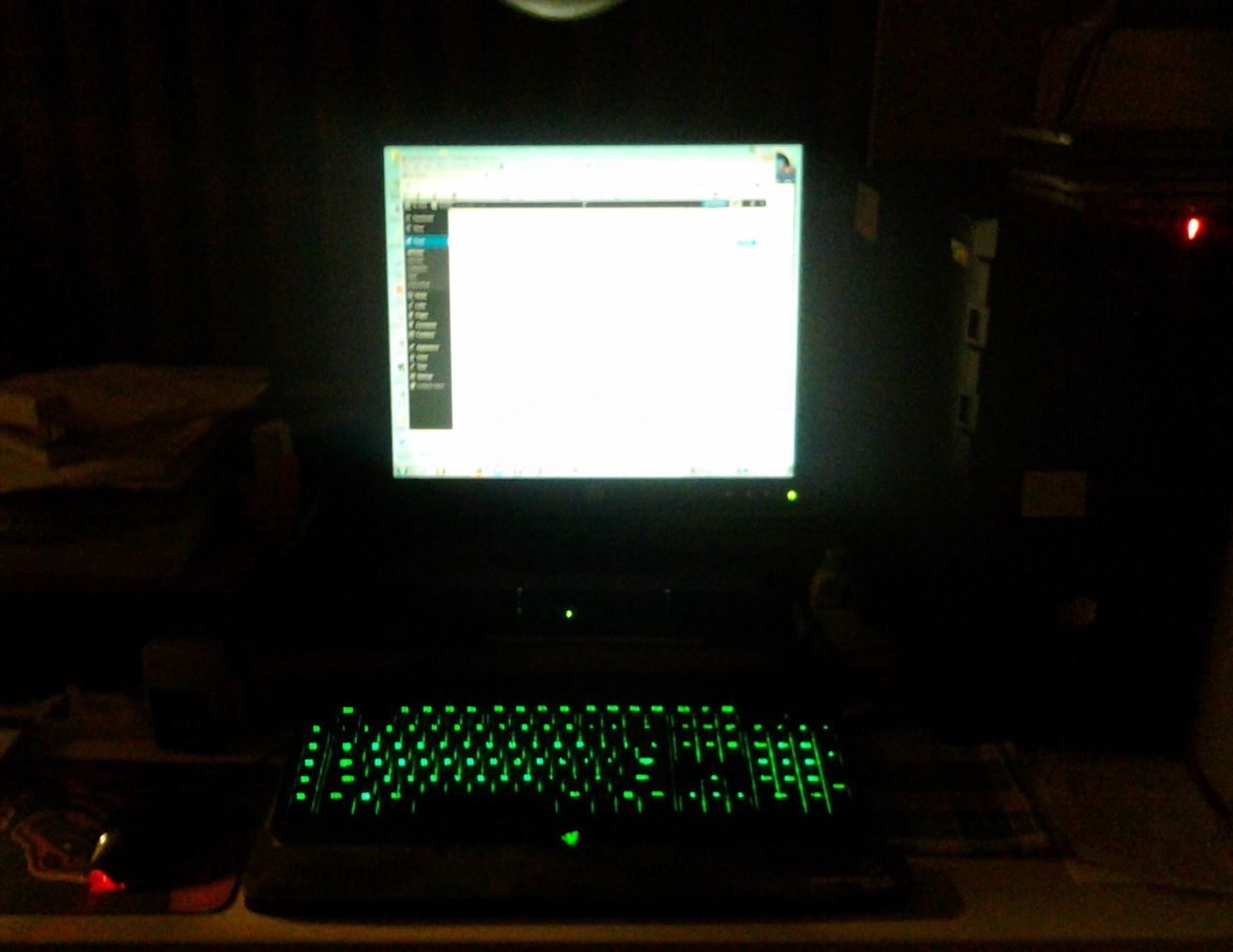
Swoopy cyborg keyboards for writers

I’m fussy about keyboards. And since my work demands that my keys do as they are told when pressed, I can’t afford a crappy keyboard.

That’s what I had until recently, when my space bar wore out on one side. I grant that it was something of a crappy keyboard to begin with, but I did not consider it so crappy it would last only a year. It still worked, but about every tenth time, it would fail to insert a space between words as desired.

If we measure anger in curse words used, and assume that I cursed 50% of the time when this happened, and figure that I type several thousand words most days, we may see that it was getting on my nerves.

It sounds so simple, right? A keyboard’s a keyboard? I suspect that every user has his or her foibles, and here are mine.

  • My keys must do as told when pressed, every time. When this does not occur, I have the disposition of a cottonmouth.
  • I must be able to pop off the stupid Windows keys, sources of so much irritation. Only Microsoft could have come up with those, and put them where literate persons might bump them by accident.
  • The board must have risers to angle it.
  • It must be rectangular, so my wrist rest will stay in place.
  • No decals; I will wear them off in a month. Painted symbols are okay; molded are much preferred.
  • Has to have the full number pad.
  • Needs the full Insert/Home/PgUp/etc. block, by itself, above the arrows like the gods intended.
  • All stupid newfangled keys (defined as anything I don’t ever want to bother with), that I cannot remove, must at least be somewhere I won’t hit them by mistake.
  • Any ergonomically cruelty-free fair trade gluten-free free-range keyboard that looks like it went through a microwave, no way.
  • Has to feel sturdy, not crappy.
  • No wireless. I do not like things that require a battery. I like real cords.
  • No touchpads. Only a technology company could think it intelligent to put a pointing device right where my thumbs are likely to hit, but I don’t even want to look at a touchpad that’s well out of my thumbs’ range. In my ideal computing life, I would never again even see a touchpad.
  • Did I mention that it mustn’t have a touchpad?

You can see why I don’t like laptop keyboards. I’m an 80 wpm typist, and I don’t normally stop every ten words. (80 is not bad, but my wife–who does not spend a tenth of the time I do on a keyboard–slaughters me at a blistering 120 wpm.) I can’t write if the keys don’t do what I say. On top of that, I’m a former bookkeeper whose fingers know where to go, and my fingers had better find the key where they expect them, without me having to send out a search party for some mystery Fn key to use the 10-key or the Delete key.

Well, it turns out that my requirements are very expensive to meet. Like $150 expensive. I did find one: the Razer Blackwidow Ultimate, a gaming keyboard that does a crapton of things I’ll probably never want, but has a number that I do:

  • Clicks. I so sorely miss the tactile click.
  • Molded symbols with backlighting.
  • Heavy enough to stay in place unless I choose to move it.

Of course, I was fool enough to assume that I could just plug in one of its two USB connectors, and that the other was for all the gaming stuff I don’t need. Didn’t work. In the end, I had to slide the machine out, shuffle the USB devices, and fiddle with all the cable re-routing. Now my keys glow with green backlit symbols, as if I were some hardcore gamer nightly dealing frags to others around the globe

And joy of joys, Windows recognized it, so I don’t have to install Razer’s software and create an account just to use this thing. At first, it looked like that might be the case.

It’s going to be fun editing people’s romance fiction, Native American historical fiction, and horror thrillers on a keyboard meant to withstand a lot of Cheeto dust in the dark.

razer

Newly published: No Circuses, by James O’Callaghan

This novel has recently been published. I was substantive editor.

I loved the story concept from the start. Written by an authoritative source (a retired Foreign Service officer), Latin American cultural nuances, subtle, informed. I am at my happiest when dealing with people who know things I do not. The protagonist finds himself assigned to direct a bi-national center, which I did not know we even had. They’re either designed to promote international friendship and understanding (if you’re idealistic), or a way to try and broadcast our policies and why people should embrace them (if you’re cynical). Our hero finds himself immersed in the culture–perhaps a bit too much. Or perhaps just the right amount.

Author Jim O’Callaghan approached me to edit the ms. I could instantly tell I was dealing with maturity and openness, someone who could and would learn, but I was also dealing with a pretty good writer. There were some baroque and wordy constructions to simplify here and there, but not outright English flaws, and that was refreshing. Perhaps the greatest thing about the story, besides his comprehensive understanding of Spanish and LatAm culture, was his gift for letting the reader find the humor. It was a long project, but as the end approached, I realized I would miss it.

I am a devotee of Andina, the musical sounds of the Andes (mostly popular in Peru, Bolivia, Ecuador, and heavily overlain with Native rhythms and language). They are heavy on guitar and pan-flute, and while I worked, I played nothing else on my MusicMonkey. When you read it, if you have any Andina, I recommend you do the same. If you find yourself desiring to try some, I suggest K’ala Marka, Nativo, Los Kjarkas, Ecuador Inkas or Savia Andina as starting points. Lively, passionate, soulful.

Jim was one of the easiest authors an editor could seek to work with. He handled himself like someone who has already been successful, and that bodes well. It’s an adventure story that pokes fun at bureaucracy, the labyrinthine ways of Latin American politics, and how things are not always as they seem. The Hemingway vibe is perceptible throughout. It has complex characters with crises, emotions and motivations; that is one area where I have nothing to teach Jim. There is no one in this book you will find difficult to picture. It has goofy and often hilarious situations, but none quite so goofy as to crack your suspension of disbelief. As I neared the end, I was convinced this was autobiographical with only names changed. It isn’t, but he had me going.

While I always hope my clients will succeed, and handsomely so, I often edit books that I would not myself purchase. I’m buying a copy of this one. If anything I’ve described sounds interesting to you, consider this one to receive an unqualified recommendation.

Blogging freelance editing, writing, and life in general. You can also Like my Facebook page for more frequent updates: J.K. Kelley, Editor.