Category Archives: Editing/writing life

About doing this stuff for a living.

Why didn’t you notice that before?

Not that I’ve ever been asked the question, but some clients may have thought it. Picture this:

You, welcomed reader, bring me your literary pride and joy for developmental editing. I examine it, see fairly early on that it has major issues to address, load it down with comments explaining those issues, and send it back to you with the recommendation that you fix them. I explain that it will cost a lot less, and be more reflective of your creativity, if you take a stab at fixing them. I had you at ‘cost a lot less,’ so you then demonstrate to me what a superb and coachable client you are by addressing them. In most cases, you ‘get it.’ Beaming, you ship me the modified ms. I edit it this time, and I include a bunch of comments about stuff I didn’t point out in the first pass (but dealt with this time). And perhaps here you wonder: how’d he miss that stuff the first time?

Let’s use an analogy to a flipper house. The carpet needs replacement. The color scheme chosen was Crazy Cat Lady Provincial. The rose bushes are out of control. The crushed rock isn’t strangling the weeds. The hot water heater has a failing thermostat, there isn’t enough insulation, and some imbecile fixed numerous nail and molly bolt holes in the wall without bothering to sand the filler. The bathroom fan is about to chuck a bearing, and so on. Oh, and no one raked leaves last year, so half the yard is dead. Except for plenty of thistles, dandelions, and morning glories.

If we’re going to turn that house into the cozy, attractive property that it could become, we are going to begin by taking care of the big stuff so that it no longer obscures the small stuff. We restrain the roses and discover that the squirrels planted a walnut sapling at their base. We pull off the baseboards and find evidence that something in the wall has leaked. We rip up the carpet and find that the previous imbecile covered up battered but beautiful hardwood. We pull out the range and learn that someone had a chronic problem with stuff boiling over and running down the sides, rotting out the subfloor.

While we are doing all that, we are not really seeing the smaller but important stuff, because the big stuff obscures it. It’s not that we are incompetent; it’s that we will notice the miniature burro in the room only when the elephant has been herded out of it.

That’s how it is, editing books. Fix the big stuff so that the small stuff can stand out, then fix that, and you have a good book. Because you don’t retexture drywall that you know you will be replacing anyway.

Swoopy cyborg keyboards for writers

I’m fussy about keyboards. And since my work demands that my keys do as they are told when pressed, I can’t afford a crappy keyboard.

That’s what I had until recently, when my space bar wore out on one side. I grant that it was something of a crappy keyboard to begin with, but I did not consider it so crappy it would last only a year. It still worked, but about every tenth time, it would fail to insert a space between words as desired.

If we measure anger in curse words used, and assume that I cursed 50% of the time when this happened, and figure that I type several thousand words most days, we may see that it was getting on my nerves.

It sounds so simple, right? A keyboard’s a keyboard? I suspect that every user has his or her foibles, and here are mine.

  • My keys must do as told when pressed, every time. When this does not occur, I have the disposition of a cottonmouth.
  • I must be able to pop off the stupid Windows keys, sources of so much irritation. Only Microsoft could have come up with those, and put them where literate persons might bump them by accident.
  • The board must have risers to angle it.
  • It must be rectangular, so my wrist rest will stay in place.
  • No decals; I will wear them off in a month. Painted symbols are okay; molded are much preferred.
  • Has to have the full number pad.
  • Needs the full Insert/Home/PgUp/etc. block, by itself, above the arrows like the gods intended.
  • All stupid newfangled keys (defined as anything I don’t ever want to bother with), that I cannot remove, must at least be somewhere I won’t hit them by mistake.
  • Any ergonomically cruelty-free fair trade gluten-free free-range keyboard that looks like it went through a microwave, no way.
  • Has to feel sturdy, not crappy.
  • No wireless. I do not like things that require a battery. I like real cords.
  • No touchpads. Only a technology company could think it intelligent to put a pointing device right where my thumbs are likely to hit, but I don’t even want to look at a touchpad that’s well out of my thumbs’ range. In my ideal computing life, I would never again even see a touchpad.
  • Did I mention that it mustn’t have a touchpad?

You can see why I don’t like laptop keyboards. I’m an 80 wpm typist, and I don’t normally stop every ten words. (80 is not bad, but my wife–who does not spend a tenth of the time I do on a keyboard–slaughters me at a blistering 120 wpm.) I can’t write if the keys don’t do what I say. On top of that, I’m a former bookkeeper whose fingers know where to go, and my fingers had better find the key where they expect them, without me having to send out a search party for some mystery Fn key to use the 10-key or the Delete key.

Well, it turns out that my requirements are very expensive to meet. Like $150 expensive. I did find one: the Razer Blackwidow Ultimate, a gaming keyboard that does a crapton of things I’ll probably never want, but has a number that I do:

  • Clicks. I so sorely miss the tactile click.
  • Molded symbols with backlighting.
  • Heavy enough to stay in place unless I choose to move it.

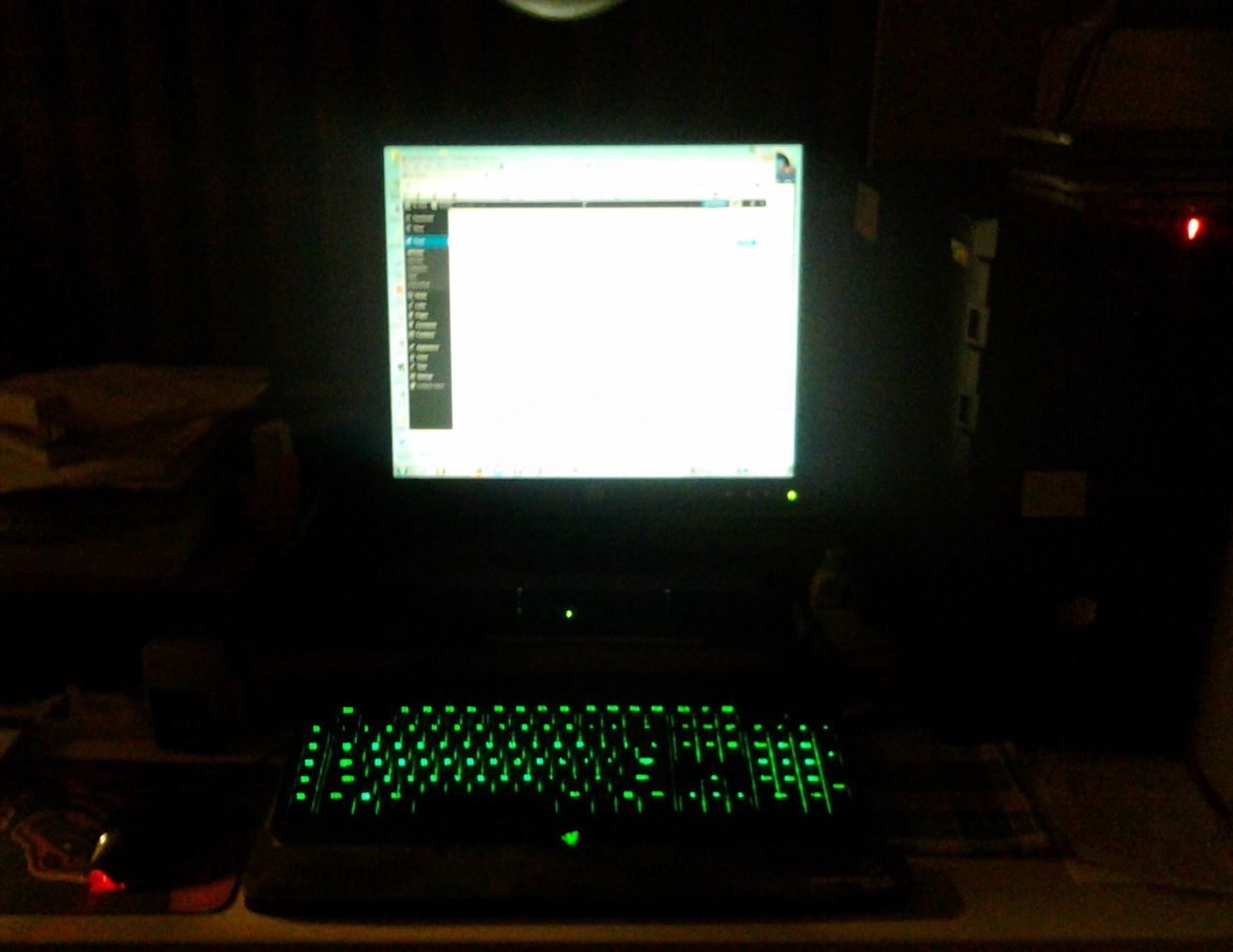
Of course, I was fool enough to assume that I could just plug in one of its two USB connectors, and that the other was for all the gaming stuff I don’t need. Didn’t work. In the end, I had to slide the machine out, shuffle the USB devices, and fiddle with all the cable re-routing. Now my keys glow with green backlit symbols, as if I were some hardcore gamer nightly dealing frags to others around the globe

And joy of joys, Windows recognized it, so I don’t have to install Razer’s software and create an account just to use this thing. At first, it looked like that might be the case.

It’s going to be fun editing people’s romance fiction, Native American historical fiction, and horror thrillers on a keyboard meant to withstand a lot of Cheeto dust in the dark.

razer

Newly published: No Circuses, by James O’Callaghan

This novel has recently been published. I was substantive editor.

I loved the story concept from the start. Written by an authoritative source (a retired Foreign Service officer), Latin American cultural nuances, subtle, informed. I am at my happiest when dealing with people who know things I do not. The protagonist finds himself assigned to direct a bi-national center, which I did not know we even had. They’re either designed to promote international friendship and understanding (if you’re idealistic), or a way to try and broadcast our policies and why people should embrace them (if you’re cynical). Our hero finds himself immersed in the culture–perhaps a bit too much. Or perhaps just the right amount.

Author Jim O’Callaghan approached me to edit the ms. I could instantly tell I was dealing with maturity and openness, someone who could and would learn, but I was also dealing with a pretty good writer. There were some baroque and wordy constructions to simplify here and there, but not outright English flaws, and that was refreshing. Perhaps the greatest thing about the story, besides his comprehensive understanding of Spanish and LatAm culture, was his gift for letting the reader find the humor. It was a long project, but as the end approached, I realized I would miss it.

I am a devotee of Andina, the musical sounds of the Andes (mostly popular in Peru, Bolivia, Ecuador, and heavily overlain with Native rhythms and language). They are heavy on guitar and pan-flute, and while I worked, I played nothing else on my MusicMonkey. When you read it, if you have any Andina, I recommend you do the same. If you find yourself desiring to try some, I suggest K’ala Marka, Nativo, Los Kjarkas, Ecuador Inkas or Savia Andina as starting points. Lively, passionate, soulful.

Jim was one of the easiest authors an editor could seek to work with. He handled himself like someone who has already been successful, and that bodes well. It’s an adventure story that pokes fun at bureaucracy, the labyrinthine ways of Latin American politics, and how things are not always as they seem. The Hemingway vibe is perceptible throughout. It has complex characters with crises, emotions and motivations; that is one area where I have nothing to teach Jim. There is no one in this book you will find difficult to picture. It has goofy and often hilarious situations, but none quite so goofy as to crack your suspension of disbelief. As I neared the end, I was convinced this was autobiographical with only names changed. It isn’t, but he had me going.

While I always hope my clients will succeed, and handsomely so, I often edit books that I would not myself purchase. I’m buying a copy of this one. If anything I’ve described sounds interesting to you, consider this one to receive an unqualified recommendation.

The client question I dread most

No, it is not, “Where do you get your ideas?” It is not, “Now that I have gone through and torn apart your completed editing work, will you re-edit it for free?” And it is not even, “Will you look at my child’s writing and give her a critique?” It is not, “How do you deal with writer’s block?”

Not that I don’t dread those questions; I do. But for all of them there are responsive answers to offer: ‘from life,’ ‘not for free, nope,’ ‘only if you understand that I will lie,’ and ‘it doesn’t exist.’ For this one there is no good answer:

“How do I do that in Word?”

You might be amazed at how often clients look to me for Word tech support: on how to enable this feature, or make that go away, in a Word document. Often I am their first point of call, and it does not occur to them that I dread the question.

Perhaps the assumption is that I’m a Word expert, and that I have mental models of every version of Word since Word 97 to summon forth. What else can I assume?

So why do I not just say “no, not my line of work?” Because that come across as bad customer service. It doesn’t matter that the expectation is unreasonable. How I feel is beside the point. If I say what I am thinking, the client will think I’m a jerk, unhelpful, and crabby. That’s no good. Most clients find me easy to work with, helpful, and cheerful, and that’s important to me.

But life is not fair. As an editor, at one point or another in the relationship, every client will ask me for Word tech support, and I will have to attempt to offer it, and if I cannot do it with a happy smile, I must at least muffle the curse words and replace the grimace with a mask of calm. Never mind that I feel like a flight attendant who has just been handed a baby and asked to change the diaper.

What’s the big deal? Why all the stress and dread? Because:

  • I am incompetent at it, I know this, and being inept is intensely uncomfortable for a person who takes pride in capability.
  • I don’t want to become competent at it. I’m an editor, not a technical guru. All I want from my word processor is that it serve my work functions. I don’t want to be the Word Answer Man. I want to help people perfect their brainchildren, combining candor with consideration and camaraderie.
  • I used to be a computer shaman, and came to hate it, and when I left that line of work, my mind and heart left it behind. When I have a computer problem of my own, I don’t go very far trying to solve it myself. I call the tech support guy I know in Utah who does a fantastic job (that’s Ray Ross of Bugzap), and I do whatever he says to do.

So why is it impractical? Why can’t I just joyously answer the formatting question and be happy to be helpful? Because:

  • The client and I are probably not using the same version of Word, nor will we be, because Word gets worse with every new version. I’m using Word 2002 and will not switch unless/until forced, and if forced, may end up switching to a Mac. With each new version, MS rethinks the names of some concepts, and moves some features around so that one no longer knows where to find them, and calls that an ‘upgrade.’ I don’t have time or patience to go on a new treasure hunt every year, paying for the privilege, so I am not ‘upgrading.’ Neither should most people.
  • Clients vary in technical know-how, but writers often seem to take a perverse pride in technical dufosity. Most computer users don’t even know the real meanings of words like ‘login,’ ‘download,’ ‘malware,’ and even ‘word processor,’ thus often we do not even begin by speaking in the same terminology. It is a weakness of mine, related to my line of work, that I count upon knowing exactly what words mean.
  • Since we are probably not using the same version of Word, I can’t know what s/he is seeing, or where/how to tell him or her to start looking. I can, with laborious effort, explain in some cases how it is done in Word 2002. But if it’s Word-flaky, I can’t answer why theirs isn’t working like mine.
  • Since that is the case, the client will probably still have questions, which I can’t answer. I will look useless, feel uncomfortable, and silently dislike the unfairness of the situation, powerless to change it.
  • If on the other hand my help does solve the problem, the client may decide that I am a Word Deity, and may even come to depend on me for Word tech support in the future, since that went so well.

Thus, there is no good outcome for me.

What do I wish people would do? Join a discussion forum about Word. Many are staffed by actual Microserfs, or people blessed by the company. I don’t know of a specific one to suggest, but I know they are there. When I find myself confounded, here’s what I do (or would do if need be):

  • Save a backup copy of your document beforehand. Now you can experiment and butcher it to your heart’s content, because you have a fallback position.
  • Check Word help, though it will probably be irrelevant and clunky. I marvel at how much worse they have managed to make it.
  • If you think it’s a technical problem with Word, restart your machine and try it from a fresh Windows and Word session with nothing else going, just to rule out some potential conflict sources.
  • Use the exact terms Word uses, and feed your problem to a search engine. That will probably lead you to the MS Knowledge Base, or to a message board discussion about the situation, where someone already solved this for someone else. Be sure to include your version of Word in the search, but when the search turns up solutions that seem to apply to other versions, try to run with them.
  • Sign onto one of the message boards that seemed to have the most helpful people. Read the FAQ in case you are about to become the 101,000th newbie to ask this question; it may solve your problem. Be prepared for very brief, direct questions and answers; gurus don’t waste lots of time. Be prepared also for at least a few people who don’t read your post with attention to detail. List your version of Windows, your version of Word, the type of document, what you are trying to do, and if necessary, take a screenie of the problem, using these instructions. Explore anything they suggest.

Some other generally-sound-practice technical tips, while I’m at it:

  • Always save a copy of your work before doing anything daring, so you can revert if you butcher it.
  • There are two types of computer users who do not back up their data files: those who have lost data that way and do not learn from their mistakes, and those who are waiting for doomsday.
  • Just because software offers you an update does not mean it’s always an upgrade. There are exceptions, but the usual result is everything gets moved around and you gain nothing new. Firefox is the poster child for software that gets worse with every new version.
  • If you do not keep a virus scanner updated and current, you are just waiting for the suffering. If you take my advice, you’ll either go with Panda AVG for a free version, or for a powerful pay version worth every penny, Eset’s NOD32. That’s what I use. When I hear that someone got a free trial of McAfee and just stayed with that after the trial period expired, that’s someone I’m expecting to hear got a virus.
  • Not everything your computer vendor pre-installed is garbage, but a lot of it is free trials, tutorials you will never use, and other whizbang stuff from which you can not benefit. Always be careful (like the time I uninstalled a network speed monitor and it took my Internet access with it), but a lot of that is just crapola that can be uninstalled.

New release: Second Chance Wedding, by Shawn Inmon

Let’s ring in the new year with a new release.

This novella is the fifth and concluding piece in Shawn’s Second Chance Romance series. I was substantive editor.

I don’t recall the point at which Shawn decided to make this a series, but it’s a good one. All along, I have been urging him to resist the temptation to let the story be too derivative of his first book, a non-fiction true romance. While this is inarguably inspired by that story, it’s pleasing that he has diverged a great deal from its concept. He has built up a number of interesting supporting characters, and shows a gift for seeing the comedy in everyday things that are ridiculous when we consider them.

When he sent me the plot digest, I responded by asking (paraphrased): “So are you changing the title to Second Chance Wedding Planning? Because that’s about all you have here.” Shawn is an exceptionally coachable author who gets fuller value from my services than any other client I have, and he went back to work. In so doing, he expanded the story by 50%, though I brought that down to about 30% in editing. The outcome is a very clean conclusion that introduces new players, has conflict and suspense, and does a nice job of setting up a sequel novel if Shawn decides to go that route. I hope and suspect that he will.

Lastly, I want to thank you all for your readership in 2014. I enjoy a thoughtful, kind, and intelligent reader base here at The ‘Lancer. May your 2015 be the best year yet for you all.

Filtering referrals

Today, I give myself a little permission to wander and reminisce.

Where possible, I think most of us prefer to select vendors and providers by referrals. There’s only one problem with that: motive.

Many years ago, I served in the trenches of the IBM/Microsoft War as the rough equivalent of a corporal. I did this in downtown Bellevue, Washington, about five miles from the Microsoft campus in Redmond. It was easy to tell a fully vested Microsoft guy, because he was likely to come in looking like hell, spend a few thousand dollars at whatever price you quoted, and do wonders for your numbers. I made $500 per month plus 15% of the gross profit on whatever I sold, which meant that if my margin (profit) stayed good and I had a good December, $30K per year was achievable enough. Like most sales-driven organizations, the sales staff ran the store, and functioned as the default executive committee. Whoever generated the most money for the company had the most say. As I look back, it was a sign of the owner’s wisdom that he took such good care of the non-commissioned support staff. Had he not done so, we would have been tyrants.

The owner was an American success story. As I understood the history, his family had fled the Chinese mainland for Taiwan with the Kuomintang when the Nationalists lost the Chinese Civil War to the Communists. They had killed his father. The family had emigrated to the United States, where young Chang Te-Lung–whom I would know as just ‘Telung’–became a Hoosier, and a Boeing electrical engineer. As he would remind me now and then, Mr. Chang had been an American citizen longer than I had. Sometime in the early days of the PC revolution, he and his wife Mei-O had started a retail PC business, which had grown through a combination of hard work and Mr. Chang’s technical understanding of electronics. By the time he hired me, I think he had about twenty-five employees, nine of whom were sales staff.

Mr. Chang had some eccentricities, including a certain amount of preachiness about his Buddhist beliefs, and was a man of his times in terms of mild general prejudices, but he was also a hell of a businessman and a fundamentally good man. When I decided it was time for me to move on, he offered to list my reason for leaving as ‘position eliminated,’ so that I could collect unemployment. Later, when I became a bookkeeper and began paying payroll taxes, I understood that this had been a very generous gesture on his part. Mr. Chang has passed on in recent years, and I miss him. I learned about a third as much from him as I would have had I been more mature and less selfish, but even that third made a difference.

In those days, for me, referrals had far less to do with “This provider provides excellent products and/or services” and more often meant “I see an opportunity to send some business this provider’s way.” You might say that I tended to be in referral debt, and was always trying to find ways to catch up. Now I’m in the same position, fielding the same referrals. I am gearing up to sell a house. Everyone I know has an agent s/he wants me to call. Almost none of those I have called have impressed me; most have just chanted the usual fifteen minutes of real estate bullshit, then seemed irritated when I asked anything of substance.

It was immature, certainly. I should have made referrals based only upon my perception of the person’s best interest seeking goods or services. And nowadays, in more mature years, I do. I learned yesterday that a typesetter has completely jacked around a client of mine. When you demand advance payment before releasing inferior work, full of mistakes, you do bad business. I don’t even know this typesetter’s full name yet, but I can tell you two things:

  • Nearly every new client asks me where to go for typesetting. I need capable typesetters to whom I may refer clients.
  • I will make sure I get her full name, so I make sure never to send anyone to her. She has also tarnished the name of her referrer.

That also is part of the dance: referrals reflect back.

So, the moral here is this: when someone tries to refer you to a friend, take a look at who that someone is. Is s/he in sales? If so, is s/he in a mode of needing to make sure one hand washes the other, in a way that could mean that s/he made the referral simply because they are in the same Leads Club (every Tuesday morning at Denny’s)? If so, then it’s questionable. Because with certain people in certain economic situations, it’s not disinterested. My home inspector tried to steer me to a listing agent. I heard nothing from that agent that would make me see why I should be impressed. I do know for sure that home inspectors get a lot of referrals from agents, and this inspector won’t get the chance to make any more money from me in life, so he must look to those from whom he can. That’s why the referral. It has nothing to do with actual endorsement of a blowhard part-timer who can’t even mail a damn business card when asked.

Have a great Christmas Eve, and remember: a lot of folks tonight will turn keys in cars when not in condition to drive. I hope that the ‘Lancer’s faithful will not be among them. Be safe, and ride only with those who also be safe.

How writing can warp your perspective on life

It is so. It can. Take that from someone who spends a lot of time in the locker room with authors, and hears what they say when the public is not listening.

The locker room analogy isn’t accidental. Please consider this: being an author is much like being a professional or collegiate athlete. For the author, hours, days, months, years go into a public performance: a book, which will tend to cause people to read and react.

The read might take a few hours to a few days of the reader’s time, then she’s on to the next book. If the reader feels compelled to comment, she does. She might be knowledgeable; she might not. She might be fair; she might not. She might have understood what the author was trying to do; she might not have. But she did the equivalent of buying her ticket. She gets a seat in the stadium, from which she can watch the game. As long as she doesn’t make death threats or throw bottles or urinate in the aisle, she can react as she wishes. She can yell “you’re a bum!” She can stomp her feet, clap, gush approval, boo her lungs out. She can sit there and eat her nachos in silence. Fairness, kindness, patience are all choices she can make or not, without penalty. She’s the reader, the audience, the customer.

So imagine the author as a college football tailback. In order to perform for a total of thirty minutes before the public, 12-14 times in a year, she worked nearly every day for nine months. She lifted weights until she sagged in exhaustion. She ran sprints, miles, agility drills. Her coach tried to teach her techniques, and she tried to learn them. Some she resisted, some she embraced, and some she didn’t understand worth a damn. She studied thick playbooks with pages of diagrams that looked like a drunk, amnesiac tic tac toe game covered in cold cooked spaghetti. She watched endless hours of game film, with a high concentration on her own past errors. If she invested four hours per day for nine months, we might guess that she strained, sweated, grunted, cursed, wept, self-criticized, self-pushed, self-doubted, for something like a thousand hours of her life. That was in addition to the basics of normal life, for which she was also responsible. Whether she felt like it or not, she had to keep at it. And that’s just the summary of the off-season; in season, it might be more. This enabled her to compete with others (who did everything she did) for the right to compete against others (most of whom worked just as hard, some harder) for, at most, thirty minutes 12-14 times a year, with an audience of thousands or millions.

If she gets hit by three Neanderthals and fumbles inside her own 20-yardline, that one bit of her life might be all that millions of people remember of her thirty minutes of performance that day, into which a thousand hours of preparation poured. And if she makes one great, prescient cut and juke that busts loose a seventy-yard run, that will be the snapshot of her life the audience will retain.

And if, when booed or insufficiently applauded, she feels the urge to stand before the public and yell: “You goddamn idiots! You don’t even know what play we had on! I didn’t call that play! I had only an instant to react! The linebacker made a superhuman effort! On top of it, I was still a little rung up from the defensive tackles that landed on me forty seconds ago! Someone else blew an assignment! You don’t even know what the hell’s going on out here, or what it took me to be here and perform for you! All of y’all can go to hell!” can we blame her?

We can and we will, unfair though it is to her. Not for having the feelings, but for doing the one thing capable of making her situation worse. The performer has no say in the composition of the public, and that’s one reason not everyone is cut out to perform. The public is also the customer. The customer isn’t always right; for the most part, the customer is wrong. Unfortunately, the customer nearly always gets away with being wrong, and it’s bad form to come out and prove her wrong.

Welcome to the author’s world: a place where the best way to make a bad situation worse is to speak your mind.

Case in point: Ayelet (free pronunciation help: ah-YELL-ett) Waldman. She is a successful novelist, and this isn’t her first controversy, but it’s a lulu. If you want to read the short version with examples, go here. We should realize that this isn’t “why doesn’t anyone buy my book.” This is “how could my already successful book be left off this very select, prestigious list?” Going back to the athlete analogy, this isn’t “why am I still stuck covering kickoffs and playing target on the scout team.” This is “how can I not be first team All-Conference?”

And in that situation, Waldman did the one thing that could creatively make an unsatisfactory situation worse for herself. She took to the media to call out the people who make up the All-Novelist team for not making her a first-team pick. This isn’t going to get her what she wants. Once she did that, even the knowledgeable minority–those who were prone to factor in the thousand hours of suffering and stress that created her book–shook their heads. Tsk, tsk. Shouldn’t have done it, Ms. Waldman. And that’s those who know. The vast majority, who do not, react even less to her advantage.

Because when an author has a public tantrum, it ceases to be about her work, and becomes about the tantrum.

That’s why you never do that. Never respond to a negative review. Especially never throw a hissy fit because you are left off a high-profile list. Keep that locker-room talk in the locker room, where those around you understand. Kick a locker. Throw your gear. If you must, avoid the media. But don’t lose it in public.

The public will crucify you and desecrate your corpse. And then they will be disrespectful, and you’ll become a meme, like Laurell K. Hamilton’s infamous Dear Negative Reader blog post.

Powell’s

Powell’s is a bookstore in Portland, Oregon.

This is a bit like saying that the Smithsonian Institution is a museum in Washington, District of Columbia: factually correct, but grossly understating the case.

I am aware that the readership will now divide into two categories: those who have seen it, and can verify that I’m not exaggerating in the least, and those who have not. Some of the latter may suspect that I am embellishing. If so, it is accidental. I am making a conscientious effort to stick to the facts.

For everyone who thinks that dead tree publishing is just dead, period, I offer you Powell’s. And not just because it’s a huge bookstore with multiple locations, but because it’s doing well in the Amazon and Kindle era. With smart, helpful employees. Of course, it does help the employees that most are working in what they consider paradise. Many of the customers arrive in wonderful, even spiritual frames of mind, as if entering a library, and are in a mood to treat the staff as temple caretakers, so it’s a good place to work retail.

The physical facts: the main Powell’s location in downtown Portland is about a five-minute walk from where the high-speed rail lets you off, past numerous exotic food trucks (I tried Georgian), to a three-story building that takes up an entire city block. It sells books, used and new, and very little else. I would estimate the shelves at ten feet high, all wood. Newcomers do well to accept a free map of the color-coded sections. It has clean bathrooms, wide aisles, places to sit down and rest a bit, and a rare book room. While you will find at Powell’s a copy of any current and popular book you seek, the hidden beauty is what you find that you did not know existed. It is a marvelous place for subject readers, especially if books on the subject tend to stay out of print once sales fade.

Take travel essays. I read a lot of travel essays. I’m not so much the Bruce Chatwin and Paul Theroux type; more the Tim Cahill, Tim Severin, Tony Perrottet, and Tony Horwitz type. (What is it about those two first names that seems to indicate a book I will like?) It combines a true adventure story with cultural and geographic learning. When I go to Barnes, and I still do, the Travel Essays section occupies one segment (roughly 4′ wide) of shelves about six feet high, and stuff I’ve already read or do not plan to read dominates it. Everything by Frances Mayes about Tuscany. Everything by everyone else about the glories of Tuscany. More about Tuscany. Anthologies themed on a region or gender. Titles designed to make the author out to be a badass, which he really isn’t. Titles meant to sound cute, but which would sound cute only to the sort of person who would never read a travel essay. Plenty of ways to learn that Paris is a major city with eight figures of population and lots of dog waste. Never a shortage of Bill Bryson’s prissiness. Still more about Tuscany.

Travel essays at Powell’s? About four or five segments of shelves ten feet high. Everything Barnes had, plus more: old hardbacks about people who did Brazil in the 1930s, or south Asia in the 1920s, and more. Might find Pico Ayer or Shiva Naipaul; Sven Hedin, Freya Stark. Best of all, you might find someone whose book has been out of print since before your birth, or who wrote about someplace besides Tuscany or Paris. And unlike Barnes, Powell’s isn’t likely to mistake Horwitz’s Confederates in the Attic for a Civil War history book due to the title, or his Midnight Rising for a travel book due to the author’s past body of work. Powell’s employees might actually open the book and use their brains. And once you get them home, Powell’s price tags peel off without leaving a mess.

Powell’s has two major satellite locations, plus a few minor ones. I have been to the Beaverton satellite, and it’s about the size of a Costco. If one uses the costco (symbol [c], perhaps) as a measuring unit for gigantic stores, I would estimate the downtown Powell’s as a 3[c] store. If the Hawthorne location is anything like the Beaverton cavern, you could spend a day there alone. And that’s good for me, because downtowns are not normally places I like to be. All that urban vibrancy, rapid pulse, people-watching quirkiness that you find right at the heart of the action? Lost on me. I lived in Seattle for sixteen years. When I worked downtown, I went downtown in the morning and escaped in the evening. If I went at any other time, it was because I had a girlfriend or guests who liked downtowns. I probably took less than eight solo non-commute trips downtown in sixteen years, and I believe I overdid it.

While I will never tire of loving up on Powell’s, in this day and age one may reasonably ask: how do they stay in business? I think I have it figured out. If you find business icky, you can skip this para. You will not find a lot of deeply discounted used books at Powell’s. This is not Half Price Books, or Hastings, or Amazon sellers who put it out there for $0.01 plus $3.99 shipping. I do not know how cheaply they buy, but they do not have mega-low prices. Powell’s seems to assume that if you want the book, $8 or $12 won’t bother you. Their continued existence says that they’re onto something; it’s not just about ‘give me the best price even if my experience sucks,’ in spite of the conventional wisdom of airlines, Walmart, and so on. Powell’s also has unionized employees, and while the company handled the unionization better than many, there have been conflicts and layoffs. I don’t know what the pay and benefits are like, but I suspect they are not lavish. Part of the answer, therefore, to the business survival question is that staffing costs remain in check. Powell’s evidently was/is no sweatshop, but at least at one point, there were enough issues for employees to organize a union in spite of all social trends to the contrary.

That said, I would bet it’s a happier workplace than Barnes & Noble. While I’m not wishing any bookstores gone, even Hastings, former and current B&N employees I have spoken with fall into two categories:

1) Those who said it was a job full of callous management indifference, low pay, scrambled hours, inordinate pressure to sell memberships, and poor advancement opportunities.

2) Um…haven’t heard anyone tell me s/he liked working there. The employee discount, yes, but not the job.

If you read–and you wouldn’t be here if you didn’t–Powell’s is the most important stop on your trip to Portland.

It was enough to get me to desire to be in a downtown.
Why I don’t take Paypal

Not long ago, I had an editorial project in which the client pretty much needed to pay by credit card. Mostly because I figured it was something I’d have to make possible from a business standpoint sooner or later, I made a commitment to signing up with Paypal to accept credit cards.

Before I’d ever billed anyone through Paypal, I came to dislike them. I had some concerns about the information they required and the steps they took to set up the account, and after a couple of dismissive phone conversations with representatives, I already doubted this relationship was going to work. However, it was a way to accept credit cards, and I had agreed to do that, so I had to hold my nose and prepare for it. Maybe it wouldn’t be so bad; maybe I was through the annoying part.

Months passed, I did the work, great client relationship. Coachable author, great story, happy times. When I completed the edit, the time came to get paid. I created the invoice in the approved fashion, and my client paid promptly. The resulting fee, deducted from my proceeds, came to $50. While I had known it would be about that, I mention it to make the point: at this juncture, they are a paid service provider, and I’m paying the bill, and the question here is: what value do I get for my $50?

Paypal advised me that I could not have the money yet, but that the ‘approval’ should take 24 hours or less. It took so near to 24 hours that one suspects there was no actual process, just hanging onto the money for a day’s float. All right, fine; then I checked in, and found that I had to affirm that I’d provided the services. Oh, brother…but I did. (If I had not, does one suppose there would be a client payment waiting?) And now I am told that my funds will be available in twenty-one days.

This is what my $50 bought. It also bought a rather unhappy client, which I cannot afford. I didn’t ask about all the details, but the client said: “The thing made us practically sign away our firstborn to make that payment.” That’s not the way I treat my clients, nor am I at all happy that it was done by an agency I paid $50 to act on my behalf. I just hired service my client did not appreciate, and it reflects on me, and while I may not have dictated the behavior, the responsibility is still mine. I chose and paid the service provider.

So if you’re thinking of signing up to take Paypal, it looks like what you can expect is for your client to get a runaround, and if all goes perfectly, you can have your money twenty-two days from date of actual payment. While Paypal gets to hold onto your money for all that time, you pay them not quite 3% of your proceeds for all this great service. Just because that’s pretty much the standard Visa fee does not make this a good deal. It’s only a good deal if everyone gets great service.

To me, this wasn’t worth $50. This is the last time I am doing this, because neither I nor my client is happy.

Why don’t I just tack on a fee and keep taking Paypal? Now that would be even worse client service. “Hi. My payment provider is going to annoy you. And just to make your day even brighter, you have to pay the fee they charge.” That is exactly the screw-the-customer mentality I’ve been cursing for years in corporate America, and where the matter is left up to me to decide, I refuse to perpetuate it.

Therefore, once I get this money safely away from Paypal, I will close that account. While it would add convenience for some clients for me to accept credit card payments, the associated aggravation–including where I either choose to screw the client or get screwed myself–is not worth it for any of us.

The stock response from the is “if you don’t like their policy, don’t use the service.” Not to worry. And no, when I cancel it, I am not going to tell them why. At least, not for free.

If they want to know why, the fee is $60. And they may have their answer in twenty-one days. And I will not accept payment via Paypal.

PS: the saga continues. To their somewhat credit, I got a notice that my money would be released sooner. When I got home, I attempted it and discovered that, unless I also give them my SSN and link the account to a credit card, I can only withdraw $500 per month.

Cold day in hell before I give them one more bit of sensitive information. This is hostage-taking.

I should have all my money by March. Isn’t this just marvelous?

PPS: called to see if closing the account outright would get me paid in full. The rep seemed able to lift the $500 limit at that point. Imagine that. Suddenly I am able to ask to have all the money in my account. I have minimal faith that I will actually see it there.

The difficulties inherent in ‘semi-autobiographical’ writing work

I’d say that the majority of mss that come my way are semi-autobiographical fiction. I do not think that the authors realize the issues involved. The words ‘based on’ are the first signal. The second signal is when I get an hedgy answer to “is it fiction or non-fiction?”

Why is it such a frequent choice? Some of the following reasons may apply:

  • They want to write their own stories, or something akin to them, but with added fictitious events. Which raises the question: why add fiction, if the real story is interesting enough? The answer is that most of our real lives are more interesting to us, and to our loved ones, than to people who don’t know us (the paying customers).
  • It’s easier to use characters, places, situations and events they know; creating them is harder. Perhaps they were told ‘write what you know,’ and misunderstood what that meant.
  • They have a point they want to make, but do not want to do it in non-fiction, for whatever reason: privacy, liability, etc. That’s probably the most understandable reason, but it might be preferable to present it as non-fiction with some locations and participants changed.

Compare two sentences, and let me know which is easier to support:

  1. Everyone has a story, and if it feels good to write it, s/he should do so.
  2. Everyone’s story is equally marketable and fascinating to the audience, which is everyone.

Put less gently, we have a tremendous species tendency toward believing that our life stories are marketably interesting. And, perhaps, they are–to that small minority who are collectors of life stories. The other 314 million Americans need something beyond ‘but it’s my story.’ Absent that extra something, your audience was just pared down over 99%.

Long as people don’t mind that, they should continue the way they’re doing. But know: the first major storytelling divide is that between fiction and non-fiction. There is no true ‘semi-fiction.’ One asserts that the story is true, or does not.

In fiction, no one is asserting truth. The characters may be modified. The plot can change. Not only can we lie, it’s our job to lie in the most engrossing way possible. The reader accepts this, sets her bullshit detector on ‘plausible under the postulated circumstances,’ and takes a trip to a land of fancy.

In non-fiction, we invent nothing, unless we so specify and have a credible reason. What happened, happened. If we want to use pseudonyms, we indicate that we have done so. If we must reconstruct and approximate dialogue, not being ourselves eidetic, we admit this. We may leave out events as long as the choice does not slant the story away from fact, but we cannot make any up. There are no characters to create, simply participants to describe. The ending is as it occurred. We defy anyone to sue, for we assert that this is how it happened. The reader’s bullshit detector is set on ‘even a whiff will make me doubt every word.’

So what’s the matter? If it’s semi-autobiographical, why can’t we just label it fiction-with-winking? In fact, we must call it fiction. It is fiction. As the umpire said: they ain’t no close calls; they is either this or that. And from an editing standpoint, it’s fiction with a ball and chain attached. As editor, the shackle goes on my leg.

  • What if the events are very personal to the author? S/he may veto changes to the events, even if they make bad fiction, because they may be the reason s/he sat down to write.
  • What if it would make a better story for this character to do something unadmirable? Sorry, that’s his or her daughter: “No way would my daughter do that!” In fact, in fiction, it isn’t his or her daughter. It’s a fictional character in an untrue story, and for good story development, we have to be able to make her do whatever we want.
  • What if the author reaches very personal events where s/he very obviously breaks the fourth wall, and is clearly venting from the soul? How do I tell the author that this is unsuitable narrative and needs to be removed? “But I hurt BAD! I need to say this!” What will happen when I advise the author that this is amateurish and a turnoff, and that we are forgetting the ‘fiction’ part?
  • How am I going to tell the author anything about his or her protag? If adverse, that will come as a personal insult. It shouldn’t, in fiction; it’s okay to size up any character any way we want. But with semi-autobiographical, the little boundaries stymie such frank editorial assessments.
  • If we need the story spiced up, how’s an editor supposed to tell that to the semi-autobiographer? “‘Your’ life isn’t that exciting. Could we arrange for ‘you’ to empty a pistol into ‘someone?'” What kind of response will that likely elicit?

It is not that semi-autobiographical storytelling is an automatic nyet. It is not that it cannot be good. It is not that I don’t ever want to see or read or edit any again. I understand the motivations.

I also understand that I can’t talk anyone out of it. You’ve already written it, or already plan to write it. Thus, please take it with a smile and simple realism when I acknowledge that you will therefore ignore any suggestion from me that you change this course. If a person wants to write something, and has his or her mind made up about what it will be, the person will tune out everything but encouragement and approval. I don’t necessarily think that’s a bad thing. I simply mention that I anticipate it, based upon experience, and that this is why I get so much semi-autobiographical fiction, and why my view of it begins with a certain skepticism about the prospects.

On to the helpful part. If a non-fiction presentation is unpalatable to you, and you want to write semi-autobiographical fiction anyway, but without the blinders that say “everyone wants to pay to read everyone’s story and that includes mine,” what ought you to do?

  • Classify it as fiction, without qualifiers, and resolve that no character or event is more sacred than the goal of quality storytelling.
  • Depersonalize the ‘you’ in the story, and ‘your’ loved ones, enough that we can speak of them as professionals, editor and author, without you taking offense. If I can tell you that your protagonist needs serious counseling, or belongs behind bars, and that won’t hurt your feelings, you have succeeded.
  • Do as much outright character invention as you can. This is fiction, so you may do this, and are encouraged to do it well. ‘Write what you know’ refers to regions, professions, hobbies, languages, and other esoterica where you can ring authentic without effort. It doesn’t mean to limit yourself to people whose actions you can predict because you know them. But show the reader that you can invent compelling characters, and show the editor that we may alter them if we can think of a better way.

Do those things, conscientiously, and you maximize our ability to turn your brainchild into something you can be proud to have authored.