All posts by jkkblog

I'm a freelance editor and writer with a background in history and foreign languages.

Why I don’t have or want a so-called “smartphone”

It may come to pass that I am the last holdout in this area. This bewilders all but a handful of those I know. How could I possibly not want one of these devices? They act as though this were a Luddite decision, a sort of insanity, Old Grumpness lived out.

Not so.

I use technology (such as now) when I see the benefit from it. What I never do is adopt technology for the sake of technology. If the corporate world holds up an object and says, “This is what you get now,” most people just say “okay” and buy it. I do not. Instead of assuming that the corporation is presenting me A Good Thing, I assume the corporation is my adversary and never has my interests at heart. And that’s fair; if it were up to me, the corporation would probably see some dark days (and worse ones when it actually sinned), so I can’t expect it to mean me honest fairness when I mean it anything but.

So we begin with me thinking the corporation considers me too mindless to do anything but Just Buy Now, and me looking at the corporation like a suspicious car lurking in front of my house or Jehovah’s Witnesses standing on my front steps. It means I will think most critically about whether I want the thing. The corporation does not enjoy the presumption of honest intentions; the default assumption is that it wants me to spend money I should not. It spent a lot of money creating marketing in order to do this.

Must admit: naming it the “smartphone” was a stroke of marketing genius because it hoodwinked the world. This thing isn’t smart! This is just a miniature laptop with Internet and phone capability. I grant that some of them are gaining ability to interpret simple commands and engage in something resembling conversation, but this thing is not a fraction as smart as an average human being with a search engine. Most people just accepted the term “smartphone,” which made it sound as though all other phones (and by extension, other phone users) were dumb. It is my way in life to analyze clever marketing. If it offends me, I feel free hold that against the marketer. So, for starters, I don’t want one because the name is misleadingly stupid and insults my intelligence. For that alone I would resist owning one. I keep retraining myself to say ‘mobile phone,’ but that also includes my flip phone that doesn’t have Internet access.

Even so, I might have ended up with one of these phones had I not come to hate them 98% of the time. Not just a garden variety casual hate, but a long, slow, muriatic loathing that is to be savored. I hate them because people behave in shocking fashion with them. Look at a breakfast table, and you’ll see five people who got together for breakfast. All are silent and appear to be contemplating and/or manipulating their genitals. They are all texting. Some probably felt the world needed to see a picture of their food. Many will take calls at a restaurant table, or just about anywhere, having an outside-voice conversation in absolute disregard for everyone else. They have come to worship these things, to give them priority over the people they love the most, certainly over any consideration to complete strangers. For that alone I would hate them. Remember payphones? Eating in a restaurant these days is like in the old days if your table was next to a bank of payphones.

Then there’s usability. I am a man. While I have a man’s hands, I admit to a great vanity over them. They are big without bulkiness, almost ridiculous-looking on me, except that they border on feminine. They might be the hands of a WNBA center. And I’m good with my hands. I’m the guy who fixes the little screw on someone’s glasses, or achieves some other tiny, fussy, precise little repair. I type about 80 wpm, which by male standards is not bad at all. All this bragging is to explain that my hands are not clumsy bunches of sausage-shaped paw-tips. And yet I find it difficult enough to hit the right depressable buttons on my flip phone. To type on tiny chiclet-sized images on a glass screen, I would need a little stylus. My fingertip is big enough to hit four of those images at one time. Anyone who writes will tell you that s/he expects and requires keys to make, when struck with fair accuracy, the impressions s/he intends. Any other situation is intolerable. And while I muddle with the thing trying to figure out what to do, as when my wife asks me to look something up, it goes dark on me, and I have to wake it up again.

Then there is the screen. At 19″ my monitor isn’t large by modern standards, but it’s large enough to meet my needs. The modern mobile phone screen looks to me about 4″ diagonal, max. This is unusable for any sustained period. So my rejoinder is: “When you violate all the laws of physical space and time, and invent a telephone that fits in my pocket but has at least a 17″ screen and a full-sized 102-key keyboard, definitely get in touch with me, and let’s do business. Until then, I don’t want one of these.”

Also, I can mooch. Everyone else has one. If we as a group are going somewhere, and cannot find it, I don’t need to have one of these because someone else will. Probably everyone else will–and they will enjoy using them to solve our problem. I acknowledge the benefit of access to the data; I just don’t like the medium most of the time. So why not just mooch off those who love the medium? All I have to do is refrain from saying something hateful about the device while it is benefiting me. I’ll go that far. Since it’s a device, I owe it no consistency of opinion. I am welcome to like it in someone else’s hands, at his or her expense, while it’s making my life easier. I can hate it the minute someone pops it out to text in the middle of a once-civil conversation. Next time it does me some good, I’ll remember to be quiet for the duration of the benefit, and we all get along fine.

So I don’t need one. I don’t need to check my email when I’m out. I don’t need to be on Facepalm 24/7. I can do them when I get home.

And given the costs of these things, mooching is no small benefit. These are hideously expensive, with constant ‘new’ models that become faddish and create enormous buzz. “Do you have the new Hamhock FY2?” “No. I’m waiting for the Hemroid 5bs. It has a home colonoscopy app.” Monthly costs are outlandish, especially with data plans. I know because I pay our bills, and I see what we pay for my wife’s phone activity. This amount is far more than the device is worth to me–especially when I can mooch.

And even if I wanted one, there are some companies I won’t deal with on any terms. If Arrogant Turds & Trash buys out our current cell provider, we’ll hit the road. There is nothing I would wish to mail to that company that the law allows, except for perhaps a bag of small gummi penes. There are no telecom companies I want to deal with, only those I dislike least. When my wife’s former employer required her to accept a company-provided Ipad and pay a monthly (reimbursable) bill to Abhorrent Tongues & Tushies, requiring me to send money monthly to that company, I was not a happy person. Had she not been in a somewhat delicate position, I’d have tried to get her to refuse–what’s with this idea of making it obligatory for employees to lend money to the employer? So even if I did want one, I’d be choosing among the least hated, not the most liked.

Now you see what a stony resistance lies along this path.

It’s like with debit cards. Same thing happened. Corporations mailed them out and said, “This is what you get now.” Most people accepted the clever marketing implication that if credit cards got you in debt, and ran up your bill, debit cards did otherwise and were better. Debit cards simply give your money away sooner. If you do not realize why this is bad, read up on a concept called the Time Value of Money. You may not care, but your bank definitely does. I see two uses for debit cards: for people too lazy or innumerate to manage a checking account, or for people who want the free ATM feature (so they can pay cash for more things, again proving they haven’t read about the time value of money). I guess they might be okay for people whose credit or self-discipline precludes using a real credit card.

I took one look at debit cards and said: “This makes no sense. This benefits only the bank, at my expense. Forget it.” One credit union blithely mailed me one anyway. They did not do this a second time. To this day, I have had a debit card only for as long as it took me to drive the mailed item to a credit union branch and have the discussion. I have never used one.

So, no. I don’t want one of these phones. No, I’m not going to chew you out for having one. I may even mooch off what you can do with it. (Not “off of” what you can do with it. Anyone who uses that combination, please desist. It is acceptable until about seventh grade.) But I don’t want or need one.

When you find one that has a full-sized keyboard and monitor, yet fits in my pocket, made by and with serviced provided by companies that don’t roil my stomach too much, let’s deal.

What your keys used to do, long ago

What did they do? Why did they have weird names? Why on earth are some of our current computer keys called as they are?

This is an IBM Selectric typewriter. If you think electric typewriters sound painful to write with, you need to try a manual. For one thing, on a manual, light strokes would produce light or no impressions. You had to try for a consistent level of physical force when hitting keys; if you didn’t produce enough power, the type character might not make it to the ribbon at all.

I included this picture so that you didn’t have to guess what my 1980s writing implement looked like.


Starting along the top, the Mar Rel stood for Margin Release. Once you set your margins, the carriage (the typing ball and its mechanism) would not move past them. If you wanted to finish a word that went one character past the margin, you hit Mar Rel so that it would let you past just this once.

I’m serious.

The Tab worked much as it does today, except that it relied upon ‘tab stops’ which one set wherever one wanted to indent. Typical was five spaces in from the left margin, for para indents, but one could set more tab stops. As the web came along, this morphed into a way to cycle through links and fields, as one does now on a fillable PDF or online form.

I don’t even remember how we got [brackets] on the 1. On the number keys, of course, we got the symbols instead by holding down the Shift key–not different from now. For the alphabet, of course, that’s how we did upper case on a letter-by-letter basis. To get italics, we had to change out the ball, which was easy enough but tedious to do very often–if, of course, one had a ball with italic type of the same style. I never did, but I assume they existed. The Selectric was way ahead of other typewriters because you could change out the ball. Different fonts! Miraculous!

Notice that the shifted 6 is the ¢ sign, which one now has to hunt up in the ASCII character set. Nowadays you get the ^ (caret) for a shifted 6. The caret was unknown on the electric typewriter.

See the with the _ above it? Since we didn’t have italics or bold, by and large, we did emphasis using the underbar. We typed the text, backspaced to where we wanted to start underlining, and held down Shift and the hyphen. In both its forms, that key was one of the machinegun keys–if you held it down, it kept striking until you let up (as all modern computer keys seem to do). Very good when you wanted to underline a whole sentence. I do not remember the full inventory of machinegun keys from that era, but my hands would remember them. If you held down a key that was not a machinegun key, it typed its symbol once and did nothing further.

Backspace backed you up one space without deleting anything. In effect, it was the left arrow key. To delete something, you either painted it with white-out, or put tape over it or slipped in a sort of white carbon paper, and re-struck the key. Since photocopies cost $0.10 each in 1978 dollars (minimum wage was about $2.20 or so per hour; imagine if copies cost about $0.40 now), we used carbon paper, or ditto machines. Some forms still use carbons, mostly in government. Of course, if you made a mistake, you’d have to fix it on all the carbons. Sensibly, Backspace was a machinegun key.

Index has vanished as a concept. What did that thing do? It turned the carriage roller–advancing the paper one line–without returning the carriage to the left margin. It was more precise than turning the roller by hand, since the roller could be turned less than a full line. It clicked as one turned it, unless one released the catch that kept it in synch–then it rolled smoothly with nothing keeping it in horizontal alignment. Do that, and you would have a hell of a time getting it back into perfect alignment.

On the second row, notice that the ! has its own key, which shifted to °. For years, typewriter manufacturers varied on what symbol belonged with the number 1. (We obviously did not have a separate number pad, arrows, num lock, or accompanying mathematical operators. Had the number pad not come along early in the computer world, I’m not sure what accountants would have done. Seppuku, perhaps.) In any case, this is where IBM was putting the exclamation point on this model of the Selectric.

Return has become the Enter key, but you still hear people call it by the old name; early in the PC days, it retained that label. That was an important key because it advanced the roller one line and ran the carriage back to the left margin; one did it at the end of each line. On manual typewriters, this was truly manual. They had a bar one grabbed and ran the carriage back with physical effort. As word processors came along, we got the soft return and the hard return as concepts. Soft returns change positions with margin, font, etc. changes. A hard return says: “Start a new para no matter what.” Novice authors usually clutter their mss with loose hard returns. You’d be amazed how many create these awesome title pages (which should have been their very last act, not their first) and use a bunch of hard returns to center the title rather than use the software’s functions correctly.

Some writers don’t know how to tab or indent. They instead just hit the space bar five times. Dirty secret of editing: when I first begin to edit a ms, I clean up all the incontinent extra hard returns littering the place. I then do a global search and replace for two spaces with one, which fixes all the archaic and novice misuses of two spaces. Except that sometimes it’s ten spaces. I re-run the S&R until it makes no corrections. Even dirtier editing secret: I judge my client’s word processing software usage competence by the quantity of loose spaces and hard returns. If there are a lot of these, I know that my client doesn’t really understand much about document creation’s technical details. She may be a superb writer, but that’s not coupled to her user level on software. I’ve had clients come out and call themselves techno-doofuses, even those whose uses of English were at high levels.

This affects me because clients generally expect me to provide them with free Word tech support, especially with regard to tracking changes. I dread this; since this feature is central to my work, I don’t really have a choice. If they can’t use it, they can’t process my efforts efficiently, but it’s also hard to make people understand that I am not necessarily seeing what they see and can’t always just walk them through changes. The only place where I flat decline is typesetting; i.e. finishing the document. I don’t know the software well enough to help with that, it is beyond my scope, and I may punt.

The Clr/Set rocker was how we set our tab stops. The On/Off rocker is self-explanatory. When typing, things were clackety-clack noisy; when not typing, there was a quiet whirring hum.

The Lock you see at left, third row, is the caps lock. Num lock and scroll lock came along with computers.

Shift, of course, got us the upper case or other shifted character outcome. We needed one on each side because we were coached to station our fingers on the home row: asdf jkl; . Thus, if you wanted an A, your right hand did the shifting. If you wanted a P, your left pinky held down shift (if you were doing it exactly as taught). My high school had a yearbook advisor who had lost an arm in some accident, and having two Shifts must have been pivotal for him.

They called it the Space Bar because that’s what we used it for, much as now: advance the carriage one space without any image. Except there’s a big difference that I don’t think a majority of computer users grasp. While the space looks to people like an absence of something, to a computer jock or sophisticated user, it’s a character. It has more in common with an ñ or F or ^ than with nothingness. When you hit the space bar now, you type a character; it just happens to be a blank character.

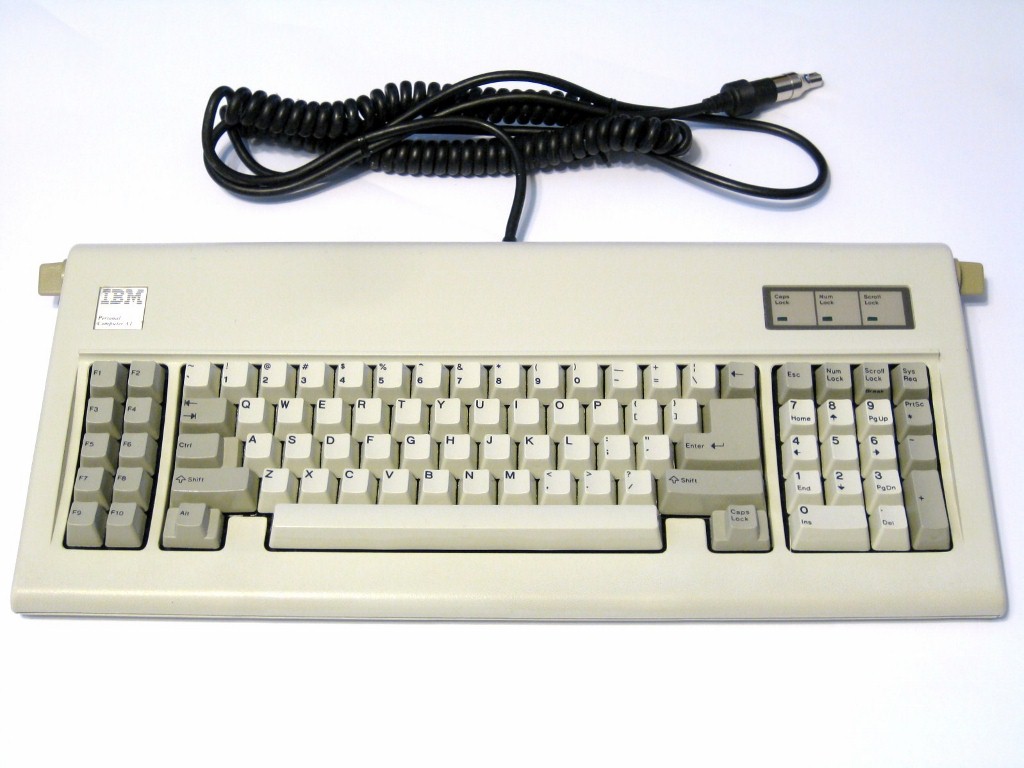
We did not have: Esc, Ctrl, Alt, any of the F keys, `/~, \ / | (the backslash and vertical bar, in case that looks weird), Ins, Home, PgUp, PgDn, Del, End, Pause, or the stupid Windows keys I always pop off my keyboards. A typist circa 1975 would have wondered what in hell all those weird keys did.

“Pause? It pauses any time I do nothing. I don’t need a key for that!”

“PgDn? Page down, you mean? That’ll just spit the current sheet out. Pointless.”

“Esc? I’d like to escape, all right; I’d like to escape back into what I know, which isn’t this.”

Thing is, the transition happened by degrees and with variations before the advent of the 84-key keyboard (had only ten function keys, arrayed at left; combined directional keys with number pad). Only portables, then laptops had the number pad mushed into the main keyboard (which sucked then and sucks now). Each time there has been change, it has taken time to absorb. Some have made sense, but some have made none.

In any case, if you’re looking at a fiftysomething, now you see where he or she learned to type. And that fiftysomething probably learned on an electric typewriter; imagine the heckling he or she took from the die-hard manual typewriter oldsters as to how easy it was now.

I assure you of this: I completed a degree in history, resulting in a stack of term and other papers an inch and a half thick. And I typed every one of them three times (at least) on an electric typewriter. There actually was college before an Internet, and you’d be surprised how much we managed to learn without the ability to google anything.

Tree topplers

Ever since I was a kid helping decorate the tree (and the one year where my toddler sibling and myself had the misapprehension that ornaments were meant to be stomped into the carpet for fun and noise; our parents issued correction), tree toppers have struck me as stupid. Not because the idea is stupid, but because none of them fricking work. They all assume the top of a tree to be ramrod-firm and straight, capable of supporting an ornament. I call them tree topplers because what they mostly do is fall over and piss me off.

This year, I finally did something about it.

We use a plastic tree (we don’t really need to kill one and clean up a lot of fir needles) and it already has integrated lights. Just like a real tree, its tip sucks for a tree topper. This year I threw away our old one, which I remembered only as a source of pissing-me-off; it was the kind where the insertion hole was a sort of spring, which sounds like a great idea until you try to use it for real.

First, I went out and got a new topper–I didn’t even care how heavy it was–with a straight-up hole in the base rather than a spring. I then bought a dowel that fit the hole, and cans of spray paint: black, forest green, and flat clear. I already owned spring-loaded clamps in great surplus and could easily dedicate two to solving this annoyance for me forever.

Then I spray-painted dowel and clamps green, let it dry, and added a mottling of black splotches. On the clamps’ rubber tips and handles, the paint was very tacky even when fully dry. The flat clear coat changed that. I sprayed every cranny I could hit with it.

When it was all dry, I brought the dowel in, put it on the back side of the ‘tree’s’ ‘trunk’ with the top near where I wanted the topper, and clamped it to the ‘trunk’ from behind. On with the topper. It fits perfectly, stays straight, is at zero risk of falling off unless the whole thing goes over (for example, someone sets off fireworks and our miniature schnauzer decides that his fate depends upon burrowing into its lower branches), and looks great. The clamps and dowel blend in well. You have to look twice to notice anything special about the topper.

Nearly fifty Christmases of irritation, problem at long last addressed. If you have experienced the same irritation, this post is your Christmas present. Happy topping.

Ho ho ho.

This, by the way, is available for $100 at Gorilla Goodies.

I know that’s what they taught you in school; I don’t care

We still use language for the same purposes we did when I was a child. For that reason, I’m generally averse to changing a term’s definition, especially when we need that word (like ‘literally’; without it, we have no way to separate metaphor and exaggeration from accurate recitation), or when the word has been redefined not because it needed redefinition, but due to basic sociopolitical cowardice.

What we don’t do the same is commit language to record. We do not type on manual typewriters, where it took physical effort to begin a new line. We do not type on electric typewriters, where one used to hit a button for that purpose. If we wanted center justification, we did elementary mathematics. Younger people who never used typewriters would be astonished at how much of Word’s superficial presentation originates in the typewriter, such as tab stops. The earliest word processing was meant to imitate what people understood best, and that was the typewriter.

We also don’t write with a pencil or pen in our dominant hand. Many of us can no longer write a word of cursive English beyond our own signatures, and schools are discontinuing its instruction. One day the ability to read cursive English will be a specialized skill for wonks only.

Nowadays, we either type on a computer keyboard, a laptop keyboard (I only consider laptops as half a computer), or some tiny chiclet-sized key images on a glass surface. We do have to hit the space bar after a word or punctuation–the space itself is a character–and we have had some more years to debate the way punctuation inflects meaning.

We also don’t so often print the words on paper. We often send them electronically. No one–at least, no one whose hands are not too arthritic to type in the first place–is going to type several hundred pages of text, revise it with multiple rewrites, and send this ream-sized manuscript to one publisher at a time, awaiting its return and enduring its entire loss if it is not returned. We can wave the mouse and make the whole document double-spaced. We can enforce a paragraph-opening indent. We don’t need underlines or caps for emphasis. We have proportional fonts with automatic kerning. We don’t even need font cartridges, as we used to use in the earlier days of inkjet printers.

What we learned as kids, and in typing class, was what teachers of the day were conditioned to teach us. Some of it made sense. Some really didn’t. We got marked down if we did it differently, conditioning us to consider it ‘correct.’ Then: the way we committed language to record transformed. Those of us in ‘the industry’ transformed with it. Those not, mostly did not, obstinately insisting that what they learned in 1963 must still be right, and if you don’t like it, get off my lawn and stay off my Social Security.

It is time they–you, if you are reading this, and you are over fifty–awaken to what you are doing wrong. This is especially true if you start a blog, or start shopping your manuscript. If your editor tells you we don’t do it that way any more, believe him or her and cooperate. I would not lie to you about the industry standards, and if I tried, I could not get away with it.

Most people over fifty are doing some things wrong.

The Comma Formerly Known As Oxford. I have often vented about my refusal to recognize Oxford’s moral authority over the English language, but this comma phenomenon exists by any name. When presenting a listing with commas, our grade school teachers taught us to omit the comma before the conjunction (typically ‘and’ or ‘or’). Thus, “Seattle, Pullman, Eugene and Corvallis have I-A football teams.” They and we were doing it wrong most of the time, and here is why: failure to use this comma creates an association between the last two items in the list. If we want that association, we should omit it. If we do not, we should use the comma. There is no mindless rule yea or nay. So no, TCFKAO is not always required, but is usually appropriate; intended meaning must govern.  We were taught wrong, and rather than continue to do it wrong, we must improve. I don’t care what Miss Unruh taught you back in school. Start doing it right.

Two spaces vs. one space. This did not exist for me until I began to type. Our typing teachers taught us: two spaces after a period, exclamation point, or colon. One after everything else. For some reason, my age group and those older cling to this obsolete usage as though it were heavenly gospel. It existed because, on the typewriter, all fonts were fixed-pitch. A font consists of a typeface (Arial, Times Roman, Courier) and a pitch (size; typical number of characters per inch of printed text). Courier 12 is a font, as is Arial 8 or Times Roman 24. A typeface is proportional or fixed-pitch as one of its basic properties; most are proportional, because proportional was what we always wanted but could not do on a typewriter. Professional typesetting used proportional fonts because it could, and because it was more readable. To see what every one of my college history papers looked like, pull up a document in your word processor and change a paragraph to Courier 12, which is a fixed-pitch font. Our typewriters could not handle proportional fonts, like this blog’s. Because they could not, Courier was harder to read, and we learned to use two spaces after certain punctuation marks. This is no longer Mrs. Overley’s freshman typing class. In modern documents, an extra space is just pointless air. Let it go. Even Mrs. Overley probably has.

Underlines and caps. Gather round, children, for a tale of the days when we were one step above writing with flint knives, burins, mastodon grease, harvested ochre, and dried stretched deerskin. We could not make text bold on a typewriter. We could not italicize it. Only on later typewriters could we change fonts at all. Even then, we could not change their size as issued. If we wanted emphasis, and we were too lazy or illiterate to make our word choices convey the emphasis–or, in fairness, we were writing dialogue and needed the occasional emphasis–we had underlines, and we had all caps. This led a generation of kids, mine as it happens, to use these methods even into their middle age–when italics were available and didn’t cost a nickel. Stop it. There are very few reasons to use underlines. Debate goes on about book titles, but I think the underline is a holdover from when we would backspace and hold down the underbar key. There are even fewer reasons to use all caps, unless one wants to scream in text. When I see underlines and caps, I don’t see a good writer. I don’t give a damn what your IBM Selectric let you do; start doing it right, won’t you?

Thanks.

Dear Ophelia, part two

(Continued.)

I learned why Guinness traveled badly by asking at Elliott’s Bar (in Leitir, about ten minutes’ walk from our cottage), which is only open from 6:00 PM to midnight daily. Friday night is traditional music night. Daniel Elliott, the pubkeeper, was a friendly young gent who for whatever reason seemed to like us very much. He explained that in some pubs, particularly hotel bars, the Guinness might spend a long time sitting in the lines. It never sat for long in the lines at Elliott’s. The craic (banter) was always strong at Daniel’s establishment, with a motley assortment of locals glad to engage us at any given time. Turf (peat) fires produce an unmistakably Irish smell (think rich burning earth, which of course it is), and for a Gaelteacht pub in west Donegal it would be the norm. It is at Elliott’s. Daniel’s father founded the pub one year before I was born. Considering how few people live within easy walking distance, its prosperity speaks volumes. I’ve never been to a better.

It can happen this quickly: on the first night, we were somewhat novelties: down-to-earth tourists with in one case some slight proficiency in Irish, and the locals got to take their time discovering us. Over those days, Daniel hinted rather often that I might be called upon to sing on Friday, when there would be traditional music and an open mike. I gave all the expected and quite truthful evasions: I have a lousy voice, I tend to forget the lyrics, I’m not good at singing at all, I could clear out the pub in half a minute of atonal wailing. All dismissed, of course. It’s one of those cases where you know you will be had, but at least you are given fair warning.

Friday came, and most of the band was German (plus Daniel’s mother on the accordion, and now I can see where he gets his kind heart). After a few of those in attendance gave us some rather pleasing renditions of traditional Irish and American rock tunes, Daniel arranged somehow for my dragooning in the direction of the mike. (Yes; MIKE. I don’t give a damn who spells it ‘mic’; that in my view is pronounced ‘Mick,’ and I refuse to do so. People need to learn their phonics. It’s a damn MIKE-ro-fone and the short form is MIKE—thus, ‘mike,’ and I hope we won’t have to have this discussion again.)

Perhaps a few days of unease got to me. I started with a southwestern American number originally from the Kingston Trio, but faltered a pint too far on the lyrics. I figured that was the time to retreat in modest disgrace, but the crowd would not have it. I wasted a lot of their time looking through the songbook for something Irish to which I could do moderate justice, then gave them the first three stanzas of Back Home in Derry, a lament with at least neighboring historical overtones of Ireland’s past anguishes. All good, except that the songbook page misplaced the final verse, and by the time I found it and tried to continue, I had the tune misplaced with regard to the lyrics. I prepared to get back to the bar and let a competent entertainer take over, but again they would not have it. I looked about the pub, and they were shushing one another, not a scornful face to be seen.

All right. I knew one short song I could get right, one from my own homeland, the state song of Kansas: Home on the Range. I told them what it was, then delivered it as well as I can ever deliver a song. The assembled gave me a lusty round of applause. I got up, thanked everyone, and let an actual musician take over. I saw nothing but smiles. At first I didn’t understand. Not even two more pints of stout helped.

At first I felt like a flop, but over the next couple of days I came to see that for what it had been: an initiation, however voluntary, into the society of Elliott’s Bar. What mattered was not how well I sang, but that I kept after it upon request until I managed at least to sing up to my own modest level. In the days after, I could see a change in the locals’ approach to us; no longer novelties, we were as near to regulars as any tourist could ever be. The patrons began to tell stories of ways in which other tourists acted: either marveling that rural Ireland had things like electricity and flush toilets and Internet, or braying in the typical American outside voices, or very uptight and unsure what to expect. “Yous’re genuine,” said Daniel, a kind word I’ll treasure along with every other memory of Elliott’s.

Two days before we prepared to head south, the word was all out: Ophelia was coming. Ophelia, an Atlantic hurricane, looked to centerpunch the western Irish coast (Leitir included) come Monday. Forecasts varied, but in general the forecast called for sustained 40mph winds with gusts up to 80. It would slug Counties Cork and Kerry, then Limerick and Clare, then Galway and Mayo, then Donegal and Derry and Antrim. The whole country would be hit, on one level or another. Bus services, flights, and schools were canceled. Gardaí (‘gar-DEE’, guards; the national police) asked people to stay indoors if they possibly could, and off the roads unless urgently necessary. We let the local small shopkeeper (the town’s only one) know that if fate and fortune deposited any scared and lost tourists on them, our rental cottage could easily take four more people, and to send them up. I could just imagine a couple of terrified young tourists guilty of poor situational awareness having fetched up at the shop in a panic about where they might shelter for the night. If there were nothing else we could do to help our new friends, we might lift one small worry from their ready supply of concerns about life and property.

It is the Irish way to commiserate with the traveler about any bad weather or inconvenience, apologizing as if they’d had personal responsibility for designing the weather. In the first place, what mental defective would go to Ireland in October unprepared for wind and rain? We tried to tell people that they needed not worry about us; while we understood that the disaster potential was real for a country not built to stand winds clearing 80 mph, we had spent a good portion of our married life somewhere that weather like this could be expected about thrice yearly. Our ‘holiday’ was not spoiled. If the power went out, we’d light a candle. If the satellite TV went down, we’d use the radio if it were operational. In the evening, we’d at least go down and see if the pub was open, and join in the usual fun. Whatever happened, we’d battle through.

The satellite TV stayed up into early evening, giving us some news of what Cork and Kerry had experienced. Trees down, roads blocked, over 300,000 people without electricity. Ministers on TV taking media questions. Government acting like adults (in the US, we are beginning to forget what it felt like to be governed by honest adults who at least felt the obligation to make a show of desiring our best interests). Only two reported fatalities by the time it began to grow dusk, rather miraculous in a country unused to such a storm.

In the end, it was exhilirating to be shot at without result. By the time the eyewall reached our latitude, it had veered out to sea. We got high winds and plenty of rain, but didn’t lose power. The worst thing that happened was I aggravated a hamstring pull from before the trip, and it would slow me for the rest of our time in Ireland. It could have been far worse.

Our second week was less adventuresome, mostly due to illness: first Deb’s, then mine. This was worsened by our unfamiliarity with available cold remedies, as well as the inability of Irish pharmacists to adapt recommendations to our situation. Everything they had was probably great for someone who could take a few days of paid vacation and let the disease run its course. They were not equipped to help people who would be glad to suppress as many symptoms as possible and save up the suffering for later. We had to buy a random assortment of medications with which to experiment. By the time she began to feel better, I was feeling horrible, and that’s how it was when I entered the airport for the twenty-two-hour trip home. (Fourteen hours in airplanes, four in a layover, three at the airport before, one riding home with our house-sitter back in Portland.) Our second town had more amenities than Leitir, but much less charm, and pubs are less fun without your wife. She felt up to some exploration a couple of times, so we had to settle for that.

In future installments, I’ll get to some of our other observations, and Ireland’s peculiarities for the traveler.

Dear Ophelia, part one

The trip was, in a way, misbegotten.

Maybe it fits well that I drafted this account in a hurricane that appeared destined to centerpunch our location.

Like most people in the modern age who are comfortable with computers and the Internet, Deb and I handle our own domestic travel arrangements. It isn’t that hard, and a travel agent can’t offer much value helping you plan your dream trip to Wichita. We knew the travel agency industry was in decline, but for a trip to Ireland using some unfamiliar means through an unfamiliar entry point, we felt it was of value to consult a specialist.

Nah.

We went to one of the longest-established travel agencies west of the Willamette (the river that divides eastern and western Portland, Oregon), and contacted the individual billed as their Ireland/England specialist. On everything we could as easily have done ourselves—flights, car rental, hotel nights at the airport—she seemed to perform fine. All that remained was to pick out two cottage stays, a week apiece. We had given her a three-week window and asked her to time our two weeks of travel so as best to fit the cottage schedules.

That seems logical, right? Flight day, jetlag airport hotel stay, then pick up rental car and head for cottage. Week later, transition to next cottage. Departure day, drive to jetlag hotel, drop off rental car, enjoy last day in town using mass transit, fly out in morning.

She sent us three options for cottages. In all three cases we thought perhaps we could do better, and asked for more options. What naïfs we were. We waited patiently, and time marched on. Options were disappearing daily as places booked up. After a week’s strained patience, we contacted her and asked could we please move this forward. She made a number of unverifiable excuses, the kind of plausible deniabilities one usually hears from people who have learned how to lie by habit, including that she had not forgotten about us. I grew uneasy, but presumed that she would not simply cease to bother helping us to complete our plans. A blistering review online—and if I may say so, when a professional writer wants to blister someone, he or she knows how to make sure the marks hurt like hell—would be exactly what she did not need.

It is a weakness of mine to underestimate human stupidity, laziness, and shortsightedness until nearly too late. I show no signs of improvement.

After another week, she sent us a batch of .pdfs of cottages, nearly all without prices. A rather important bit of information, one would think, and I contacted her to explain that this was hardly workable. She ignored me. I went over and over in my head: had I done something wrong, somehow alienated her? Or, more likely, had she just decided she had gotten all the money she cared about, and that we could now fuck off until her convenience allowed her to deign to finish booking our trip?

I was sure I had been very restrained and non-alienating to this point, but in case I had somehow been socially ham-handed, I asked Deb to take over the interface. Deb got no better response, not even with a message for the owner. Now we saw that the firm’s rot seeped from its leadership. After one full month since first meeting and arrangements, and with barely that long to go before departure, and no further anything from the agent or her chieftain, we realized that we must book our own cottage stays. All right; go to hell, lady, we’ll muddle through without your expertise.

We soon learned that she had botched the flight dates. Irish cottages typically run on the calendar week with Saturday as the beginning and end, and she had scheduled our flights so that the two weeks did not fit calendar weeks. After checking dozens of cottage prices, we learned was we were welcome to book an available cottage any time that suited us, but that each cottage stay would mean paying the equivalent cost of two full weeks. It would transform about a $650 experience into well over $1100, exactly the sort of blunder we had expected a travel professional to avoid. As I’ve often said to errant vendors (especially contractors), if I wanted it all fucked up, I could have done that all on my own without professional assistance.

It was either change the days off, the flights, the hotels, and the rental cars, or swallow the cost. The flight alone would be problematic to change without a large cost.

Nothing for it but to pay up and hope, and we did. Our plan was to fly into Dublin (mistake #1; we saved a lot of money we later wished we had not, as Shannon is far easier to deal with), hotel stay, then pick up the rental car and take it deep into the wilds of County Donegal. That part at least went well enough, and after overcoming the lunacy of getting out of Dublin with right-hand drive, we were free and making for the village of Leitir mhic an Bhaird (in Irish; say it, LAY-chur WICK-a-word, in English, Lettermacaward pronounced LET-er MACK-a-word).

Ireland doesn’t have much freeway kilometrage, but most of the roads have good enough surfacing. There often is no shoulder, so there’s the rock wall or dropoff to avoid, and oncoming trucks can be harrowing when their right tire is over the line and won’t move. It took about four hours to reach Leitir, as locals call it, complete with confusion over directions to the cottage. This being a Gaelteacht (Irish-speaking area), some of the signs are in Irish alone, some bilingual. Our turnoff was at a place called Dooey Beach, and had I not seen the sign saying ‘Dumhaigh’ (roughly, ‘Dooey’) and figured out that part, we wouldn’t have known where to go.

The cottage had a number of disappointing aspects; no Internet (I admit that failing to note this in advance was my bad; I had been very flustered), an odd mixture of interactions between electrical devices (where you had to turn on this switch over here to make that device work, but please kindly turn it off as soon as you are done), an absentee owner, and a local caretaker who seemed put upon, leaving us to figure out much of the house for ourselves. We gave serious consideration to just leaving and finding B&Bs, but we decided to buck up and make the best of it. There we were, on a one-lane country road without Internet service, a forest behind and north of us, a pasture to the immediate south with rooks (think of a crow with a light gray beak) scavenging all around the livestock, and not much of anything in near walking distance except an elementary school. Oh, and an obviously closed-up bar. There had been a bar just after the Dooey turnoff, though, which looked like about a ten-minute walk. Fine.

One way you know you’re in a Gaelteacht: the school zone signs are in Irish alone. Just south of our cottage, painted on the road in big letters:

AIRE (AR-rah)

GO MALL (guh MAWL)

SCOIL (SKULL)

“Attention, slow, school.”

Over the next few days, we explored western Ulster by day. By night, we became part of the scene at the local pub; we’ll get to that later.

One of our trips was to the southwest Donegal coast, to visit the cliffs of Sliabh Liag (‘SLEEVE LEAGUE’; I am not going to render all the Irish names in English as well, but I will help you say them right). Great slate-layered rocky upthrust headlands gazing down talus slopes and sheer faces into the North Atlantic, with coppery sheen in the broken black stones at your feet, astonishingly white quartz chunks here and there, and of course Ireland’s ubiquitous grazing sheep. One might say, with justice, that any attraction where there is no risk of stepping in sheep crap isn’t very Irish. True to form, one had to pass a gate posted with a fógra about keeping it closed in order to avoid letting the sheep out.

I had better explain about fógraí, which means ‘notices’ or ‘warnings’ (depending on how one chooses to take them). At antiquities, the Fógra advises one in Irish and English that the site is under the protection of some state ministry, and requests visitors’ aid in preserving them. It then advises that there are severe penalties for doing the opposite. Last time we visited, Deb and I picked up the habit of giving each other ad hoc fógraí as we perceived each other’s demeanor and actions demanded it.

Another day, we took a drive up to Ros Goill (ROSS GULL), a narrow rocky peninsula sticking out of north Donegal. On Donegal’s coast, which is part of a long drive called the Wild Atlantic Way, it’s hard to find an ocean view that does not offer some kind of holy-shit-you’ve-got-to-see-this scenario. That happened to be my birthday, a fact which my treasonous wife revealed of course to our waitress during a wonderful early dinner in Dunfanaghy (dun-FANN-a-hee). Irish food has gotten a lot better since the early 2000s, though hotel bar pints are still the soured monstrosities they once were. Guinness does not travel, and responds badly to long supply lines not merely between keg and tap, but brewery and delivery.

Other trips took us to Beltany Stone Circle near Raphoe, the Giant’s Causeway in north Antrim, and Killybegs, an important port for the North Atlantic fishing fleet. The latter had delicious seafood, eaten in sight of the giant looming trawlers. We will have a lot to say about the Causeway later; what has been done to it, and to other Irish signature sights, deserves its own cross-hairs.

Back in Leitir, I learned why Guinness traveled badly by asking at Elliott’s Bar… (To be continued)


[The title is a stupid self-indulgence. Stupidly self-indulgent titles are a peeve of mine, and I deal with them in clients on a regular basis. The client thinks she has just come up with the coolest title ever. She should kill this Faulknerian darling, but she will not, so she ends up with a garbage title. In this case, the title is stupid because it barely says anything clever about the story, and in fact is just a lyric from an Abney Park steampunk song. It’s like the author had only heard two instances of the word ‘Ophelia’ in his life and decided that somehow they deserved connection even when every reader would be left asking: “and what was the point of this?” However, I went through a lot to bring you this story, so I am stupidly indulging myself in this, covering the privates of my indulgence with the fig leaf of intellectual honesty.]
An abnormally long absence

I do not normally go this long without posting.

Here’s what happened: I was preparing for international travel. It is clear to most people that if you are about to leave your home for a couple of weeks, what you don’t do is announce it to the entire world. That invites criminals to come visit you.

Deb and I were in Ireland. I did not post from there for a number of reasons:

  • There was no Internet at our first week’s stay.
  • The Internet at our second week’s stay was glutinous.
  • About halfway through, Deb grew very sick, and I had other things on my mind. As she began to improve, naturally, I got sick.

Having to spend fourteen hours in aircraft seats, plus seven hours sitting around airports, doesn’t do much for a sick person–especially one who has not had access to familiar remedies. When I got home, I was ill enough I could not sleep reclining, and every cough created a ripping feeling all the way up my trachea. A couple of times I even coughed up tissue. In short, I have not really had a very good time since returning.

I do have some material I composed in Ireland (when your wife wants only to lay around and suffer and be helped by you, you have a lot of leisure time), and will sort it out and publish it as I regain strength. For now, that strength is limited but improving daily. I also have some client work that is due soon, and I trust the reader to appreciate that such has first claim upon my finite energy supplies.

Thank you for your understanding. I have not forgotten my regular readers, and I am grateful for each of you.

The dumbness of single-bit binary logic: everything that is not this, is not necessarily that

My bro JT, one of the most unconventional thinkers I know, has long commented upon the problems with single-bit binary logic. I understood this, but I’m embarrassed at my failure to process it until very recently.

In binary notation, everything is a 0 or a 1. They is a this or a that, as the old umpire used to say. This is a base two system, and it is the basis for digital electronics. If you don’t know what base two means, that means there are two numbers before you have to start a new column. We count in base ten, logically since we have ten fingers.

Binary notation works fine as the basis for our electronics. In the world of humanity and issues, where things are rarely so clear and exclusive, it is an indicator of feeble-mindedness. Consider: “If you aren’t for us, you are against us.” “If you aren’t part of the solution, you’re part of the problem.” Stop and think, as I believe in doing any time someone trots out a glib saying repeated so many times that people assume it wise. This is dumb. Just because I am not for you does not mean I am against you. If you’re dumb enough to construe me as your enemy because you can’t bully me into signing onto your cause, that’s your problem and mistake. And just because I am not participating in a solution does not automatically signify that I am part of the problem. I may be neither. I might be a little of both. I might be in the process of using my brain to make up my own mind without consulting you. And this attitude isn’t adding luster to your side, I might add.

The fundamental problem with single-bit binary reasoning: it allows only two categories, choices, alignments, what have you. When applied to a human issue, that’s feeble-minded. It oversimplifies the human condition down to a moronic level. It works only for those who yearn to be spared all nuance. Is Bill Gates an evil man or a good man? He made a fortune by monopolizing our computing environment with increasing mediocrity. Then he decided to retire and use his wealth for such good causes Warren Buffett said “here, take mine, too.” He left behind his company still doing all the same things, growing more mediocre by the year, but no less monopolistic. Hate or love? Respect or disrespect? It is not so easy. It confounds feeble thinking. It makes modern America’s brain hurt, so its members just apply selective amnesia. They derided him back when his software company was strangling every possible competitor, and he was an evil guy, but now that’s old hat and he is a good guy. Nuance is hard. Absolutes provide comfort of the shallowest kind.

Look at the United States’ political system, which embeds and defends single-bit binary logic. If you aren’t one of these, you are one of those. This is idiotic. There are lots of things to be other than those two. Single-bit binary logic works fairly well on life and death (it’s very rare to be neither dead nor alive, I’ll concede), sports events on the field (can’t really play for both teams at once, I’ll go along with that), and other such clear-cut situations. Most matters of opinion are not so.

Thus it is with public demonstrations. Not every failure to join in a public demonstration of homage amounts to disrespect. Only single-bit binary logic can conclude that it does. Suppose that my national anthem is on television before a hockey game. I could choose to stand, interrupt my activities, pay attention, even sing the song: that would be respectful. I could choose not to pay attention, but to avoid doing anything overtly self-indulgent or gross. I could talk with someone about the imminent game, look at a magazine article, or simply sit in silent passivity; that would be somewhere in between. Or I could choose to scratch my groin, flip off the TV, use bad language, drink cheap beer, chomp tortilla chips, and/or make a snide remark; that would be disrespectful. It’s feeble-minded to think that all non-respect is disrespect, just as it is feeble-minded to think that all the different forms of respect can be conflated into one term.

(One of these days I will go into depth on that. There is the respect born of fear (s/he can and might hurt me), that born of affectionate regard (s/he has done great deeds I admire), and that stemming from positive regard without affection (s/he may be a bastard, but in some ways I respect him or her). In some situations, more than one may apply in some proportion. Our error occurs when we fail to qualify what we mean by respect.)

Single-bit binary logic works fine for dogs. If you are a dog, I recommend it without reservation. In most cases, a dog not mistreated either likes you (you are best pal for life) or hates you (you are intruder, competitor for scarce affection, etc.). My friend Jim had a rather ratty little dog named Willie. Willie liked everyone. I mostly don’t like dogs, and I didn’t like Willie. Willie didn’t care; he liked me.

(And lest you think Willie had no importance, let me tell you, Willie was an impact player in one of the funniest pizza-related instances in the history of the faux-Italian menu. I think I’ve told that story on here. If I have not, I must. If I haven’t, you are permitted to rag on me until I do.)

Why are so many issues presented to us in single-bit binary logic? Because it’s easy–and because it makes us easier to manipulate.

Who’s a good boy? Good boy!

How to fix your self-esteem problem

This can be done.

I got to thinking about it while reading yet another forum post by a Lost Soul wondering why he didn’t have any friends, why people stood him up and showed him little consideration. It looked pretty straightforward: he had low self-esteem. The other theoretical explanation, that he was an asshole, does not work in practice. Assholes have all kinds of associates, even friends, and people might be less likely to stand them up. Assholes might be assholes about it, after all, and people tend not to want to stir that up. So as I see it, we’re back to low self-esteem: they do not esteem him because he does not esteem himself.

All right, fine. He doesn’t esteem himself. He doesn’t really think he amounts to a lot. He may tell himself he does, but he doesn’t feel it. Maybe he’s afraid it would bring out a latent narcissism (I can think of people I wish would have considered that). Maybe he’s let the world tell him what opinion to have of himself. However one looks at this, it’s all too simple to say and quite another thing to do: “Then treat yourself with some respect, and people will respect you more.” That’s like telling a fat person to exercise more and eat less food. Certainly it is correct, but if it were that easy to break bad habits and establish new ones, we wouldn’t need a whole medical specialization in bariatrics, a drug rehab industry, or eternal therapy for neurotic people.

Okay. Let’s assume that a person who is consistently ignored, disregarded, stood up, not considered by others has probably conveyed a lack of self-esteem. If it’s not so, my advice won’t hurt. If it is so, this might help.

You can’t get self-esteem from others’ approval. It comes from within; whether it’s a conscious choice, a value judgment after examination, or just ingrained from youth, no one can confer it on you. It’s self-administered and self-maintained if it has any validity at all. Likewise, no one can take it away unless you grant him or her that power. If you grant someone the power to determine your self-esteem, I submit that it’s not your own to begin with.

Whatever the case, you can’t wait for it to come from anyone else. What they offer is not self-esteem; it’s their own esteem of you. They can esteem you with a mighty esteeming and you can resist it if you wish. Or you can accept it, consider this handled, and then learn that your supposed self-esteem can be taken away as easily as it was given. Only self-esteem you confer upon yourself gives you the power to veto anyone else’s attempts to damage it.

Let me also present this: in order to esteem yourself, you must not have a terminally bad metric for value. If nothing you could do would make you think better of yourself, then any such effort is gutshot until you decide that you would permit a path to better self-esteem. That too is a choice. No one can make it for anyone. Nothing I can write will make it for anyone. Anyone bound and determined to loathe him or herself will always find a way.

If you buy that, here’s what I propose: do anonymous good deeds.

Do small good deeds. Do them a lot. Do them as a way of life. When you cannot do them anonymously, do them with minimal fanfare and the simplest possible ‘you’re welcome’ for any gratitude. If need be, ask of the recipients only that they never mention it again (very good in the case of monetary aid). When possible, do them for complete strangers you’ll never see again. Do them for humanity at large, or the environment: pick up that litter, wave to those kids (even though you live in a big city and big-city coolness more or less demands you act like a self-absorbed ass), take your shopping cart back to the collection area.

Your massive-ass grocery shopping takes an eternity in front of that young guy just buying a six-pack? Ask the checker to tack his charges onto yours. You knocked a bunch of crap off the grocery shelf? Pick it up and put it back. Leave good tips and give retail service people kind words. If they do really well, tell their supervisors. When you sense that you’re about to bitch about something where bitching won’t help anyone, swallow it this time. Make a regular habit of doing a lot of little things, and some bigger things, that you can respect in yourself. Be the kind of person you respect–but do most of it where no one else will see or know or praise you. You’re doing this to earn your own respect, not theirs. If they respect you anyway, fine, but see that for the potential pitfall it is: their respect, while kind and probably sincere, can distract from the real reason you did it. They could withdraw that respect as easily as they proffered it. It’s nice to have, but at the core, you did it so that you could look back at the day and say, believing it: “I did good. I lived my values today.”

You could esteem that in yourself. Made a habit, it would sink in. You’d like that person. You’d respect that way of life. You’d esteem you.

And if it doesn’t work? If you still don’t like yourself? Then you know have rigged the game against yourself in the way I described earlier. In that case, since it’s your game, you’ll be needing to change the rules. Rules that say “I can respect myself when I brighten others’ lives” are perfectly reasonable.

And what when you are treated with disrespect? Stop wanting that person’s respect. Letting the same person keep disrespecting you, and wanting him or her to change, signals permission for everyone else to do the same. Bear in mind, that doesn’t mean you have to ruin your work environment, go nuts, end up in jail. It just means you don’t want what they won’t offer. Go about your life. Don’t make plans with people who dump your outing as soon as something better comes along. Don’t make efforts to make the office snob happy. Don’t offer a place to stay to people who don’t treat your home with respect. Do your work, live your life; do good things because you respect them in yourself, and do good work because you respect it in yourself. It’s true that we teach people how to treat us. It’s also true that if we do not treat ourselves well, others learn that they also may mistreat us.

There is a very toxic person in my life, one I cannot readily erase from it. This person has always talked as if I were the bee’s knees, but has for many years behaved so as to provoke me whenever possible. This sort of dichotomous conduct is par for that course. This person knows all my buttons and had (yes, past tense) regularly completed his/her own toxic circles by jabbing at them. This person is mentally ill and there is nothing I can do to change that–nor is it my job.

What I could change was my judgment on that person: his/her utterances, actions, attitudes. The key point for me was where I realized a thing about judging: the reason not to judge wasn’t that it was fundamentally bad or wrong or not my right. Screw that. I am perfectly entitled to judge bad behaviors, and there is nothing morally wrong about it. However…by judging the behaviors, I opened the door to the toxic manipulation. I’m entitled to judge, but it wasn’t working in my favor. It was leaving me vulnerable.

Only when I no longer judged the mentally ill behaviors did I learn to let them wash past me. Now this person has no idea how to relate to me. The vending machine is eating the quarters. Maybe s/he will learn better behaviors; more likely s/he will not. Either way, it is not my problem. This person must own his/her own problems; I already own enough and can’t add new ones.

How I reacted, and why I reacted (or more accurately, did not react), were the point. I didn’t do it to change this person. This person cannot change, and I was foolish to hope otherwise. I did it to change myself, to liberate myself. It was what a self-respecting person should do. I didn’t respect in myself the feelings that came up after those interactions, and I had to find the key to their banishment. I think it’s the same way with wanting people’s approval. If we live in ways and make choices that give us reason to approve of ourselves, esteem ourselves, respect ourselves, people’s approval is a nice-to-have but doesn’t control us.

I know another toxic person who is a career ass-kisser. Literally, in the career part of the term: this individual made a living for decades marketing instruments by sucking up to unbearable assholes, treating them as though they were the most important persons in the world, enduring all their disrespect without ever daring complain or walk away. Over time, ass-kissing became this person’s fundamental identity. AK, as I will name this person for short, was also famous for giving things away. No one could outdo AK in giving, which was not the same as generosity. AK was trying to buy people–friends–by kissing ass and giving them stuff. If you knew AK, AK told you how neat you were, how great you were, and tried to load you down with stuff. AK probably never gave anything anonymously in AK’s life, because the point was that AK wanted to buy people’s favor. Doing so anonymously would only be a good deed; what would be the point of that?

After a while, AK and I stopped seeing eye to eye because I didn’t respond to the constant overpraise and layers of bullshit. I understood that it wasn’t sincere; bullshit was simply the way AK rolled, and if AK’s current bullshit level wasn’t getting results, AK kept dialing it up. AK was not used to people who declined excessive gifts; AK felt most comfortable when AK had ‘bought’ someone’s ‘respect’ or ‘friendship.’ A person who could not simply accept all the bounty–who recognized it for the toxicity it was–made AK very uncomfortable. A person who attempted to reciprocate (the act of a self-respecting person) sent AK into orbit. AK’s game was to always be the giver, and that is pure toxicity. Anyone who can’t receive can’t give, and vice versa, because there is giving in all receiving and receiving in all giving. AK doesn’t really give; AK bribes. AK doesn’t really praise; AK sucks up.

AK doesn’t have very much self-esteem. AK lives a fearful life, dwelling on the slightest negative feedback, always trusting the wrong people and often betrayed. AK has been in therapy for decades, and it doesn’t seem to be doing much good. When AK’s spouse of many years just walked away, AK did not understand. Had AK not done all the requisite things? Had AK not kissed sufficient ass? Had AK somehow managed to give insufficient material things? Whatever AK’s spouse had most wanted in life, AK had not provided it, and when the kids were grown, AK’s spouse got out. Maybe said spouse had decided that decades of toxic relationship patterns were enough. Maybe said spouse had self-esteem, a thing unknown to AK.

When AK retired from the first ass-kissing career, s/he began a second one. Life without kissing ass was unthinkable; ass-kissing had become an identity. Some people are manipulators, some people are tough, some people are cold, some are cuddly; some suck up. All AK’s esteem came from the people with whom AK shopped for it. Sometimes it was genuine; other times it was a facade. In the end, nearly none of them will stay bought. In the end, AK does not esteem AKself, and neither will the people AK has tried to buy esteem from.

I am glad to have distanced myself from AK. Had I kept associating with such an individual, it would probably have drawn me into more toxic cycles. The last thing we need is to add more of those to our lives.

It begins with doing good things, but always for the right reasons: because they are meritorious, acts that speak for themselves in the way they validate our self-concepts. The fewer other people that know who did them, and the less accolades they bring, the better they work. If I were independently wealthy, I’d just go around wiping out medical bills with several layers of anonymity between myself and the recipients. From those who have been blessed in life, more is expected. You’d be surprised how little self-esteem some of them have. Or not, considering that celebrity suicide is a thing.

There. If you want self-esteem, stop lamenting over the way people treat you. Go get it in a way over which no one on earth has a veto.

The dumbest criticism of writing I ever hear

Book reviews are great places to see people say dumb things. Some of those dumb things are also common in message board posts, comment sections, and ordinary face-to-face speech. I have a passionate loathing for “dumb things everyone repeats as if they were automatically true,” but this one is the dumbest of the dumb:

“Profanity is a sign of a limited vocabulary.”

The ability to rub together four brain cells would dispel this bromide at its birth, but since that ability seems so lacking, let’s perforate it once and for all with a volley of logic bullets.

In the first place, while I have been accused of many faults–some, with cause–a small vocabulary has never been among them. I don’t normally brag about it because it’s nothing for which I may take credit; it is the residue of fifty-one years of avid reading, 99% of which I enjoyed with gusto. I also have active vocabularies in foreign languages ranging from five to five thousand words depending on the tongue, with inactive vocabularies rather larger. There are few times to show off in an effort to humiliate someone, and that would be one.

I swear. I curse. I use bad words. I use them in speech and writing. Do I have a limited vocabulary? Pretty certain I do not.

People swear for many reasons. Some do it to release frustration. It’s better to swear than to break something, hurt someone, or bottle it all up inside. It can be used to intimidate, and intimidation is not always a bad thing. Some people will not do the right thing except when legitimately frightened, and a bad word or two says “I do not care what you think of me.” Some do it for comic purposes. Some swear just because it happens to feel good right about then. Some would not get through freeway and arterial traffic with sanity and language purity both intact. Some do it for effect in writing. I am sure you could think of other cases.

None of those reasons speak to a limited vocabulary. Claiming that swearing does so indicate only announces one’s own lack of reasoning capacity. Nice going. Look, if it offends you to hear or read profanity, just admit that it offends you. It’s okay to be offended. I’m offended by the foolishness of the claim about limited vocabulary, and I’m not going to apologize, so if you want to say that profanity offends you, fine. Be offended when you feel it necessary.

In our single-bit binary logic republic, perhaps a fair number of people will look at that and say: “Ah, so you advocate unlimited profanity without restraint. Classy.” Now that’s going from the frying pan of dumbth into the fire of stoopid. I advocate nothing of the kind.

In speech, as anyone not jumping into or out of frying pans of dumbth will grasp, times and places occur where profanity is appropriate or inappropriate. On the phone doing business? Mostly inappropriate, unless the situation is special. If my listing agent calls me to tell me that the buyer has bilged out of the deal for a stupid reason, and I have a long, collegial relationship with that agent, I may be entitled to a cussing-of-the-situation. If I’m calling the sheriff’s deputies to request their assistance, and there’s no reason for me to be worked up, gratuitous profanity would be a lousy idea. Let’s say I’m making a sales call on the Sisters of Perpetual Outrage convent; I probably shouldn’t drop bad words on Mother Superior, nor even on Daughter Inferior.

In writing, the rule would be: depends on the situation, but on balance one should consider profanity a chip one may play when and where it will have best effect. Like em dashes, ellipses, italics, caps, adverbs, passive voice, and all the other quirks that bad writers seem to mistake for ‘style,’ profanity loses its effect in high concentrations. Like all those chips, profanity has its place in the language. Its place is not in formal historical writing, for example, nor in a legal brief, nor in a cover letter. In a travel narrative? It may have its place. In fictional narrative? Same. In dialogue? If credible. How could one write credible stories involving bikers or ironworkers without profanity? “You better walk that stuff back, you child of a prostitute, or I’ll kick your backside!”

Telling people when to curse aloud is beyond the scope of what I do, but I can speak to the place of profanity in writing. The best approach I can suggest is: consider appropriateness and effect. Have you been burning lots of chips? If so, you should not tack on another bad habit. If not, then consider whether the likely impact is worth burning one of your precious deviations from good orthography. Would this naughty word make a real difference, enhance your narrative? If it would, let fly. But don’t do it just to indulge yet another lazy novice writing habit. Don’t waste the chip.

Admit it: you were waiting to see whether I would swear, weren’t you? Why would I? The goal of this article is to educate and persuade (with the secondary goal of shaming, in a few cases). Profanity would not do that. It would be as trite, predictable, and amateurish as the typical Facebook meme.

Not that I am incapable of triteness, predictability, or amateurism, of course. I’ve even been known to combine the three. I would like to think I rarely use them without reason. And I don’t need profanity to curse out the mentality that imagines profanity a sign of limited vocabulary. It would be fun for me, but less persuasive.

That is the point.