Column collection books

Molly Ivins did it often, and as much as I liked her writing, I never liked the concept. Some journalists or authors who get a lot of articles and reviews published eventually bundle them together in a book, presumably with some unifying theme, and release it.  Handy!

One may readily guess that a specific volume inspired this piece, and it is Jonathan Raban’s Driving Home:  An American Journey. I’m not done with this book yet, and have taken to skimming parts of it, so let’s stop short of calling this a book review and label it as it is:  observations about the book so far. The good part: he’s a capable observer of Americana, and in the main quite a fair one. Raban writes well and provocatively most of the time, though I find some of his fancier phrasing a bit overdone.  Therein may lie one of the problems with packing your columns and articles into a book; what may have made a fine article in Outside may not be desirable in a full-size book where we go on a longer journey with the author.

Which this is not. I am much bothered by what I thought (having failed to scan the cover and description too closely, taken in by the title) was a travel book by an English author about his journeys in the United States.  Sometimes it is, in disconnected fashion, with the added draw (for me) of a Seattle focus. Other times he’s talking about things like Shackleton’s expedition, poets he likes or dislikes, or something else only very distantly related to American travel. If you don’t mind some literary critique and commentary interspersed with some travel and living observations, then this is right up your alley, but it’s not what I meant to purchase.

His sophisticated tone and style would be offputting to many Americans, but most of those who would be put off a) do not read books to begin with, and b) wouldn’t understand most of what he says if they tried.  Neat solution, eh? I don’t fault Raban here, for I find this style honestly English and without ill intent.  Better he be himself, than adulterate his style for fear we might misinterpret him as snobbish. Some English authors just sound that way, in the same way that the Northeastern accents sound naturally pushy and abrupt to many Westerners.  It’s not that they are either, in general; we simply get it from the tone, and should have the depth to look past it. Give him credit for not talking down to us, and sousing us with honesty whether we find it comforting or not.

Had Raban authored the book from scratch, and kept it on a topic that fit the title, I’d probably find it a smashing read and one of the best foreign perspectives yet on my country’s foibles.  The disjointed half of the book that does this, I like very much.

But Shackleton? Really?

The native guide, sahib

We recently had a visitor from Sweden named Mattias (ma-TEA-us), stopping by on the last leg of a five-week driving vacation around the United States.  Eager to meet him, I promised to act as a native guide and driver; after over 8000 miles of driving, I figured he’d be pretty happy just to be in a passenger seat with someone else responsible for navigation and steering.

Matti speaks very good English, and I speak a little bit of Swedish, so we mostly spoke English together.  The exceptions came when I had something to say and could remember how to say that in Swedish.  It’s actually a very easy language for English speakers, because one can see where the two languages parted in development centuries ago.  A good example is the word ‘so.’  Define the word ‘so,’ please.  Ulp…err…it means…damn!  Yeah.  You see the issue now. Imagine trying to explain it to a Russian or Arabic speaker in all its contexts.  Happy day:  Swedish not only has ‘so,’ used exactly the same way, but pronounced the same:  ‘så.’  How hard can this be? (And what does it say about me that I speak it so haltingly?) Anyway, Matti was patient and tolerant with the indignities I inflicted on his native language, though it wouldn’t surprise me to get a letter from His Majesty the King of Sweden asking that I please not attempt to speak it in the future.

Our first sojourn was down the Columbia Gorge and back.  I decided to start on the Oregon side and return via Washington, so that sahib could have the best view both ways.  If you have never seen the Gorge, well, it’s a river roughly a mile wide ripped out of basalt lava flows by Ice Age floods involving about 500 cubic miles of water leaving the Missoula area all at once.  This makes for steep basalt cliffs and impressive vistas, especially for a geology nut like Matti (or me).  We lucked out with a cool day in the 60s, which is great because I’m too cheap to put air conditioning in my truck.  Drove past Hermiston and then down to The Dalles, pointing out various sights and features to sahib.  It’s about two hours to TD, where we stopped at Spooky’s pizza place.  This is in western TD, pretty much out in the middle of its Cletus country, and is one of the best pizza places I know.  In my youth it was even better, but a couple of misguided business makeovers have left it merely great rather than oh-my-god-what-is-this-doing-all-the-way-out-here superlative.

Since we were doing well on time, I suggested we go as far as Cascade Locks and cross at Bridge of the Gods.  This is named for an ancient land bridge created by a large landslide, attested by Indian legend and corroborated by modern geology.  The modern version is a steel cantilever structure with a $1 toll and a 15 mph speed limit.  By this time it was raining, exposing sahib to the sudden climate shift of going from the dry side to the drench side.  The Washington side is not freeway driving, so it’s slower and a bit more leisurely, with the road climbing higher in several places for the kind of views that make jaws drop. Matti spent a lot of time making bad jokes until I began doing variations of the headdesk:  headsteeringwheel, headtable, headwindow, headinterpretive placard, headetcetera.  This habit committed the error of encouraging him, making sahib attempt to increase the density of bad jokes just to see if I were resourceful enough to find new objects to bonk my head against.

We swung by the Maryhill Museum, which has a brand new wing this year.  That’s the good news.  The disappointing news–and you know I have to be pretty damn disappointed to say anything less than glowing about a museum–is that the new wing isn’t that big a deal in terms of displayed objects.  They moved the deli there, basically.  They did improve the overlook view of the surrounding beauty, I’ll give them that, but I was hoping for much more new exhibition.  I don’t think Matti was terribly wowed by the museum, not that he said anything, but I do think he was surprised to find something like that out in the middle of nowhere.  We continued on to Stonehenge (a concrete replica built full-size as a WWI memorial).  I think sahib found it interesting for the sheer novelty value and photographic opportunities; as a camera nut, he was taking pics every chance he got, with me doing zero to discourage him.  A long and lovely drive it was, as ever.  That night, I made him some glögg (Swedish style mulled spiced wine) which was a great drink for a cool evening.  It was only six months out of season, but never mind; glögg I had procured for sahib, and we were going to drink it.

The next day, Matti had a barbecue/picnic to go to with Amanda and her friends/family.  The day after, he and I set forth for Vantage, then Palouse Falls.  We got a late start, so I decided to take the Hanford way rather than the Ellensburg way, hoping to go up I-90 at Vantage and come back so he could watch the whole thing unfold on approach.  Then I learned that the first westbound exit and return is twenty miles past Vantage, almost at Ellensburg.  Oops.  Sahib had to be content with what we had, and it was a hotter day.  Back across the Columbia, then off through Royal City and Othello (about 80 miles of farms and sagebrush).  I always get turned around going to Palouse Falls, and made sure sahib got a good view of the inhabited junkpile that is Kahlotus.  Amazing: the state actually regraded and oiled the dirt road to Palouse Falls.  No washboard!  Seriously!  On a sunny day, the falls were all they were cracked up to be, and surprisingly well attended.  Normally there’s almost no one there; today there was a tour bus plus about fifteen cars.

Palouse Falls is where the Palouse River falls off a cliff into a big cylindrical hole and continues downstream to join the Snake.  You look at it from above; I’d guess it’s 70 yards to the bottom, sheer cliffs with somewhat low fences restraining one from accidental swan dives.  Palouse Falls is a thick, powerful waterfall where kestrels fish, rainbows play off the spray, and all sorts of birds make their homes.  I saw a lot of swifts, barn swallows and an oriole, plus some dark average-sized bird with an orange head.  Not red, orange.  No idea what it was.  Sahib lived by his tripod.  Footing was hard for me with a cane and a lame/heavily braced knee, but one just doesn’t miss the views of Palouse Falls.  Another gem, even more in the middle of nowhere than Maryhill.  The nearest towns are Washtucna, Kahlotus and Starbuck, and of these Washtucna was the only one I was pretty sure had a functional open gas station or place to eat, though we instead headed for Connell.  Connell is unremarkable unless you are attracted to medium security jails, but it was sure to have a gas station.

Our last leg was a bit rushed due to our late morning start, but I wanted Matti to see Wallula Gap.  This is where Lake Lewis (the Ice Age lake that repeatedly inundated eastern Washington) backed up and blasted out, near where the Oregon border ceases to be a straight cartographer’s line and becomes the Columbia.  Imagine all that water pressure forced through a mile-wide gap, which must have been much narrower at first, before several dozen such floods got a crack at things.  The atmosphere on the way to the Gap is worsened by a paper mill and an Ioway Beef feedlot, with dozed-up rows of piled cow manure right by the highway.  Tyson now owns the feedlot, so one expects all the scumminess one associates with Tyson.  Even so, that couldn’t ruin the majesty of Wallula Gap for sahib, who took his fair share of photos of the imposing sight.

Amazing privilege:  as I was sitting and gazing, I heard a familiar sound overhead.  Familiar to me if not to most today: a World War II bomber’s engines. It is familiar because I have taken a ride in a B-17–well worth the cost, even if they weren’t at all designed for guys who eat as well as I have been doing. I looked up and it was a B-24.  Nothing else looks quite like those.  I alerted sahib so he could snap some shots. He was educated enough in aerospace studies to know what a B-24 was, to his credit, despite hailing from a nation that typically builds and uses its own military aircraft, with little need or reason to know of ours. I never tire of Wallula Gap myself, but Deb was making us nachos and we were both in Voracious Males mode, so we booked back to the house.

I hope Matti had as fine a time as we did.  I have to give the largest share of credit to Deb, though, for cheerfully letting me run off and do this stuff while she did work at home, cooked great dinners, and otherwise reminded me yet again why she is not merely a great hostess but a sweet wife.  It is always fun to share the West with someone who appreciates what he’s seeing.

Screw this. The conventional mutual fund model is broken.

It pains me to say that.  I used to work for Rainier Investment Management, a good company with smart managers that ran (and still run) several relatively successful mutual funds.  They treated me well; I still have friends there, and I hope they prosper as a firm and as individuals.  I learned so much there–and ironically, learned why conventional mutual funds are a broken model.  At the time (mid-1990s), they were not.  Now they are as outdated as the idea of scanning a newspaper for stock prices, phoning a broker to get a current quote, and paying him 7% to buy a stock.

But at this point, I can’t recommend anyone invest money in conventional mutual funds unless there is no adequate alternative (as in most 401ks).  They have three big problems:  the creation/destruction of shares, the way they are transacted, and the fee locusts that eat away the money.  And that’s the no-load funds.  If there is a load (a massive commission paid to the manager for the privilege of becoming his or her customer), add a fourth big problem.  If your broker charges a transaction fee of any size, add a fifth.

Before we get into that, for benefit of anyone who’s not sure, let’s detail how a conventional mutual fund works.  I was present for the founding of four of them, so I understand how this happens.  A money management firm files all the necessary paperwork to open a mutual fund, gets assigned a 5-letter ticker ending in X, invests some seed capital, hires an agenting bank to custody the money/shares, and writes up a prospectus.  Included in this are the investment guidelines, which are what keep the manager from just buying whatever the hell s/he wants.  Typical guidelines sound like:  the Fund will invest no less than 80% of its assets in U.S. equities (that would be stocks)  with capitalization levels below $1 billion (that would be small cap stocks, i.e., little companies).  The fund may hold up to 10% of its assets in cash equivalents (that would be money market mutual funds, essentially the savings accounts of the investing world) at the manager’s discretion. Okay, fine.

All well and good…so you go to buy it.  You place an order (in dollars, not shares) during the market day.  A couple hours after market close, the fund reports its Net Asset Value (that’s the price per share) for that day, and your purchase executes, with amount of shares calculated to three decimal places.  Those shares were created on the fly, just for you.  Had you redeemed (sold), shares would have been destroyed.  Tomorrow morning at 6:30 AM PT (9:30 AM ET), your manager will start thinking about how to invest the new money you sent him (so to speak).  You’ll share in the fund’s gains, losses and fees.  What’s wrong with fees? Everyone’s got to make a little money, right?

Let us say that everyone’s got to earn a little money.  It is stupid to pay someone a fee to underperform (do worse than) the overall market, the performance of which can be purchased using an index fund.  The idea of hiring a pro, right, is that s/he knows stuff you do not, does major research, digs deep, knows the right questions to ask, has a finger on the market pulse? Then how come a majority of them do worse than the market indices they compare to, a majority of the time? With all respect to the pro’s hard work, what the hell benefit is the investor getting?

It makes sense here to explain the alternative, the index fund.  It may be conventional (which suffers from all the flaws of all conventional mutual funds, but suffers them with lower fees) or exchange-traded (hereafter called an ETF, mechanics different from conventional funds, explained later).  Its basic idea is that the manager just buys the securities in a given index.  Doesn’t take much brains, as the manager has zero discretion.  S/he must maintain the fund in as perfect a mirror of the given index as possible.  If you own the fund, your performance will be the performance of that index less relatively small, more reasonable fees than actively managed funds.

The only reason to pick conventional funds over index funds is the belief that the manager will beat the market on a consistent basis.  Most do not.  Most get beat by the market, accentuated by the fees.  This adds value…how?

In fact, it subtracts value–and you pay for that service.  Well, if I want to do worse than the market, I don’t need professional help for that.  If I want my investments screwed up, I’m capable of that all by myself.  Now that I’ve explained the model and how it functions, let’s detail why it is broken.

1) Creation/destruction of shares.  Sounds simple enough, right? Not so much.  Suppose the market is going great guns.  Everything the manager bought is fairly expensive right now.  Because the market is going great guns, investors’ money pours in.  The manager’s guidelines require him or her to buy–but there’s nothing out there that’s a good deal.  S/he must buy at the inflated prices.  Okay, now the market is eating flaming death, or the fund had a bad quarter.  Investors head for the exits.  They must be paid, meaning the manager must raise cash for redemptions.  But there’s nothing s/he really wants to sell right now! There is no choice.  The manager must sell a security s/he did not want to unload, probably because this is a terrible time to sell, locking in a large loss.  Both of those dynamics damage performance.  It’s bad enough with stocks; it’s worse with bonds, which is why conventional bond funds are such a dumb investment.  Bonds are mostly not traded on markets, but are sold from broker inventories.  One can’t just buy a bond index, as the bonds in it are not always available.  This is why bond funds can go up and down in price:  after their issue, bonds will trade at premiums or discounts to their original par.  So for a bond fund, you get the potential for losing money of a stock fund, but you don’t get the high upside of stocks.  Seriously? Who wants this?

2) The way they are transacted.  If you buy a stock or bond, you buy at a market price.  You can issue trading instructions.  If your trade conditions are met, bang, you bought it–same is true for selling.  If you buy a conventional mutual fund, you issue the order when the market is open, and after it closes, you find out the price you paid.  In what world is this even remotely acceptable? I have some books for sale.  If you place an order during the business day, I’ll fill it this evening, but I don’t yet know the price you’ll pay.  I’ll know that later.  Would you buy books that way? Then why will you buy thousands of dollars worth of mutual funds this way? Do you hate your money and want rid of it? If so, send it to me.  I won’t charge you any fees and I will pay your postage and/or wire fees with a friendly smile.

3) The fee locusts that eat your money.  The fees are not inconsequential.  How it works:  the fund pays out money, including (most significantly) to the manager for his or her professional expertise.  Okay, fine.  Typical management fees for actively managed stock funds amount to about 1-3% of the total money in the fund.  You pay that, though you do not see it occur.  Worse:  you pay that even when the manager underperforms the market.  Dead serious.  You often pay them to lose you money.  Is there a one of us who cannot lose his own money without help, for free? If you want a free money-losing service, the offer above stands.  I’ll take it off your hands and I swear not only never to charge you a fee, but to cover all costs.  Hang on; there are also 12b-1 fees, ranging from 0.25% to 1%, that go to pay people for marketing the fund.  I’m pretty sure, for example, that’s how Fidelity gets paid for its no-transaction-fee funds.  These, too, you pay whether the fund wins or loses.  How does it add value to you? It doesn’t.  It’s just a way to get you to pay the freight for marketing and distribution of someone else’s goods.  You are the customer, not the manufacturer.  Why are you paying your vendor to market his product to you? Isn’t that rightly his expense?

4) Sales loads.  Typically 5.75%, a one-time fee assessed when one buys (front-end load) or sells (back-end load).  Often called a ‘sales charge.’  The very term is insulting to one’s intellect and commercial sense.  You have to pay them a massive fee for the privilege of having them charge you further hefty fees to underperform the market? In order to make up for the crater this fee will put in your returns, the manager must outperform for years at a time.  Odds are heavily against that.  So, let me get this straight.  You’re willing to buy something this disadvantageous? I have a better idea.  Buy an index fund, and send me any portion of the 5.75% you feel fair and right.  I will cover all fees and expenses for this process, and I’ll never charge you any further fees for it.  Why do load funds even exist? That’s so that full-commission brokers, who sell the illusion that they are acting in their clients’ best interests and who get paid every time they trade securities, can get paid to put the client in mutual funds (which will not generate ongoing commissions for the broker, being typically buy-and-hold investments).  Full-commission brokers are as obsolete as sales loads, conventional mutual funds and learning the stock results from a newspaper.

5) Broker transaction fees.  These vary from discount brokerage to discount brokerage, so let’s talk about how Fidelity does it.  At Fidelity, I pay $7.95 to trade stocks up to some large amount of shares.  Some conventional mutual funds have no transaction fees (I assume because the fund managers agreed to slip Fidelity some 12b-1 fees).  Here is an excellent article about this.  Others have a $75 transaction fee.  If I buy $7500 worth of stock, I pay about 0.1% in commission.  If I buy $7500 worth of mutual fund shares, I pay 1% in commission (let’s call this what it is, shall we?). Every nickel of commission that you pay is a loss to you.  One always pays something, but in the gods’ names, why pay more for no benefit? Ah, but say you really want into that fund.  Do you want it badly enough to lose this much money immediately, so that a professional manager can then pay him or herself a handsome annual fee to do a worse job than an index fund? Because on balance, that is what is going to occur.

Think of your finances as a human body.  The conventional mutual fund model is a series of leeches, slowly but surely drinking the body’s nutrients.  In return for what? On balance, on average, in return for lowering the body’s health. What is the benefit? A sexy name? An illusion of security? Sorry, but to me it just looks like being covered with leeches.

If a single person asks, I will author a follow-up article about why ETFs and CEFs (closed-end funds) are so far superior.
Books: the Man-Kzin Wars series

This is a series of SF anthologies based on Larry Niven’s creations, the nine-foot-tall spacefaring/spaceferal felinoids called kzinti.  I think there are now twelve books in the series; not going to dig up all the Amazon links, but here’s the first book.

Niven is a superstar, though I myself haven’t read much of his work.  Some of his forewords come off pretty cocky, and if I read the runes right, Elf Sternberg managed to annoy Niven enough to get a personal diatribe–by submitting, evidently, a gay-themed kzin story involving homosexual kzinti with lavish detail about their implausible genital endowment.  One doubts that Elf, whom I’ve met and seems like a good chap, meant it to be taken entirely seriously.  Niven came off as ranting, which isn’t what I’d do even if I had his star power.  When I want to look to the model of authorial deportment, I look to the tact, class and generosity of C.J. Cherryh, whose SF is the kind that even non-SF fans find deep and delightful.

I give Niven credit for not putting up with bad writers, though; he doesn’t have to. The kzinti make a fascinating subject with a strong streak of horror (they eat humans, unless they enslave them; sometimes the latter precedes the former).  The thought of eating vegetable matter makes them physically ill. The humans described in the series are hundreds of years out of the habit of warfare, with even history carefully censored, a social transformation into pacifism that ends abruptly when they meet the kzinti.

My read is that the contributing authors, over the series, have added details and touched on/fleshed out areas Niven might never have gotten around to with regard to his feline creations.  As with any anthologies, some of the stories are a bit blah, some sparkle, and most are pretty good.  Four stars overall.

Athena’s owl

Clear caution: if references to religious faith bother you, you won’t care for this post.

We live on a quarter-acre of hilly property, about half of which is grass that I must irrigate and mow.  Lately times have been a bit discouraging for Deb and I, owing to some life setbacks that relate to business and the law (no, we aren’t in trouble with it or anything).  Most of you probably know that she and I are pagan, as in, we profess faiths that make us not People of the Book (Muslims, Christians, Jews).  This means that we see evidence of the divine in nature, most times, and while her beliefs and mine differ, they have a fair bit in common.

Lately I am lamed somewhat with knee trouble, but in at least some basics of yard maintenance, the show must go on.  Irrigation is one such, and a couple of weeks ago I was doing the annual test and startup rituals.  It was a good year, with no failed valves and no yard-high gushers of water.  I was making the rounds of the yard as the timer went through all six stations, periodically rewarding me with a surprise soakdown.  Since our piping is set up with great inefficiency–the same pipe waters a couple spots in the front yard and several in the back–this means a lot of walking around to observe results, adjust misguided sprinklers, and generally figure out what will need help.

One of my favorite parts of the property is a magnolia tree.  It’s odd.  The patio is poured around it.  In winter, it develops little pussy willow pods that in spring will break into lovely violet, magenta, pink and white flowers.  Also in spring, it produces little seed pods that will grow to the size of hot dogs, then fall.  Inside them are bright orange seeds.  If not watched, Fabius (our Labrador retriever) will eat them, as he will eat nearly anything just to see if it’s any good.  A great joy of spring here is to sit on the patio shaded by a spreading tree full of flowers; they had come and gone.

On the day I was testing the irritation system (as I usually call it), I was making my way across the patio past the magnolia when I saw several splotches of bird droppings, brightest white, on the patio under the magnolia.  We get a lot of birds on the property, attracted by various fruit trees and vines (plum, apple, cherry, grape), so I am rarely surprised but always pleased.  I leave a lot of dense underbrush around the edges, to enable the quail to find impenetrable shelter to raise their little quail families.  Ah, I thought, a new nest in the magnolia!  Hurrah!  Wonder what kind of birds they are? I went over to the obvious spot, saw a dark shape on the branch.  Didn’t look like a nest at all.  I was maybe five feet from it, almost directly below, when I saw the eyes.

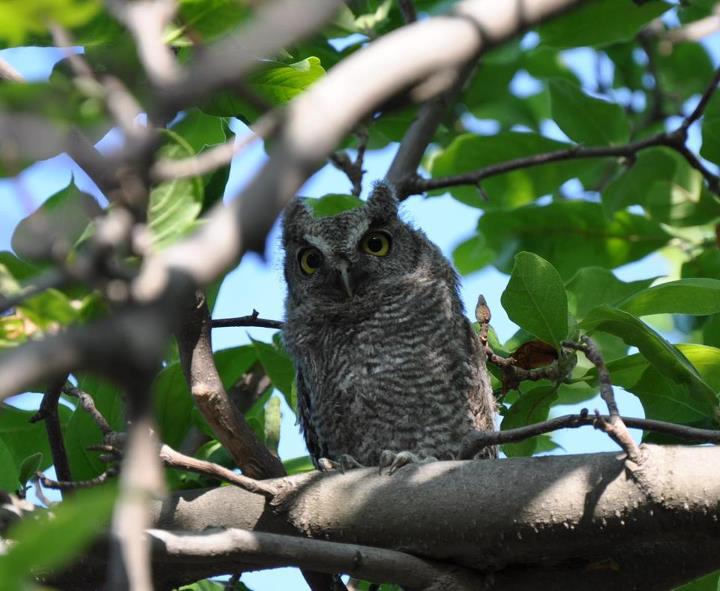
It was a small owl, maybe 8″ high, just looking at me.  She didn’t scare.  I just gazed up at her (I think it was a hen Western screech owl based on the size and later research; thank you, Rob and Jennifer) for a bit, and she back at me.  In eleven years of residence here, we have never before seen or heard a single owl, much less in broad daylight, much less perched in the magnolia and willing to let people approach so near.  Without making sudden movements, I went to the house and called Deb to come out with her camera.  Out came my wife, camera in hand:  “Oh, my god!  We never had an owl before!  She’s beautiful!”  Deb hurried to snap a lot of pictures; the owl followed us with her eyes but did not scare.  Hi.  I’m an owl!

Then I realized that this was bigger than simply a treasured moment sighting an extremely cool little owl in our yard.  Deb’s tutelary is Athena, Greek goddess of a lot of things:  business, warfare, victory, law, crafts, wisdom.  All of which, of late, come very much into focus for Deb and I as we deal with some adversity.  Rather more regularly devout than Deb, and though I am Asatru (Germanic heathen…we are the Viking pagans, in essence), in my regular nightly homages to my gods, I continue also to honor the Hellenic gods.  Athena among them; Athena’s symbol is the owl, seen on much ancient Athenian coinage and art dedicated to the city’s tutelary and namesake.  It would very much seem I might not have just been talking to the midnight wind.

I mentioned this to Deb and suggested she go in and get some raw meat and a glass of wine.  Maybe the owl wouldn’t want the meat, but it was in the nature of offering.  We did a small observance of welcome and blessing as the owl watched us.  If there were any sprinklers malfunctioning, I’d just have to find out about them later.  We watched for a while, then left her in peace.  Either way one looks at it, it was a marvel.  If one is not spiritually inclined, we got to see a wonderful owl, and got closer to her than one ever logically expects.  I myself am not the type to believe in coincidences that are too multi-faceted.  To Deb and I, this owl symbolized favor, hope, support and guidance in difficult times, a sense of being less alone against adversity.

For those who read this far, here’s one of Deb’s pictures of the owl.

A Western screech owl that visited us.

“What’s that smoke?” “Oh, he’s started mowing.”

Where I live, irrigation is necessary to have lawns.  Call it wasteful if you will, but first know the realities:  our irrigation systems were primarily built to sustain agriculture, and by providing it to homeowners as well, the cost of that system is better supported.  Also, the Columbia is about half a mile wide near me, showing no signs of drying up any time soon.  Oh, and I have to pay $400 a year for it even if I don’t use it–‘water rights’ are associated with the property.  So, yes, we live in a desert, but not like the deserts of southern California, grotesquely overbuilt for the water supply and beseeching it from five states away to support breakneck sprawl.

Each year, this means some maintenance work for me.  In fall, I must shut off the main, and have the system blown out.  I pay a guy with an air compressor who does this every fall, enabling him to pay for a family vacation every year.  He’s willing, reasonably priced, pleasant and thorough.  If I do not do this, my entire underground piping system will be destroyed that winter.  Not ‘might.’  It will.  In spring, it’s time to turn the system on.  I don’t like mowing my very hilly obstacle course of a yard, so I’m in no hurry to do that.  It usually doesn’t happen until Mrs. Anderson comes to me (again) to ask me politely when I plan to turn them on, reminding me (again) that her raspberries are actually watered by my system, and won’t thrive unless I get moving.  I usually do.

That process involves turning on the main and running a test watering from the entire system, which is set out quite illogically.  It involves frequent drenchings at the very least, occasional slips and falls onto ass in wet grass, and often repair work.  If a whole valve is hosed, I call professionals.  If it’s just a broken sprinkler or riser (that’s the piece going from the pipe to the sprinkler), I get to dig in mud, use a special tool to extract any broken pieces of riser, put in a new sprinkler and correctly aim it, etc.  This was a good year, with only minor issues.  One year, I had five Old Faithfuls, in which the riser is completely broken off and water gushes 3′ in the air.  I learned about this when Bill, who has the misfortune to live downhill from me, came over and asked me quite courteously if I would see my way clear to do something about the water pouring down his driveway.

Once I do this, of course, I will soon need to mow.  Some years I sharpen the mower blade.  Most years I change the oil.  However, I am prone to overfill the oil.  My philosophy is that overfilling is not good, but a seized engine from lack of oil is rather worse.  This year, it seems, I went a little overboard even by my standards.  I learned this within about the first five minutes of my first mowing, when my mower horked up a very dense cloud of acrid white smoke.  This is not part of the usual plan.  The cloud’s thickness was quite impressive, like a mortar had thrown a smoke shell near me.  In some alarm, I turned the mower off, went in and did some research.  It seems that excess oil is vented into the exhaust pipe, so the oil had probably sloshed into there as soon as I had occasion to tilt the mower for any reason.  As soon as the pipe got hot enough, it started to cook off the oil.

Here is what’s amazing:  this happens nearly every time I change the oil, but by the time it does, I have forgotten the above explanation and must re-research this particular problem.  Why don’t I remember?

Maybe it’ll help if I blog it.  And if it doesn’t help me, people can at least smile in wry amusement that my neighbors can usually gauge my mower maintenance by the air pollution that results.

_In Search of Gentle Death_ now in print!

And now, with the book safely on dead (hopefully gently euthanized) trees, I can tell the story of my small part in this important project by my friend and colleague, Richard N. Côté.  In Search of Gentle Death is a history of the modern right-to-die movement as it has evolved in many nations. I served as the final proofreader in a whirlwind, crash process earlier this year that had me seeing strange things due to eyestrain–and it was worth every moment.

I’ll skip the synopsis here, since the link provides one, but my enthusiastic endorsement of the book probably won’t stun you. As a participant, I can’t ethically put up an Amazon review.  I can tell you that Dick is a dedicated researcher and social historian, and he hasn’t failed us here.  Not one bit.  For some samples of his best previous work, I commend to you Strength & Honor:  the Life of Dolley Madison, and City of Heroes:  the Great Charleston Earthquake of 1886. If you are at all interested in the right-to-die movement, Dick talked to all the right people, which isn’t as easy as with, say, the quilting or racquetball communities. To a certain degree, the movement exists on the ‘down low.’ In many countries, helping a terminally ill person end life on his or her own terms can mean jail time. Even providing or publishing the information is illegal some places. Therefore, not everyone has these folks on speed dial, or can get them to speak frankly. Dick will tell you where the movement has been, is and is going.

For the project’s first five years, specifically until its final month, I wasn’t part of it except as a projected advance copy reviewer and general waver of pompoms. I’ve known Dick for some years, and he’s given me heaps of helpful guidance. Now and then we’ll have a fine chat on the phone, usually about our current projects and/or the current state of the literary markets. That’s how I knew about his progress with In Search of Gentle Death. So happened, at about the typesetting stage, Dick sent me an advance galley of the front material and first chapter of the book. After typesetting is supposed to come final proofreading. What Dick hadn’t known is that proofreading is my wheelhouse, one of the very few things in life I do well enough to have an unbearable ego about. I spotted a misspelled name and reported it to him. (Amusing side note:  it was that of the infamous Tim LaHaye, author of some apocalyptic religious novels.) I offered to be the final proofreader, knowing that if I saw that one on a cursory read, there’d be more. After I reiterated the offer a couple more times, Dick advised me in his trademark jolly way that I’d made the mistake of offering too many times, and as my punishment, he was accepting my service.

It would be a fast-paced, demanding job, and I was looking forward to showing my stuff. Editor Diane Anderson and editor/typesetter Betty Burnett seemed to have fine chemistry with Dick from the outset, so I’d be coming onto a team that was all business and tightly focused, with some work to do in order to show that I belonged. I’d also be pointing out people’s errors, which demands a certain degree of tact. In this world, no one hates you for doing that, provided you do so with professionalism and good humor. A license to nitpick.

My pace was about a chapter a day, sometimes a little more. The only work I did on the computer was compiling and e-mailing the list of items needing editorial attention. The actual proofreading involved printing the chapter, taking it upstairs, reading it, redpenning it, and slapping post-its on the pages. Dick told me I didn’t have to look up all the names. I ignored him and did it anyway, and glad I did–found a fair number misspelled, but as a whole the book was not heavily littered with typos. After my initial pass on a chapter, I set it aside for about eight hours, then came back and proofread the whole thing a second time with tighter focus. This typically turned up about as many items again as my first pass. In a couple of cases, when I saw a suspiciously low typo count, I presumed I’d been phoning it in, snarled at myself for slipping, and read it all a third time.

It was a mentality not alien to a totalitarian regime’s interrogators: everyone is guilty and must confess. Thus, the typos were there to be found, in my mind, and by the gods I had better get every one.  Ninety-nine out of a hundred was not satisfactory. If I needed additional motivation, I could always consider that Dick had been working on this for five years. Five years of a man’s life, great effort and expense invested. Yeah, I’d say that merits doing whatever it takes to do the job justice, even if not for the need on my part to justify a ginormous ego and some fairly loud boasting, to say nothing of simple professional pride.  Yeah, I was going to bust ass on it.

I did this work for about three weeks until I caught up on the previously typeset material.  About that time, I began seeing strange things in my lower right field of vision and went to my ophthalmologist, who told me my eyes were fine but sent me for a carotid ultrasound and (when that proved normal) a brain MRI. Of course, my friends all razzed me that they hoped the MRI found something. It did:  that I did have a brain, it was functioning as designed (for good or ill), and that nothing was wrong. I put it all down to eyestrain and stopped worrying about it.

Dick was still writing the last two chapters as my proofing caught up to him.  On those, when I got the galleys (literary-speak for edited but unpublished manuscript), I would be the bottleneck, the whole project waiting on what I might find. I think he was fully booked out by then, at utmost strain of effort to finish, though still keeping amazing good humor considering he probably wanted to just knock back a bottle of Chardonnay and sleep for three days. What I hadn’t told him at the outset was that in real crunch times, I have another gear. Can you imagine what kind of lunatic gets an adrenaline rush from proofreading under pressure? You’s lookin’ at him. I got both chapters turned around in about two hours each as they came to me. It felt like being the setup specialist in a baseball bullpen:  come in, throw a double-play ball, fan the next batter on two sliders and a knuck, put out the rally and hand it off to ace closers, lefty and righty.

Most of my interaction was with Dick and Diane, only much later in the project with Betty (with whom I’d have liked to get better acquainted, but we were, well, busy as hell). I’ve worked with a couple dozen editors, and most ranged from good to superb. This crew can all take their places in the top tier of that listing. Our relationship was bantery when it could be and frank when it had to be, such as if I was marking up something the author/editors had already decided needed to stay as given. (Editese: ‘stet’ is the term for this, short for ‘let stand as set,’ meaning “don’t change it.”) Probably 1/4 of my catches ended up stetted, I’ll guess. That’s perfectly fine. My work wasn’t to change anything, simply to notice and pass everything on for the team to evaluate. It was a wild literary ride, but a happy rollicking one, livened by Dick and Diane’s cheerful wit and a sense of socially productive work.

Wouldn’t have missed it for the world. Glad I didn’t shut up about it in the pre-beginning! Dick, Diane, Betty, thanks for having me. Truly an honor.

Buy the book direct from Dick

Buy the book from Amazon (when it gets into stock there)

Needy writer syndrome

This is not so much a condition as a phase most writers pass through.  It’s the phase where you are bugging anyone and everyone to read your sonnets, screenplay, novella, or whatever.  If you have matured somewhat in your writing, you may want honest critique.  If you have not matured in it at all, you just want them to tell you it’s great.  My own travels through this phase lasted longer than I am glad to report.

Unfortunately, most people don’t want to read it, and they really don’t want to give you honest feedback, in case it completely blows.  Take it from me:  if you give something to someone to read, and you don’t hear back, either they just kinda didn’t do it because they really just didn’t want to, or it was a terrible piece and they are afraid to tell you so.

If you were going to be really smart about it, you’d pick up a copy of Stephen King’s On Writing, digest and absorb its lessons, and then you wouldn’t benefit from this blog post.  However, you probably won’t buy and read that book.  In that case, what you need is a writers’ group–and I don’t say that very often, because I have had very little luck with those.

The benefit of the writers’ group is they are going to read your work and critique it.  Their critique may be fair or unfair, smart or dumb, but they will read it, and you will likely improve.  You’ll get past Needy Writer Syndrome faster because you won’t be after everyone to critique you, and that’s all to the good.

Marital justice

As some know, I’ve had some bumps in the road lately, some very saddening.  And yet, even at such times, something funny can happen, and if one can’t still laugh, one simply rejects whatever the cosmos is doing to try to cheer one up. Not wise.

Tonight Deb and I were watching the Survivor reunion episode, where Colton had every chance to prove that he was something other than a twit, but wasn’t strong enough to do so.  Too bad.  At one commercial, rather than mute the TV and try to avoid seeing silent car advertising, I got up to hit the restroom.  Now, Deb at times thinks it’s great fun to block me from whatever I want to get done at a commercial.  I guess it’s just her way of being playful, but it isn’t always my favorite joke.  So, tonight, she hurried into her slippers hoping to get in my way, but even with bad knees I was too swift and agile for her.  Around the corner I darted.

She does not habitually admit defeat at that point.  As we all know, to urinate, men typically stand before a toilet and lift the lid (which we had put down previously, as we are admonished without cease, by guess whom).  I did in the typical fashion.  Deb sandwiched herself between me and the commode, confident I would not, well, just go anyway.  (I’ve been tempted a time or two.) I gave her the “really?” look.  No effect.

With an air of exaggerated defiance and satisfaction, she prepared to assume the traditional female posture of urination on a commode–in such a hurry that she didn’t stop to consider that the seat was up.  I saw this immediately but said not a word, of course.  Down she sat–on the icy porcelain, the thing no female wants to sit on, for several easily grasped reasons.  Her eyes went wide and she bounded up as I started laughing.  No normal laugh, but a belly laugh, the kind that doubles one over.

She used a profane term for me that means the rectal opening, and also called me a ‘meany’ as she fled.  There I stood, bent over laughing, trying to figure out how it was that I was the ‘meany’ and other choice terms, when it had been her giving me trouble in the first place.

“On the blog!” I called out after her.

“No way!” she exclaimed.

“You gotta own it, dear,” I rejoined.

Sure enough, after the show when I headed downstairs with my hasty notes, she tried to block that also.  However, I threatened to just go to her computer and post it, and she yielded with dire threats.

They didn’t work.  And I had a very difficult time typing this, because every time I think about it, I start laughing my head off.

When you find yourself a human vending machine

This is something that giving persons tend to see throughout their lives:  the toxic evolution into something not a friend, but a human vending machine.  When are you such a thing? When a person or person begins to take you for granted, make you their ‘easy way,’ expect some commodity of you on demand:  emotional support, information, some sort of effort on your part, whether you feel like it or not.  Those with specialized knowledge, especially in technology, particularly become the vending machine of choice because it’s ever so much easier to just impose on another than to use one’s mind and resolve it oneself.   Persons who do this are rarely emotionally stable, and tend to have significant issues.  I don’t know the official definition of co-dependency, but I suspect it plays in.

Such situations aren’t hard to identify.  The person involved rarely asks about your own life or needs; doesn’t really care, as machines don’t have needs.  He or she shows frequent signs of instability.  This person often praises you, perhaps to the skies, and why not? That’s supposed to be your payoff. That’s the unspoken deal, that you will be told regularly how wonderful you are.  A person constantly raging about his or her other vending machines, for example, doesn’t imagine you to be thinking:  and one day, it will be me.  And yet, if you are perceptive, that is what you are thinking. You as vending machine are being tapped for support because other vending machines have started eating this person’s quarters, perhaps.

To test this status is simple.  One day, simply eat the quarters.  Not angrily, not cruelly, simply don’t perform the expected behavior.  Most often that comes when you are at a limit, or at your lowest ebb in life, and simply can’t fulfill the demanded role–it’s not that you choose to eat the quarters, but that you lack the resources to process them.  In any case, the vending machine doesn’t operate as it always did.

If on that day, the individual simply kicks the vending machine and stomps off, yeah, that’s what it was.  Don’t feel too bad for the loss of a toxic situation.  On the phone, it usually takes the form of hanging up on you. In person, someone stomps off; on chat, someone fires a barb and logs off so as not to receive a rejoinder. I have a dear friend who moved away from a place she lived for decades, and most of her ‘friends’ reacted with shock and anger: the vending machine was not even going to eat their quarters, but was going to be removed from the vicinity. A few wanted to keep in touch, wished her well, and were happy for the improvement in her life, even if that meant less access to her.  Those few wanted her in their lives not for what she could do for them, but because they cared for her and believed, correctly, that she felt likewise. Everyone else gave the machine a vicious kick and stomped off, presumably to find another machine.

So on that day, when you eat the quarters, you’ll learn something about that person. If he or she now makes time to care for you, understand that you aren’t available in the normal way right now, and gives of him or herself, that was never a vending machine relationship–even if at times it looked like one.  In vending machine relationships, the machine isn’t allowed feelings.  If yours matter, then it’s not that sort of toxic dynamic.

If he or she kicks the machine and stomps off, my advice is to say nothing, turn, and walk away.  Don’t look back.  If that person shows contrition later, suspect it.  Rarely, it is a true epiphany; most often, it is sudden regret and realization that they may have permanently broken the machine, and a desire to get it back in working order.  You can accept the show of contrition, but it does not obligate you to resume vending machine status.  That’s the key. There need be no hard feelings, no animosity, but that does not imply that you must once again open yourself up to another kick. If you do, in my view, you are not showing much self-respect. If you do, you are partly the author of your own future misuse or abuse. How can it be otherwise? Let mistreatment sneak up on you once, well, anyone can get caught napping. Let it walk right up to you, say a few of the right words, and resume as before? Don’t allow that.  Respect yourself.

That person will need to find new vending machines (he or she has learned how to search for them over the years), and will do so.  Those situations will be toxic also.  However, you do not own that problem.  A very wise woman once taught me:  “Always ask yourself who owns the problem.  Whoever owns the problem needs to deal with the problem.  You can’t own anyone else’s problems.”

She was right.

Blogging freelance editing, writing, and life in general. You can also Like my Facebook page for more frequent updates: J.K. Kelley, Editor.