Category Archives: Technology

By viewing our site, you agree to reams of crap

We see it all the time, do we not? “Use of our site constitutes agreement to [a massive Terms of Service that has probably been read once in history, by the paralegal who mashed it up for the lawyer’s signoff, and contains gods only know what].”

I am making the case for paying such TOS little to no heed.

Here’s my approach: I don’t recognize them. Yes, they probably in theory have the law on their side; no, I don’t care. I will not comply, and they can go to hell for trying to give me orders. Here is my reasoning:

  • No one put a weapon to the organization’s head and caused it to publish a website viewable by the random general public. The information now has the moral privacy rights of a billboard, or the side of a city bus, or the painted front window of a business.
  • I am not planning on misappropriating their information, nor plagiarizing it. If the site has downloadable content, it looks to me like a pile of flyers with a sign that says “take one.” Any information whose distribution they wish to restrict, they will put behind closed doors (requiring login and password, perhaps more). The New York Times does just that. In turn, I decided not to keep visiting the Grey Lady in her assisted e-living home.
  • If the site doesn’t like people using itself unless one allows all the data mining and other widgets to work, fine; have the designers break it for anyone who will not. Oh my heck, they say, but that results in a lot of complaints? Too damn bad, not my problem. If the company does not care about my problems, as evidenced by a bulky TOS, it gives me no moral reason to care about its problems. I have the loophole here and I see zero reason not to use it.
  • Absent some moral reason, only enforceable laws and claims matter. One can claim that someone ‘signed’ an agreement all one wants, but unless one is willing to sue to enforce it, and would win, it means nothing. If the law or claim cannot or will not be enforced, the question then becomes whether it has moral force. For example, taking too many napkins at the burger joint: how many is too many? Legally, it’s probably as many as you can pull out before being noticed and kicked out. Morally, it’s as many as necessary to maintain some semblance of civilized dining. Morally, the business has trusted you without putting up an admonishing sign, or putting the napkins behind the service counter, or trying to tell you that your eating here constitutes acceptance of these terms. Trust deserves validation.
  • The best case for a moral reason comes from sites which ask politely, but do not penalize anyone for declining. Fark.com is one. DuckDuckGo is another. In those cases, with no compulsion, the site’s offer has moral validity and deserves reasonable consideration (and will get same from me).

The same is true for license agreements. The law has let the software industry construct a bizarre situation which now allows, for example, a car company to install software in your vehicle and thus claim that you haven’t really purchased all of your vehicle, that you don’t really own it. In service of the legitimate cause of fighting piracy, the law has let them construe it that you don’t ever actually own anything tangible, just a license.

That’s crap. To me, morally, a piece of software looks more like a book (or a coffee maker, etc.) than like a legal right to do a thing. I believe that if I bought a copy, I own that copy. The law says otherwise, and I do not care. If I duplicate the book and sell copies, that’s morally wrong. If I copy part or all of the book and claim it myself, that’s morally wrong. But if I tear a page out of the book because for some reason I don’t like it, I see nothing morally wrong with that. And if I want to hack the software for my own use and purposes, I see no moral problem with that either. It’s when I rob the producer of sales, or misrepresent the producer’s work as my own, that I step over the moral line. If it’s shareware, though, I should (and often do) pay if I plan to use it.

It is an example of how corporations and government frame a situation the way they prefer, and we allow them to get by with it by speaking in their terms, acknowledging the moral legitimacy of their framing. We could cease to do that.

  • “The TOS says you agree to take cookies and not to block our ads.”
  • “That conflicts with my own TOS, which say screw you, since there’s nothing you can do about it.”
  • “But you made a legal agreement!”
  • “Great. Sue to enforce it, and see how well that works. I don’t recognize agreements done in slimy ways, like four pages of fine print written in legalese full of hidden gotchas. If you want us to make an agreement, make it up front, sensible, and readable. If it’s not stupid, maybe I’ll agree to it. If it’s stupid, I’ll just say screw you.”
  • “You can’t do that!”
  • “Then stop me. There are a lot of things I would stop you from doing as well, perhaps, but I can’t. Better hope I never can. In the meantime, tough; screw you.”
  • “But the ads are part of our revenue stream!”
  • “The implication is that I care about your future. I don’t; we all have our problems. If you feel that way, then break your site for anyone who blocks them.”
  • “That’s not feasible!”
  • “I’m still waiting to hear how your problem is my problem. Some of your scripts, cookies, and such serve useful purposes for site operation; some are just data mining and shoving stuff in my face. My own TOS, which are not written down but which I consider binding, say that I should avoid all data mining that I can, and that once your site attempts it, you forfeit all moral anything and I can use your site however I want provided I don’t damage it.”
  • “If everyone looked at this your way, we’d have to become a pay site.”
  • “No one held a knife to your neck and required you to publish a website. You think it looks like your office filing cabinet. I think it looks like a billboard. I can look at the billboard all I want, and I don’t owe the billboard any data about myself. And if the billboard demands data, I get to flip off the billboard. Do what you have to do, but I’m not letting you frame this from a standpoint of legal or moral superiority. Legally, there’s nothing practical you can do. Morally, you have done the opposite of establishing moral high ground, turning the gesture of flipping you off into a pleasing act of rebellion. Party on.”

The philosophy in play here is simple: we are not morally obligated to comply with a situation/agreement/TOS just because it has some tortuous legal basis. Law is not morality and shouldn’t ever be mistaken for it. And when we forget that, we are letting government and corporations define all the terms, set all the parameters, dictate right and wrong.

They’d like that, wouldn’t they? They do like that. They hope you will troop along in submission.

And what of my own website, this one? Well, I’m the maintainer, not the user. I can’t do anything about whatever rules WordPress imposes; it imposes some on me, and I have to abide by them or they’ll kick me off. I have no difficulty with that in an ongoing relationship as a trade for a permanent hosting platform, since I get something of value.

But perhaps some users don’t like something about whatever TOS WordPress may have. If so, someone will probably circumvent them, with a minor impact on me–one is user data. But how, then, do I feel about the missing visitor data? I feel great about it. My right to compile visitor data doesn’t reach the moral level of my readers’ right to privacy, and if I ever try to say that it does, someone needs to put me out to pasture. Therefore, if you are reading this yet blocking a bunch of cookies or scripts or what have you, okay. I have no opinion on it. If I were the type to set up hoops for you to jump through, I’d be doing that. I am not, and it’s not feasible, and you could just ignore them, so it’s a stupid discussion that we need never have. I am just glad you are a reader, and that you visited today, and I hope you come back again regularly. Thank you for not plagiarizing or misappropriating; those are all I do ask, and I appreciate that you do not do them.

I hope more of us, in more situations, will require a better reason for obedience than “because a corporation tells us so.”

Swoopy cyborg keyboards for writers

I’m fussy about keyboards. And since my work demands that my keys do as they are told when pressed, I can’t afford a crappy keyboard.

That’s what I had until recently, when my space bar wore out on one side. I grant that it was something of a crappy keyboard to begin with, but I did not consider it so crappy it would last only a year. It still worked, but about every tenth time, it would fail to insert a space between words as desired.

If we measure anger in curse words used, and assume that I cursed 50% of the time when this happened, and figure that I type several thousand words most days, we may see that it was getting on my nerves.

It sounds so simple, right? A keyboard’s a keyboard? I suspect that every user has his or her foibles, and here are mine.

  • My keys must do as told when pressed, every time. When this does not occur, I have the disposition of a cottonmouth.
  • I must be able to pop off the stupid Windows keys, sources of so much irritation. Only Microsoft could have come up with those, and put them where literate persons might bump them by accident.
  • The board must have risers to angle it.
  • It must be rectangular, so my wrist rest will stay in place.
  • No decals; I will wear them off in a month. Painted symbols are okay; molded are much preferred.
  • Has to have the full number pad.
  • Needs the full Insert/Home/PgUp/etc. block, by itself, above the arrows like the gods intended.
  • All stupid newfangled keys (defined as anything I don’t ever want to bother with), that I cannot remove, must at least be somewhere I won’t hit them by mistake.
  • Any ergonomically cruelty-free fair trade gluten-free free-range keyboard that looks like it went through a microwave, no way.
  • Has to feel sturdy, not crappy.
  • No wireless. I do not like things that require a battery. I like real cords.
  • No touchpads. Only a technology company could think it intelligent to put a pointing device right where my thumbs are likely to hit, but I don’t even want to look at a touchpad that’s well out of my thumbs’ range. In my ideal computing life, I would never again even see a touchpad.
  • Did I mention that it mustn’t have a touchpad?

You can see why I don’t like laptop keyboards. I’m an 80 wpm typist, and I don’t normally stop every ten words. (80 is not bad, but my wife–who does not spend a tenth of the time I do on a keyboard–slaughters me at a blistering 120 wpm.) I can’t write if the keys don’t do what I say. On top of that, I’m a former bookkeeper whose fingers know where to go, and my fingers had better find the key where they expect them, without me having to send out a search party for some mystery Fn key to use the 10-key or the Delete key.

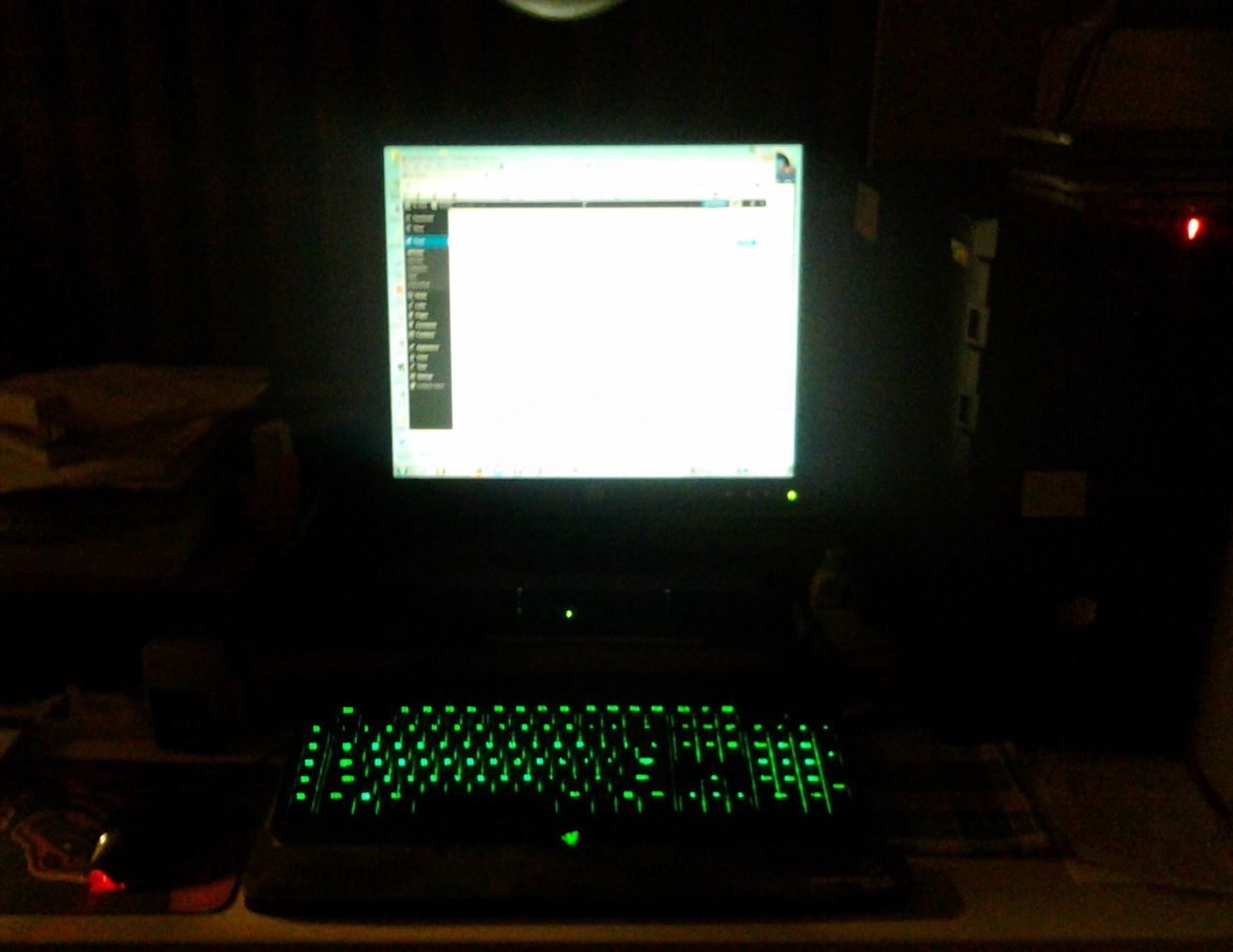
Well, it turns out that my requirements are very expensive to meet. Like $150 expensive. I did find one: the Razer Blackwidow Ultimate, a gaming keyboard that does a crapton of things I’ll probably never want, but has a number that I do:

  • Clicks. I so sorely miss the tactile click.
  • Molded symbols with backlighting.
  • Heavy enough to stay in place unless I choose to move it.

Of course, I was fool enough to assume that I could just plug in one of its two USB connectors, and that the other was for all the gaming stuff I don’t need. Didn’t work. In the end, I had to slide the machine out, shuffle the USB devices, and fiddle with all the cable re-routing. Now my keys glow with green backlit symbols, as if I were some hardcore gamer nightly dealing frags to others around the globe

And joy of joys, Windows recognized it, so I don’t have to install Razer’s software and create an account just to use this thing. At first, it looked like that might be the case.

It’s going to be fun editing people’s romance fiction, Native American historical fiction, and horror thrillers on a keyboard meant to withstand a lot of Cheeto dust in the dark.

razer

The client question I dread most

No, it is not, “Where do you get your ideas?” It is not, “Now that I have gone through and torn apart your completed editing work, will you re-edit it for free?” And it is not even, “Will you look at my child’s writing and give her a critique?” It is not, “How do you deal with writer’s block?”

Not that I don’t dread those questions; I do. But for all of them there are responsive answers to offer: ‘from life,’ ‘not for free, nope,’ ‘only if you understand that I will lie,’ and ‘it doesn’t exist.’ For this one there is no good answer:

“How do I do that in Word?”

You might be amazed at how often clients look to me for Word tech support: on how to enable this feature, or make that go away, in a Word document. Often I am their first point of call, and it does not occur to them that I dread the question.

Perhaps the assumption is that I’m a Word expert, and that I have mental models of every version of Word since Word 97 to summon forth. What else can I assume?

So why do I not just say “no, not my line of work?” Because that come across as bad customer service. It doesn’t matter that the expectation is unreasonable. How I feel is beside the point. If I say what I am thinking, the client will think I’m a jerk, unhelpful, and crabby. That’s no good. Most clients find me easy to work with, helpful, and cheerful, and that’s important to me.

But life is not fair. As an editor, at one point or another in the relationship, every client will ask me for Word tech support, and I will have to attempt to offer it, and if I cannot do it with a happy smile, I must at least muffle the curse words and replace the grimace with a mask of calm. Never mind that I feel like a flight attendant who has just been handed a baby and asked to change the diaper.

What’s the big deal? Why all the stress and dread? Because:

  • I am incompetent at it, I know this, and being inept is intensely uncomfortable for a person who takes pride in capability.
  • I don’t want to become competent at it. I’m an editor, not a technical guru. All I want from my word processor is that it serve my work functions. I don’t want to be the Word Answer Man. I want to help people perfect their brainchildren, combining candor with consideration and camaraderie.
  • I used to be a computer shaman, and came to hate it, and when I left that line of work, my mind and heart left it behind. When I have a computer problem of my own, I don’t go very far trying to solve it myself. I call the tech support guy I know in Utah who does a fantastic job (that’s Ray Ross of Bugzap), and I do whatever he says to do.

So why is it impractical? Why can’t I just joyously answer the formatting question and be happy to be helpful? Because:

  • The client and I are probably not using the same version of Word, nor will we be, because Word gets worse with every new version. I’m using Word 2002 and will not switch unless/until forced, and if forced, may end up switching to a Mac. With each new version, MS rethinks the names of some concepts, and moves some features around so that one no longer knows where to find them, and calls that an ‘upgrade.’ I don’t have time or patience to go on a new treasure hunt every year, paying for the privilege, so I am not ‘upgrading.’ Neither should most people.
  • Clients vary in technical know-how, but writers often seem to take a perverse pride in technical dufosity. Most computer users don’t even know the real meanings of words like ‘login,’ ‘download,’ ‘malware,’ and even ‘word processor,’ thus often we do not even begin by speaking in the same terminology. It is a weakness of mine, related to my line of work, that I count upon knowing exactly what words mean.
  • Since we are probably not using the same version of Word, I can’t know what s/he is seeing, or where/how to tell him or her to start looking. I can, with laborious effort, explain in some cases how it is done in Word 2002. But if it’s Word-flaky, I can’t answer why theirs isn’t working like mine.
  • Since that is the case, the client will probably still have questions, which I can’t answer. I will look useless, feel uncomfortable, and silently dislike the unfairness of the situation, powerless to change it.
  • If on the other hand my help does solve the problem, the client may decide that I am a Word Deity, and may even come to depend on me for Word tech support in the future, since that went so well.

Thus, there is no good outcome for me.

What do I wish people would do? Join a discussion forum about Word. Many are staffed by actual Microserfs, or people blessed by the company. I don’t know of a specific one to suggest, but I know they are there. When I find myself confounded, here’s what I do (or would do if need be):

  • Save a backup copy of your document beforehand. Now you can experiment and butcher it to your heart’s content, because you have a fallback position.
  • Check Word help, though it will probably be irrelevant and clunky. I marvel at how much worse they have managed to make it.
  • If you think it’s a technical problem with Word, restart your machine and try it from a fresh Windows and Word session with nothing else going, just to rule out some potential conflict sources.
  • Use the exact terms Word uses, and feed your problem to a search engine. That will probably lead you to the MS Knowledge Base, or to a message board discussion about the situation, where someone already solved this for someone else. Be sure to include your version of Word in the search, but when the search turns up solutions that seem to apply to other versions, try to run with them.
  • Sign onto one of the message boards that seemed to have the most helpful people. Read the FAQ in case you are about to become the 101,000th newbie to ask this question; it may solve your problem. Be prepared for very brief, direct questions and answers; gurus don’t waste lots of time. Be prepared also for at least a few people who don’t read your post with attention to detail. List your version of Windows, your version of Word, the type of document, what you are trying to do, and if necessary, take a screenie of the problem, using these instructions. Explore anything they suggest.

Some other generally-sound-practice technical tips, while I’m at it:

  • Always save a copy of your work before doing anything daring, so you can revert if you butcher it.
  • There are two types of computer users who do not back up their data files: those who have lost data that way and do not learn from their mistakes, and those who are waiting for doomsday.
  • Just because software offers you an update does not mean it’s always an upgrade. There are exceptions, but the usual result is everything gets moved around and you gain nothing new. Firefox is the poster child for software that gets worse with every new version.
  • If you do not keep a virus scanner updated and current, you are just waiting for the suffering. If you take my advice, you’ll either go with Panda AVG for a free version, or for a powerful pay version worth every penny, Eset’s NOD32. That’s what I use. When I hear that someone got a free trial of McAfee and just stayed with that after the trial period expired, that’s someone I’m expecting to hear got a virus.
  • Not everything your computer vendor pre-installed is garbage, but a lot of it is free trials, tutorials you will never use, and other whizbang stuff from which you can not benefit. Always be careful (like the time I uninstalled a network speed monitor and it took my Internet access with it), but a lot of that is just crapola that can be uninstalled.

The E-Tranquility Catechism

I find this mantra to work for me like the Desiderata for some, or Psalm 23 for others, especially with my morning coffee.

The E-Tranquility Catechism

  • I can get through an entire day without letting a person I’ve never met make me angry.
  • I do not have to respond to every stupid thing people say.
  • No one is entitled to demand an answer of me.
  • I may stay out of any discussion, even if it covers a subject about which I feel passionate.
  • Some of my friends keep idiots around. It does not matter why; it only matters whether I let the idiots affect me.
  • Most people do not write with care, so most people do not read with care. If someone responds to a thing I did not say, I am free to write simply “please read it again before you respond.” If the person does not, I am free to cease wasting time on him or her.
  • A good person can be irrational on a given issue. If I do not accept the bait to trigger that irrationality, life will go on, the sun will rise tomorrow morning, and someone else will probably trigger it.
  • Likewise, a good person may be a hothead. Another’s tendency to overreact does not obligate me to overreact. It is a discussion, not an attempted robbery.
  • There will be people who, for reasons I do not understand, find it stimulating to begin gratuitous and ill-informed debates with me. I am not required to indulge them.
  • Social media are not a scavenger hunt, where failure to ‘like’ everything possible could give offense. Anyone who weeps openly because a post did not get ‘liked’ needs to wait for the advent of FaceBubbleWrapBook, not whine to me, for I am not obligated.
  • If I find myself losing composure, I will step away and watch some old Beverly Hillbillies, and try to emulate Jed rather than Granny.
  • Before I engage, I will consider age. If an elder writes something absolutely clueless, I will bear in mind how many of his or her peers don’t even have the guts to participate, and I will show respect through silence. If an elder wants my opinion on clues or lack thereof, s/he knows perfectly well how to ask me for it.
  • If a child is obviously whining for attention, unless it is my child, I will let someone else be dragged into the vortex.
  • I will recognize that some adults are emotionally children at times.
  • If someone is suffering political incontinence, I will not gawk or stare or laugh. This is not Walmart. I will look politely away and go somewhere else, to spare their dignity while they soil themselves.
  • I need not be irritated by fetishism. Whether the fetish be cats, dogs, kids, camels, lame self-reassurances, trigger issue posts, preaching, anti-preaching, or any other personal quirk that baffles me, I may choose not to let it affect me.
  • If the forum has a blocking feature, I should feel no compunction about using it. However, I should realize that each time I use it represents on some level an admission of failure.
  • I will stay out of anything that is assuming the shape of a pear.
  • If while composing a reply, a vile profanity plays on my mental dictaphone, I will recognize that that now is not a good time to reply at all.
  • Above all, I will recognize trolls and trolling for what they are.

Turning the Windows Security phone scam into amusement

Everyone has his or her way of dealing with obvious phone scams. Some just don’t answer the phone unless caller ID checks out. Some pick up the phone and politely say they are not interested. Some pick it up, curse and hang up. There are many attitudes one may take: karma will get them, it’s not worth one’s time, be nice to everyone–even scum deserve peace and love, meanness only hurts you, and so on.

I’m not here to judge those attitudes, but I do not share them. I don’t really believe in karma, and in any event, I believe that I can be the agent of negative feedback for bad behavior. It’s not worth my time if it makes my day worse, but if I walk away feeling I did a good thing, it may be well worth while. I do not believe that criminals deserve courtesy. Life has taught me that criminals need to have an unpleasant and unproductive experience. Now and then, life summons me to be the agent of that experience.

Phone scam callers are criminals who prey upon the most vulnerable people they can find: the very elderly, the fearful, the ignorant, and so on. I can’t tell anyone how to view that, but I view it as so contemptible that the question is not “should I annoy them?” but “if I ditch the chance to annoy them, what kind of passive enabler am I?” I will take action against them in the same way that, if I saw someone breaking into your house, I would not just walk past and say “not my problem.”

The Windows Security phone scam goes like this. An out-of-area number shows up on caller ID, sometimes looking like a US number, sometimes ‘private caller,’ sometimes a strange number beginning with a V. No matter how you answer the phone, the script begins: a very heavily south-central Asian accent, perhaps Indian or Pakistani but could be from elsewhere, identifies himself by an English name and says he is calling from Windows Security about your Windows Computer. Note that upper case is used advisedly, because he will repeat both terms often. He explains that they have identified a problem, which may be a virus, a scam, or some other malady that your system is propagating.

Of course, he wants you to go to your machine and navigate to a website, where he can rob you blind.

Since this is an enemy operating under deceitful premises, undeserving of fundamental kindness or empathy, we should do our intel analysis on him (and it is always a he). We may assume:

  • He will not understand heavy regional accents or slang. This means that you control the degree to which he has any idea what you’re talking about.
  • Likewise, he probably cannot tell a US accent from a Canadian or Australian accent. I speak French, but I can’t tell you if the speaker is from Marseilles, Brittany, Haiti, or Saint John. In Spanish, I can tell a Spaniard from a Mexican, but not a Mexican from a Guatemalan.
  • He is using a phone connection that, due to distance, means that sound is not simultaneously bidirectional. This means that if you talk over him, he gets only scattered words.
  • His goal is to talk you to the website, and as long as he imagines that possible, he will try. This means that if he hears enough promising words, he will stay on the line for a while.
  • He has stock answers for a few standard questions: “what is my IP,” “where is your office,” and so on. Lies, but meant to sound plausible. This means that the normal challenge questions are pointless.
  • He will seek to remain in control of the conversation, just like a car salesman. Thus, when he cannot control it, this will frustrate him.
  • He is used to dealing with the computer illiterate and confused, because those are his prey. The dumber you sound, the juicier a target you seem to be.
  • He is very far away and has no idea whether you even own a computer. The odds that he can retaliate against you are remote. Thus, it’s not like telling your local legislator to perform a disgusting and illegal sex act, which might just inspire him to find a creative way to get back at you.
  • The only thing he knows about you is that you are an American. He assumes that you are therefore stupid and gullible. This should offend you, even if in an alarming number of cases (who do not read the blog), that’s not far-fetched. His opening stance insults your intellect, so in addition to being a criminal, he’s offensive and bigoted.
  • While he is on the phone with you, he is not bilking Mrs. Edna Miller of Wheatena, KS out of her Social Security money, nor rewarding Mr. Olaf Nielson of Ice Lake, ND for his brave Korean War service by ripping off his VA money. Your donation of time is bread cast upon the waters, a random act of protection for someone you will never meet. Time is finite. And if enough people donate a bit of it, the scam may become unprofitable.

So how can you ruin his call and waste some of his time? Oh, there are so many delightful ways. I derived many of them from my own experience as a computer shaman, remembering the most irritating clients I had, and found others online. I recommend you vary them, always remembering the things you may not legally do: threaten violence, impersonate the secret police, and so on. Mix and match, and find the method(s) that work(s) best for you:

  • Remove ‘yes’ and ‘no’ from your vocabulary, merging them into an indefinite grunt that sounds like ‘hunh.’
  • Affect the most outrageous accent you can pull off. Go full Clampett. Do a terrible Cockney. Pretend you’re Borat or Cheech Marin or Pee-wee Herman. Test out your New Jersey or Boston phonetics. See how much hip-hop slang you know. The Anglophone world is delightfully diverse.
  • Talk over him, in short sentences. He will get only scattered words due to the connection.
  • Find a random device in your vicinity, and pretend that it’s a computer, and have him talk you through what he wants done. He doesn’t need to know it’s your microwave.
  • Use very big words and accent the wrong syllables. That will make it hard for him to understand you. He is a foreign speaker, and accented syllables are very important to comprehension. Even if he knows the word, recognizing it over the phone when mispronounced will be a challenge.
  • Tell him you are using a version of Windows that is obsolete or never existed. Windows 3 is a good call for obsolete. Windows Works Home Edition would be a good fictitious version.
  • Affect an inability to differentiate Windows, an operating system, from Microsoft. Or from Excel, a spreadsheet application.
  • Mix up your technical terms, using ones you have heard but do not know precisely what they mean (for most people, that is most technical terms, like ‘download’ and ‘login’). Just throw them in. He knows what they mean, probably, and will either make wrong assumptions, or will get bogged down explaining things to you, which of course you will misunderstand. Tell him you bought a rootkit online. Affect not to grasp the difference between Windows Explorer and Internet Explorer, and oscillate back and forth.
  • Invent words you know do not exist. Ask him how to disable the contrapulation software. On your finger drive.
  • Let him actually guide you in the direction of the website, but keep ‘mistyping’ it. Make him repeat it back many times. Careful, though, about slipping in .org rather than .com, for example, because they may have the scam set up at similar-looking domains. Pretend not to understand. Tell him it says ‘404 not found.’
  • Tell him you went to the website and that it’s porn. Give medically graphic details. If you need help, go to some actual porn and just describe it. Express that you find it immoral.
  • Mispronounce, commingle, and butcher product names. If your computer is an Acer, pronounce it like ‘occur.’ Tell him you bought a Hewlett-Packer-Dell with Microsoft and Adobe Internet.
  • If you have two phones, put your husband or wife on the other line ‘to help figure this out.’ Revel in your spouse’s creativity.
  • Repeat back his instructions in ways that suggest you did not understand what he wanted. He can’t see what you see, remember.
  • Talk to your cat now and then. Let the caller sort it out. If you don’t have a cat, for purposes of this call, I herewith gift you an imaginary cat named Boris, who is swuch a wittwe snwookums. If you need more cats to pull it off, add to taste.
  • Start a friendly line of inquiry into his accent, telling him it’s charming, and ask where he came from. Take an absurd guess, like Finland or Japan. Ask how his day is going. Tell him he must be very proud to be helping clean up all those virus spam malwares.
  • Let your mind and your topics wander. Our society likes brief bullet points, sound bites, getting to the point. We are conditioned not to bloviate, interrupt, or say irrelevant things. Suspend this conditioning. Technical people especially hate wasted words.
  • Invent a grandson or nephew who is your main technical advisor. (Your scammer is probably very sexist and would not believe it if you cited a granddaughter or niece. Likewise, if your voice is identifiably female, he will probably make foolish assumptions about your intellect that can work to your advantage.) Extol the kid’s computer virtues relative to yours, the Second Coming of Spock. Frequently cite spurious, irrelevant, or stupid technical advice as coming from the whiz kid.
  • Work in obscure terms that only a very fluent (and somewhat perv) English speaker would know refer to kinky sex toys. See if he tries to use them in sentences responding to you while he tries to figure out what the hell you mean.
  • If you can, record the whole conversation and share it for comic value.
  • Go beyond everything I have suggested, and invent your own ways. Please share them with me in comments, so I can learn and grow with you.

Alternatively, you could just go to an online dictionary of profanities, but the trouble there is you don’t know his native language, so that will usually fall flat. Although when you score a hit, the resulting loss of composure can be most entertaining.

Gamergate and women

From what I understand, Gamergate began as a brouhaha about journalistic integrity in the game industry (a longstanding oxymoron), then morphed into game nerds harassing women in ways they didn’t harass any of the men involved. Is that about the sum of it?

I don’t care much about the game industry or its media; if they have a -gate of some sort, well, whatever. The dominance of Steam, the decisions of console makers and developers, and perhaps my own focus on other interests make me less of a gamer now than I used to be. But I care a great deal about the subject of how women cannot participate in situations without experiencing bullying and harassment. I’m not joking: if I were female, by now I am pretty sure I would have completely lost it. I don’t know how the women keep it together. (I can think of a dozen rejoinders to that. “Some don’t.” “Why do you think we do things and go places men shy away from? It gets rid of you for a while!” “Go to a women’s prison–you’ll see the ones who lost it.” “You’re asking it wrong, buster. Why is it your gender can’t learn to woman up?” And more.)

When we talk about game nerds sending death threats to women, publishing their contact information, and treating the women in ways they would not be treating a male, I suspect they come from a demographic long and often mocked: socially awkward, generally unathletic, mostly gifted males who in years past gathered for D&D, but who now gather–only virtually–in online gaming environments. This accounts for a percentage of those young males who play games, though I do not know how large the percentage is. Since these young males are not in any socially protected group, it is socially acceptable to mock them on principle without limit. It is supposed that most are gifted, but if they are, a good percentage are not all that intelligent. If they were, they would not go Full Jackass at the very hint of a female presence.

That’s why you can’t get boned, boys: because you have never taken time to develop the skills that would enable you to relate to women. You can’t ask to be ‘accepted as you are’ if ‘as you are’ is repellent. Do you like being treated like a bizarre novelty? No? Women might tell you ‘welcome to the club.’ They don’t like it either, so they tend to shy away. When they reject you, they are not being evil oppressors. And I submit that the singling-out of women in this situation tells us a lot about what’s going on inside.

The women aren’t your oppressors. They are not what inspires women to react to you as if you were a live skunk. If you have an oppressor, it is yourself.

I don’t especially care about the Gamergate brouhaha in and of itself, but when I hear about intimidation, even death threats, that will get my attention. If you’re a gamer and you are completely opposed to that, good. If you made excuses for it, or thought it was awesome, you represent the problem.

It is your choice to build social graces. It is your choice to use your intellect to adapt. It is your choice to learn what is important to other people, what they will tolerate, what they will not. It is your choice to stop being a jackass. It is your choice to decide that females are fellow human beings, who look and generally think a little differently, but deserve decent and polite treatment.

If you choose instead to be a jerk, then when the women edge away from you, and your porn dependency advances, fault yourself. Real women do not and will not behave like your porn. That’s why it’s fantasy, just as games are fantasy. And don’t try to tell me your porn consumption isn’t getting toward a dependency level, either.

However, there is a way out of your solitary world of customized self-gratification. It’s a tough level to beat, because it takes time and involves mistakes. You will reload it again and again, but it can be beaten. I am 51, I credit gaming with saving my sanity and giving me much of my teen and young adult social life, and I am happily married to a woman I would not trade for all your porno women. My wife does not mind if I game. In fact, she believes that nerds make better lovers because we try harder.

(Yes, I am going to keep calling you ‘game nerds.’ I was a game nerd back when that meant playing Asteroids for two hours at a pop, kids, or D&D until 5 AM. Unless you are over 35, you were not yet whelped at that time. I have earned my right to call you what I call myself.)

The catch is that not enough game nerds do try harder, because many become caught in the spiral of social awkwardness. It’s hard to break out of social awkwardness. I know how hard it was for me. It involves mistakes, embarrassment, stepping outside your comfort zone. It does not provide immediate gratification. The early reactions make you just want to hole up again, back in the comfort zone of the game environment, assuming an identity other than your own. The game is imaginary, but its comfort zone is not. From the comfort zone, you can vent your humiliation by behaving however you like. It is where you find your own kind, where you are not abnormal.

The way out involves self-honest assessment of what went wrong this time. Women are not vending machines, where if you dispense the correct change, they will produce a predictable result. They are people, who differ and vary, and there is no perfect formula that will always inspire them to like you. If you view it as finding the key to beating a level, you will fail. Most of the time, when I see a young man who reminds me of me in my teens, he’s complaining that he did X and Y and it didn’t work. That’s the vending machine approach. It is never that simple. If you understand that you must learn what you did wrong, and that it is not the others who are bad and mean, then you’re equipped to use your considerable smarts to change who you are. Of course, then you will learn something else you did wrong, and keep addressing the somethings wrong until you can’t come up with much, as demonstrated by the fact that you’re being invited back to places.

Overcoming social awkwardness is like getting bleu cheese dressing out of a bottle. At first, it just hangs there. Then a little bit comes out. Then too much. Then a steady, encouraging flow. Then you are at the phase where you know there’s a lot stuck to the walls of the bottle, but if you turn it upside down and wait, when you open it, there’ll be a mess.  At some point, you accept that there’s always some dressing left into which you will never dip Albertson’s deli spicy chicken strips.

“But I want to be accepted for what I am! How is that wrong?”

If ‘what you are’ is a jackass, it’s wrong, because it is unreasonable to present society with the demand: “Love me! I’m a jackass!” No matter what your mother told you growing up, you aren’t automatically wonderful just for being you. She was biased, and the prevailing culture and her own emotional needs conditioned her to say that to you. If you think it through, for her to say otherwise would have been to say that one of her most important life works was faulty, and she wasn’t and isn’t going to do that. You might appreciate her, but she’s not objective. She almost can’t be. Her connection with you is far too intimate for that.

Being wonderful takes no work at all for some people. They have it pretty good, and they have a hard time understanding why others don’t just automatically do the same. For social clods, such as myself, trying to be wonderful is a work in progress toward a theoretical goal. If you turtle, and quit trying, your skills atrophy, just as it takes time to get back into a game if you don’t play it for a while.

My father was like me, but before there were games to nerd about. So he became an engineer, then a radio control model nerd. His social life occurred only on his own terms with fellow R/C nerds. Everywhere else, he stopped trying. And when he found himself alone, having alienated his children and his wife, he went into serious but not dangerous surgery, seized up, and died. I’m pretty sure it was his final flight from social awkwardness. I decided to fight against social awkwardness because I didn’t want to die alone at 54.

Your social life does not have to suck. Plenty of game nerds are like me. They have good relationships, work and play with women just fine, and do not engage in harassment. The lonely nerd stereotype only goes so far. Being a lonely nerd is a personal choice. Being a harasser also is.

So what will it take?

  • Resist the impulse to become an idiot at the very hint of a female presence. They aren’t that special. There are three billion of them on Earth. They aren’t ivory-billed woodpeckers, and very few are pop stars or supermodels. They aren’t novelties. They’re all over the place. (They even, to my consternation, show up in traditional barber shops.)
  • Understand that feminine companionship is not a divine right. It is earned on personal merit. Every time you become insulting or harassing, you prove that you deserve only the love of your Fleshlight.
  • Accept that much feminine companionship is not romantic or sexual, and value it regardless of love or sex. If you cannot be a woman’s friend, I fail to see how you can be her lover.
  • Shut up and learn to listen. Not just hear and react, but listen and consider.
  • Try empathy, which is not the game nerd’s natural strength. For some of you, I probably need to define it. Empathy is when you take enough time to see the world through others’ eyes, and imagine how it feels to them, and give a damn. If you will not see the world through her eyes, how are you entitled to expect her to see it through yours?
  • If you behave in repulsive ways, break the habit. If you have a really irritating voice, tone it down. If you think it’s funny to fart a lot, or your belches set off seismometers, stop. No, ‘who you are’ is not worthy of acceptance if you choose to be repulsive. Choose not to be repulsive.
  • Sending dick pics, or hitting up random females online with sexual innuendoes, makes you a loser. It never works. Almost no women want that. And of those who might appear to, often they are just retaliating by letting you make a bigger fool of yourself.
  • Examine your social behavior, especially the moments where you lose people. Fault yourself, not them.

You are not going to fit into every social environment. I have learned to tell when someone has simply decided s/he doesn’t like me, and I’m fine with respecting that choice. (Maybe I’m not too fond of him or her either.) I would be outright disaster at a DC cocktail party, for example, and I don’t care to change that. I was never cut out for a fraternity. In fact, I am not even cut out for D&D groups, and I can live with that. It is not the fault of any of those environments that I do not fit into them. I chose not to bother, and I am at peace with it. I can just about hold it together long enough to get through a typical social gathering without slipping into my opinionated, emotion-sleeved, long-winded, audience-losing self. And by going to enough social gatherings, I developed the mental muscle memory to avoid making others uncomfortable by accident.

It takes effort, but it works. My wife is not my only female friend. I may have more female than male friends. Wouldn’t that be a nice situation? That is where this leads, if you choose it.

The Gamergate situation soon stopped being about the original issue, as I see it, and became about the rejected frustration and rage of loneliness. If you are a lonely gamer, you choose to be. And if you are a harasser, you are choosing to be evil simply because you can get away with it.

That’s like a bunch of smug jocks giving you a Rear Admiral and flushing your head down the toilet because they can get away with it. The answer to bullying is not to find someone else you can bully in turn. The answer to bullying is to kick the shit out of the bully (I don’t believe in turning the other cheek), and then empathize with other victims, and do not become a victimizer. When you harass in turn, you have become a victimizer. And if you are not careful, the women may kick the shit out of you.

If you harass them, I hope they give you a few kicks on my behalf. I keep encouraging them to. But I’d rather see you abandon harassment and learn to function like the kind of man that women want as a friend.
How we used to do things

Maybe it’s interesting, maybe it’s not, but daily life has changed on a tremendous scale in just my adult life. And the old everything was not best. Some of the past was better. Quite a bit was worse.

Halloween of old was much, much better.

Halloween drove me to think about this. While it is no secret that I am not very good at relating to small children, I always expected to have my redemption at Halloween. When I became a homeowner, I hoped to have fun, putting on a mask, scaring the kids a little, but always giving out the good candy. No candy corn or apples here. No way.

By the time I was in a position to do Halloween, though, it was gone. No longer did free-range packs of kids have to come up with their own strategies for canvassing the neighborhood and obtaining the maximum quantity of unhealthy snacks. Nope. They’d be escorted by parents in all cases, squired around, and generally would not be permitted to have adventures or be independent. Or they’d be hauled to the controlled environment of ‘trunk-or-treat.’

Because everyone in our society magically changed into a rampaging pedophile or sicko. If you dared let your children out of your sight, before Halloween night was done, they would all be assaulted, traumatized, and/or seriously harmed by the drugs, razor blades, and other unnatural additives The Enemy (by definition, everyone else) would foist upon the poor tykes. It went along with the Rise of Fear. Fear everything! Everyone will harm you! No one is good! Everyone but you is a menace!

Therefore, I buy a lot less candy, because at most my doorbell will ring three times. Even so, I will make sure the electric pumpkin hasn’t picked this year to stop working, and will drag out a long extension cord to operate it. I will have my lights on and will answer my door in my mask, and will give out the good candy. But it got me thinking about how much has changed.

Today, when you want an uncommon book, you comb the online used book outlets for it. And if you forgot its title and author, you do a few searches and find them. In my teens, you combed actual used bookstores for it. If you got absolutely desperate for it, you paid a search service through the nose. I did that once. It worked, but it was a long process.

Today, when you write a college paper, if you wish you can hire it done online, or look at other thoughts online. If you choose to do your own original work, you do it on a computer. In my late teens, you had to mull until you came up with a good thesis for your paper. Then you went to a library to research it, noting reference information. Then you began to type it on an electric typewriter. Often you would retype the paper through three drafts.

Today, when you get pulled over, if you have sense, you behave as if the officer will draw a firearm on you at the first sign that you do not fear him properly. You volunteer nothing. You admit nothing. In my late teens, the officer didn’t treat you like an escaped nun murderer unless you got surly. Honesty and courtesy made a difference.

Today, when you have to meet someone somewhere, you can be in easy touch up to the moment of contact. You can quite literally talk your guests all the way to where they can see you standing on your porch, waving. In my teens, if the person did not show up, all you could do most of the time is wait, wonder, and worry.

Today, public universities consider it their primary duty to ‘build their brand,’ with sports as just part of this ‘brand.’ They have become corporations with partial tax funding. In my teens, public universities’ primary duty was to offer higher education and good football to residents of their states. They would never have admitted that first part, though.

Today, the effort is in the direction of finding ways to make sure people who will vote against one’s side do not vote at all, or will not be allowed. In my teens, the effort was to try and get them to care enough to vote. However, today, a lot of people vote by mail. In my teens, that was called an absentee ballot. For example, if you were at college, and your permanent residence was technically with your parents, you got an absentee ballot. Well, really, you did not. Hardly anyone bothered.

Today you can have, almost immediately, anything you can afford. In my teens, you often had to go find it. Hours on the phone, or driving around. Usually you didn’t find it.

Today, a house with less than three bathrooms is something of a hovel. In my teens, two bathrooms were a bit ostentatious. I wonder what it’s like to grow up never having to hold it in desperation, waiting for a family member to finish on the commode.

Today, the weather forecast for the next month can be accessible from the top of your browser, and it has a moderate chance of being correct. In my teens, the weather forecast for the next day was accessible from the TV set around dinnertime, and you would be lucky if it were correct.

Today, military service is deified, worshipped, sainted, with all uniformed members anointed as automatic heroes, yet we do little tangible for them once their service has wounded them. In my teens, you went in the military if you were an idealist (rare) or saw few better prospects (common), and you were heckled for it. But when you got out, if your service had harmed you, there was a better chance we would help you.

Today, schools’ first priorities are security, avoiding liability, and complying with state-imposed testing standards. In my teens, schools’ first priority was teaching you things, or if you refused, passing you anyway just to be rid of you.

Today, everyone is afraid. The neighborhood is dangerous. The school is dangerous. The food is dangerous. The city is dangerous. The road is dangerous. Other people are dangerous. In my teens, we lived under the fear of a sudden mass nuclear strike in depth that might incinerate all our major cities and destroy society as we knew it. Some of the other dangers were also much greater. And yet we were not so afraid.

Dumbness or aging?

Please untwist thy matronly lingerie. I speak only of myself.

If any of you younger folks would like to speak of a situation when you forgot something that was once spectacularly obvious and automatic, this would be most welcome. I need it.

The secret weapon that revolutionized my motoring experience is the combination of the Ipod and a stereo to which I can connect it. It is not my way to be an automatic adopter of new technology. If it were, by now I would probably have forsaken my truck, which is older than every traditional college undergrad today (except for a few who went on LDS missions, and next year, they fall off the scale as well). If it were, I would not have a flip cell phone with rudimentary Internet capacity. If it were, I would use that Internet capacity and install ‘apps.’ If it were, I’d dump my landline. You get the idea.

When I found out that I could load all my music onto the computer, that became worthwhile. When I found out that I could load it all into a device smaller than a pack of cigarettes, that became worthwhile. When I found out I could use that as my motoring music source, it was finally time to replace the failing factory AM/FM radio and speakers in my truck with a real stereo and speakers that did not, on inspection, resemble papier-mâché projects. That was about six years ago.

I don’t much interact with my Ipod. I rarely get around to updating the music library, because to do that, I’ll have to figure out how to get MediaMonkey to do so. Itunes? It’s malware. What I do is dial up a playlist through the stereo’s knobs and buttons, start it, and forget about it for months. Every so often it locks up, I reboot it, figure out which playlist I want for the next few months, and interact with it only to change the volume or pause it when I’m at a drive-through window.

Today I thought it was done for. ‘No Device’ on the stereo faceplace. I disconnected the Ipod, rebooted it, and could not navigate it. Could not scroll through menus. The center button seemed to work, and the back button, but if you can’t scroll through a menu, you can’t do much.

I stressed. I rebooted it many times. I agonized. I wondered what it would take to get a new one (now that I have tunes in my truck, I can’t go back). I found out that all the new ones have far less storage. I thought of taking it to the Apple store. I decided to let the battery run down all the way, reboot it, recharge it, and try again.

Losing patience with the slow erosion of the battery, I picked it up and tried to use it. No longer stressed and irritated, my hands remembered. On this device, one scrolls by running a finger clockwise or counterclockwise around the circular thing. It was fine; I had just forgotten, cognitively, how to operate it. But when I was resigned and unrattled, my mind dredged up the proper operation. The only problem was that I don’t touch the thing often enough to keep its functions in my active memory.

Now I’m trying to figure out whether this makes me a technoboob, or a budding Forgetful Old Person. (I plan to decline all the bullshit laudatory titles like ‘Honored Citizen,’ ‘Senior Citizen,’ and all that. A part of me can’t wait to be a good-tipping, easy-to-please old person dining out, being kind to waitstaff. And if anyone points out the ‘senior menu,’ my plan is to smile and say quietly to the waitress, “Actually, ma’am, the truth is that most old people dining out are pains in the ass: entitled, stingy, and crabby. We should be charged more, not less, so I will be glad to order off the normal menu.” I grew up with a parent and grandparent who were abominable restaurant customers, and once I was old enough to stop imitating their bad behaviors, I went the other direction.)

So what’s the verdict? Does the above digression pretty much speak for itself? Technoboob or codger-in-the-making?

My ant crack dealership

Bugs are so valuable to the ecosystem we live in. Wipe out a vector of that ecosystem, and the damage ripples through the rest of it. If I weren’t married, I would leave yellowjacket nests alone outside my house, and spider webs alone inside it.

Yet even with my wife absent from the home, there’s no way I am going to tolerate ants in the house. No way. None. I generally support environmental protection, but it’s not as if I feel the need to show it off by being as conspicuously crunchy/green/Whole Paycheck/tilth/organic/etc. as possible. And in any case, that’s not going to change my approach to pest control. If you see a few ants, there are more, many more. If I thought it would work best, without harming the interior health environment of the home, I’d have zero compunction about putting down the insect equivalent of heavy nerve gas, strychnine, or whatever.

For millennials, who of late find themselves much maligned by the very generation who raised them and made the rules for them, I have a fun suggestion. Next time a middle-aged person tries to tell you that everything was better back when, that the old ways and old everything are the best, and that everything now officially sucks (including, by implication, your generation), ask them this:

“Okay, sir/ma’am. I’ll play. So, in 1970, when you had ants in your house and wanted to find the best way to kill them, you would not have preferred a five-minute online search? It was better, right, when you had to go to a library, or hunt up some consumer magazine, or ask your neighbor Vern, and do trial and error while the ants multiplied to invade your entire house? Just so I understand you here, sir/ma’am? Or, as an alternative, are you saying you liked ants in your kitchen just fine, and that it was better that way?”

They’ll harrumph. It’s all they can do. Because in reality, they just want a simpler time in the ways they liked, while continuing to use their Keurigs and research their osteoporosis on the Internet. They only want back the old parts everyone liked, such as cheap gasoline and pensions. I’m not even an old person yet and I am already making plans to call my peers out on hypocrisies to my dying day. (It helps to plan ahead.)

As for me, I’d like cheap gas and pensions back too, but I like even more the fact that I can find the answer to a pressing problem in a short time. Is it always correct? No. Is it a higher-percentage shot than spending the afternoon trying to track Vern down, going from store to store, wasting money on stuff that will not work, and ruining my day? Well, you tell me.

In this case, I went on a net.mosey for ant killers. I found lots of granola vegan non-toxic cruelty-free organic hippie home ingredient methods. Some of them may work very well in some situations for some people. I have never had any such method work for me on much of anything, which is why I tune most of those out. In this case, I found a product called Terro, which isn’t quite non-toxic, but isn’t exactly dioxin either.

Of course, it had a number of product reviews.

Of course, any cretin can post on the Internet, thus any given review might be wrong.

Of course, 933 product reviews does represent at least some sort of a sample base.

Of Terro’s 933 reviews, 750 gave it five stars.

Well, again, I’m not much of a fundamental believer in group opinion or the wisdom of the public. In fact, when I find myself in a majority, I’m tempted to ask myself what I might have overlooked. Even so, I started reading the reviews. Most said some variant of: “I put down these traps, and more ants than I had any idea were in my house swarmed all over them. Two days later there was not a single living ant.”

It didn’t take that many of those to get my attention.


Terro is some form of sugar glop–ant crack–mixed with borax. The ants hog it down, tell the other ants that the Ant Pizza Buffet is open, and take some samples back to the colony to share with others. One of those others is the queen, who gets waited on by the proletarian ants. Borax fatally injures the ants’ digestive systems (think of it like Taco Bell taken to its logical conclusion). When the queen dies, that’s disastrous for the colony, but in any case, it’s also disastrous for it when most of the regular ants croak.

Shortly after I put down the traps, long lines of little ants came pouring out of tiny openings in the wall, going crazy for the traps. Some died in the glop, like that kid in Willy Wonka’s chocolate factory. Some died before they got back to the colony, which I hope were taken back to be cannibalized and poison some more. Many, I presume, took ‘food’ back to the colony to poison it on my behalf. Some managed to drag little chunks of dirt into the glop, gods know how or why.

It wasn’t over yet. In fact, the little bastards just about cleaned out some of the traps. A week in, I had put down a second box of traps. More armadas sallied forth to scarf it up. Just when I’d think it was over, a bunch would discover a new trap that others had walked past for a week, and swarm on it.

Three weeks to the day after I first started slinging ant crack, and whatever the fates of individuals, it very much appears as if the colony has gone the fate of Carthage. My ant crackhouse can shut down. I have seen exactly two ants around the traps all day, and neither looked real lively.

Somewhere in the ground near my house is Ant Jonestown.

Terro delivers, if you’re patient. I would recommend Terroism as a potential solution to ant problems in the home. Just follow the rules for the conscientious Terroist:

  • Keep animals and kids out of it, obviously. Wouldn’t kill them, I’m told, but borax is not in the food aisles of your grocery store for a reason, and is not one of the four food groups. If you have cats, they may actually have to endure some temporary freedom restrictions.
  • Put down all the traps (six in my package). I had good luck with stringing them out along the ants’ path, so that even the hardiest who ranged farthest would be able to find some poison.
  • Resist the temptation to mess around with the traps once they’re down. The ants could be frightened off, and you want them pouring out to eat hearty. Think about your placement beforehand, and leave them alone thereafter.
  • Don’t spill the gunk on the floor, as I’m told it’s tough to scrub up. While you’re cutting off the ends to open the traps, I recommend leaning them against something, colored (cut) ends up. Make sure they don’t fall, or tip the wrong way when you’re emplacing them.
  • If you have to, use a second box of traps. I bought two the first time, in case that happened, and it was a wise move. Job ain’t done until there are no living ants in sight for a while.
  • To use these outside, I think you’d need a small, heavy cover to put over each trap. Otherwise, something else would probably get into it. They sell outdoor ones, though, so that’s covered.

Yeah, it took a while, but it beats having someone come and fill the house with tabun, or whatever the pest control people use. It was also much less expensive. I spent $30 and I destroyed a large, persistent ant colony. I bet the Bug Brigade doesn’t come out for $30. Plus, if I have a way to rely on my own sense and observation rather than a contractor, after many, many examples of shoddy work, apathy and arrogance from contractors, I’ll do that every time.

The death of Epinions

Word has come of the final demise of Epinions.com, one of my early writing sandboxes. I can’t say that I’m sad, but like an old apartment where one lived for a time, one may look back at it and say: there is a piece of my life’s days.

To explain why it matters, I must tell what it was and why it became popular. Epinions was born as what we might call the people’s product review platform. Anyone could create an account and write reviews of books, diaper pails, cars, wines, cell phones, travel destinations, games, what have you. And therein lay its greatest flaw: you could only review what was in the Epinions database, which meant a significant delay between purchase and waiting for the item to be added. By the time it were added, it might be discontinued, though people tried hard to keep the database as current as possible. That wasn’t a factor at Amazon, where if you could buy it, you already had an account and could review it. It’s not hard to see why Epinions reviews failed to become a go-to product research resource, in spite of significant talent and effort.

Epinions also meant exposing one’s work to public critique, because anyone could comment on and rate a review. Enough negative reviews, and your review wouldn’t show up as readily. If people didn’t like something about your review, they’d say so–although one learned to be careful taking on the site’s evident intellectual heavyweights. It developed its own culture: product detail fanatics, wiseacres who wrote reviews not meant to be taken too seriously (hi, there; my name is jkkelley), lazy two-line reviewers, moms trying to out-mom all other moms, honest hard workers, prats, and idiots.

Oh, and one got paid. At first, quite a lot, enough that unscrupulous people created click circles to scam the site out of wads of venture capital. As I arrived, pay became a trickle. I probably made $500 for over a hundred reviews spread over the course of ten years, heavily concentrated in the first three. I’d guess that I made less than $1/hour. When I started to get paid real money to write, I became less interested in donating my creativity to a site that avowedly shopped my writing to other sites with no extra compensation for me. While that wasn’t the only reason I stopped writing, I’d be false if I presented it in idealistic terms. When I learned that my work was worth more than Epinions would ever pay me, the incentive was gone–unless I had an ax to grind, as I sometimes did.

I came to know a good number of great people at Epinions. A couple are now acclaimed authors. I met perhaps a dozen or more in person. I stay in touch with quite a few. It had a few freaks, most easily avoided. Some I became close to in real-world terms that I knew would long survive the site. Some I have seen through major life changes, been drunk with, mourned. Some I’m pretty sure would take me in if I were homeless, and a few would more likely give me the coup de grace.

Epinions was a good place to learn how to write, thanks to the open-ended platform and potential for critique. Not all of it was constructive, but even the mean-spirited and bitchy critiques taught me things. I wouldn’t call it a finishing school for writing, but it was a useful boot camp. If people were heckling one’s reviews, well, there might have been a reason for that. One learned to organize one’s work (or not). One learned to be sure of one’s facts (or not). One learned how to handle critique with grace (or not). For many, Epinions was the first place where they turned to face the blast furnace of public reaction to writing.

My own specialty at Epinions was the art of the parody review. It was designed so that it could not deserve bad ratings, because it still contained helpful consumer information. It was experiential without taking the concept seriously. I reviewed Hustler as a women’s magazine. I reviewed a sippy cup for utility in drinking alcohol while operating power tools or behind the wheel. I reviewed Grand Theft Auto III as a homeschooling tool. I reviewed a CD called The Power of Pussy by Bongwater. I reviewed a game called Team Barbie Detective, playing it with my own inclinations and seeing how it went. Amused yet annoyed by a freakout review by a religious fanatic of a children’s animated DVD, which alleged that it was demonic, I bought the same DVD and evaluated it as a practical guide to demon summoning. (Hey, kids need to know this stuff.) Epinions had some review topics that just pleaded for mockery, such as ‘How To Use Action Figures And Sets.’

At times, I got serious. I reviewed Everclear, telling the story of the time it came near to ending my life in its second decade. When I decided to hammer a stake through the heart of the University of Phoenix, I was all malice and business. It wasn’t all comedy.

The defining moment, I suppose, was the breast pump review. They told me it was the funniest, craziest thing I’d ever done at Epinions. I’m not sure I’d agree, but I enjoyed the reception it got, especially from quite a few women who had actually deployed a breast pump in anger at some point. There’s a story behind it. Mark Arnold, of St. Louis, was one of the funnier writers at the site. Those of us who felt there was room for mirth commingled with the consumer helpfulness were something of a fraternity at Epinions, and Mark was in good standing. He was also dying, rather swiftly, of kidney cancer. We could do precious little for him, but we could bring our A-games to make him laugh while he was suffering, and thus convey to him our affection. I am reliably informed that we made a real difference for Mark, and I’m proud of my own small donation to the cause.

And that it may be preserved for those who enjoyed it, and survive the fall of Epinions’ flaming timbers, I present it here in modestly edited form. We remember you, Mark. You were a good guy and a funny writer.
========

Venturing among the forlorn, giving a whole new meaning to “self-expression”

Evenflo Breast Pump Kit Press and Pump Battery/Electric, reviewed by jkkelley on 2001-09-05

Pros: can be returned to Wal-Mart, sex toy potential

Cons: didn’t make me lactate, painful, noisy, sold at Wal-Mart

Summary: not recommended for milking your breast, though you might get someone aroused with it

After posting my fiftieth review at Epinions, I hit upon an idea for #100 that I nursed, so to speak, for four months. At Epinions we hear a lot about stay-at-home moms this, the Mommy Brigade that, and so on. It’s mostly silliness, but there’s an element of truth in it.  My own mom was a stay-at-home mom, and she worked hard.

So, in regard for moms everywhere, I want to write for Kids & Family. Who says you have to have kids to write in this area, anyway? Bah. A fresh perspective is needed: one from someone who has no children, has not even been to Chuck E Cheese’s, and therefore has no biases. For, as we all know, it is true that just once in a great while, the occasional Kids & Family junkie gets just a little militant.

Did you realize that men too can lactate? It’s not a simple matter; our normal acquaintance, at least in the case of straight men, involves a radically different approach to the breast. Milking our own is usually not on the agenda. But we can; just ask any doctor. And we should. Who says that only women can nurse babies? I call upon males of all persuasions to break these chains of oppression and show that we, too, can be nurturing and life-giving.

With that, I resolved to milk myself, if I could, and in so doing, review a breast pump. I figured that a new viewpoint would add a lot of consumer value, result in Informed Buying Decisions, and help me gain valuable Kids & Family-related insight so that I could better relate to the plight of nursing women.

Now, granted, unless I attempted to do the dairy routine in the shopping mall food court–and since I wasn’t going to have to clean up any baby barf–I admit that I knew in advance I wasn’t getting the Total Lactatory Experience. That part I couldn’t help. But I tried valiantly anyway, good reader, and if you’d like to hear the story, read on.

It was a typical Tri-Cities August afternoon (about 95° F) one fine Tuesday when I did something which normally for me would be anathema. Something so bizarre I had to really psych myself up to get through it. I would venture to a circle of Hell to walk unto the tormented and the damned, with faith in nonconformity as my fortress.

I went to Wal-Mart.

First priority:  avoid being ‘greeted’.  I chose my entry timing with care.  Evading the underemployed senior in blue, I moved with a purpose toward the pharmaceutical section. I was in the Wal-world, as they say, but not of it. I stepped over dropped pork rinds (that is not a joke). I disdained a cart. I dodged corpulent, aimless cartpushers lacking in depth perception. I met the vacant stares of staff and patrons alike without flinching; just as in a burn ward, it is important to people not to deny their humanity even when in a state of degradation.  Exile from humanity is far worse torture.

How unfortunate for me, then, that I couldn’t find the damned breast pump section with both hands and an annotated map. I wandered around for a good twenty minutes (the place was about the size of a big league ballpark) before at last bungling across the breast pumps. Naturally, some Queen Bee had her cart parked right in front of them. Naturally, it took several minutes for it to occur to Her Majesty that I might want one, and that I might greatly appreciate it if she would kindly back her rig up. This is normal in the Tri-Cities. They mean no harm; it just doesn’t occur to anyone that they could ever possibly be obstructing anyone, so they just stand there doing nothing, letting the mental solenoids work.

My main decision was whether to get the manual or the electric one. Since I knew I would be returning it anyway (no other reason to set foot in Walton Memorial Arena), I splurged on the electric one.  Perhaps I could milk myself while reading, or preparing possum stew, or playing solitaire Pictionary.

The waiting is the hardest part, and never more so than when being in line to check out takes you out of the Brownian motion of shopping and forces you to register what you see.  Two of the three customers ahead of me had some problem or issue (probably a twenty-cent discount that they failed to receive).  It took about fifteen minutes before I finally got to plunk down the card. During that time, the Mother of the Year behind me threatened to cut her son’s finger off if he touched a pack of gum. (I shot the boy a look of solidarity. If I’d had a sow like that for a mom, I would have wanted a few looks of solidarity.)

The checker, a thirtyfiveish woman with a sad expression and a fading shiner that spoke volumes, couldn’t determine whether the credit card slip she printed was for a credit or debit card.  This is normally a fairly elementary question, I believe, but the elementary is complicated at Wal-Mart. After seeing the black eye, I gave her incompetence a pass.  My façade fading, I just signed the slip and bugged out of there.

To my great joy, I also evaded being ‘greeted’ on the way out. Exultation of the kind I felt when I was leaving Hell High School for college. Ha, you gravy-suckers. You got to borrow my money for a week, but you didn’t get my soul. You didn’t even provoke in me any reaction but pity. I get to leave, and you will remain here, slaving away for the world’s worst employer outside of a few shoe factories in Shenzhen. I had a sense of triumph and achievement as I headed for the White Lightning, my truck, which I’d deliberately parked in the lot’s farthest corner. At the 27th and US 395 Wal-Mart in Kennewick, Washington, that effectively meant parking it in Idaho.

After my appointment that afternoon (I wonder how the nice elderly lady having trouble getting her Verizon dial-up going would have reacted if she knew; I felt slutty), I headed for the barn, pump safely stowed atop my briefcase full of computer and business paraphernalia.

I showed my beautiful bride my purchase.

“NO! You aren’t really going to milk yourself, are you?”
“Why, certainly, dear. Why should women get all the glory?”
“You are such a freak.”
“By the way, dear, I need you to help me.”
(groaning) “Oh, god. With what?”
“The before and after pictures, obviously!”

She looked at me in shocked disdain. She is so culturally conservative sometimes.

That evening I tried to assemble it. Deb’s efforts to help made the task more challenging; I had to shoo her off, on the grounds that I couldn’t evaluate the assembly directions fairly if she did it for me.

Instructions: lousy. In English, Spanish and French, interspersed together, but in a way that’s difficult to follow. The drawings are not to scale, so the parts they’re showing as being big are actually small and vice versa. I’m reasonably mechanically inclined, but I found them badly formatted and confusing–the fact that I understand Spanish and French notwithstanding. I can only imagine how much fun this might be during postpartum depression.  Hell, even during partum depression.

In the back, also in three languages, are some questions and answers about breastfeeding. Engorgement (full hooter syndrome, basically), storage, refrigeration, scheduling, milking oneself and massage techniques are all covered. None of them helped me personally, though some of them look promising as foreplay.

Assembly: poorly thought out. For example: to get the bottle in place like the manual says, you have to shove with all your might, bending the plastic. I was sincerely scared that I would break it, which would give me postpartum depression (because then I couldn’t take it back to Wallyworld). I tried every direction and method. If you follow the instructions, you will ultimately damage the pumper. My recommendation is to lightly grease these parts with Vaseline or something so you don’t have to honk on it so hard.

What it looks like: imagine a white one-demitasse coffee maker, if such a thing exists. Then imagine a milk bottle about the size of a champagne split, topped by a clear plastic trumpet bell coming out at an angle. You position the little valve on top of the bottle on the drip part of the coffee maker, at an angle, then cram and force the bottle vertical.

Attachments: it also comes with a little blue bag, so that you can cart it around in public without horny guys forming a pack behind you waiting for you to uncover an inch of breast flesh.  There are also some nursing pads (probably to mop up in case you’re doing the Old Faithful thing), a little ‘silicone nipple adapter’ (a euphemistic term for ‘miniature mammary adapter’), and a rubber hose called the ‘flushing tube’ (for if you get truly infuriated with the thing and find yourself about to flush it down the can). In some ways it was sort of like a little Kirby vacuum cleaner.

Getting going: one problem most women don’t have to face is chest hair. Like Esau, I am ‘an hairy man,’ so I shaved off a circle of chest hair centered on my nipple. The trumpet bell thing, which we should just call the sucker, is about the diameter of a baseball; I shaved an area about like a saucer. Having not shaven anything in four years, I actually had to go digging for a shaving razor. Finally found one in an old travel kit. It was that or steal from the wife.

Firing that sucker up: the instructions said to stimulate my “let-down reflex” by relaxing, thinking about my baby, and massaging my breasts. Since I don’t have a baby, or much in the way of breasts, I substituted thinking about experiences I’ve had in the past that sucked, such as Micron’s warranty service, talking to Dell Computer on the phone, and dining at Casa Chapala. Day by day I recorded my experiences:

Day 1: had some difficulty getting a firm seal (some of these aquatic mammals really need to take up Tae Bo), and when I did, yeouch! I immediately turned down the suction.  It felt like I was nursing a remora. No middle ground; either there wasn’t enough suction and it fell off, or there was enough to hurt like all hell. Five minutes of this left my whole nipple area swollen, and if I’d kept it on full, I’m sure I’d have blown a blood vessel.

Day 2: the problem with this thing is that the suction level doesn’t stay put, meaning it keeps sliding up until it could suck-start a Harley. Nipple very swollen and tender. This isn’t for wimps, let me tell you. Feels like a baby, all right:  a baby badger.

Day 3: hurts even worse, though I’m getting the hang of keeping my thumb in the right place so it can’t do the Electrolux thing to me. Feels like a needle in my nipple. It is absolutely impossible to do anything else during this–can’t chat online, can’t write, can’t even read a magazine.

Day 4: I’m building up my endurance a little here, though the thing is still painful. I’m beginning to despair that I’ll actually get any milk this week. (It was at this point that I actually, for the first time, asked myself what in the world I would do with it if I did in fact begin to do the dairy thing. Sell it on eBay, I think.)

Day 5: left the suction up higher this time and sucked it up, so to speak, when it came to the pain. I paid the price–I think a blood vessel is about to go. Tomorrow I’m going to have to shave again. In the mirror, with my shirt off, I look pretty odd.  I would have a lot of explaining to do at the beach.

Day 6: weird effect; my areola (the skin around the nipple) is getting all wrinkly, like women’s do when their nipples get erect. We may be getting somewhere here, even though with the pump attached it still feels like my nipple is in a pair of vise-grips. This has real potential as a S&M sex toy. It would give a manageable amount of mildly erotic pain.

Day 7: oh, great, I’ve finally developed a tolerance for the ‘high’ setting now that the experiment is over. It hurt acutely at first (and my nipple is always tender) but after about five minutes it didn’t bother me. The hell with it; I’m taking this back. I’m also saying the hell with the before and after pictures, on the grounds that I have to admit that it didn’t do me any visible damage.

Results: very poor. This device failed to express even a drop of colostrum from my nipple. I therefore cannot recommend this pump; I must join the ranks of the many dissatisfied customers. I see now why it has the unflattering nickname: “The Nipple Ripper.”

I don’t know of any women I’d wish it on. Couple guys, maybe.